Google+ Mars Travel: Mars
Showing posts with label Mars. Show all posts

Contact Made with Phobos-Grunt - Mission May Proceed

ESA Tracking station in Perth, Australia
Image Credit: ESA
On Tuesday (Nov 22 2011) at 20:25 UT a tracking station based in Perth, Australia made contact with Phobos-Grunt. This was the first signal received on Earth from the spacecraft since it launched on November 8 2011. [Phobos-Grunt, Yinghuo-1, and LIFE Remain in Earth's Orbit]

Teams from the European Space Agency (ESA) that made the original contact are in discussions with Russian engineers to determine the best method for maintaining contact with Phobos-Grunt. According to Ria Novosti five attempts will be made to get telemetry from the spacecraft on Thursday. Each attempt will last for approximately 6-7 minutes.

If contact is made could the mission continue as planned?

While Ria Novosti and others report that the window to continue the mission passed on November 21 2011, some people like Dr. David Warmflash, lead investigator for the LIFE experiment on board the Phobos-Grunt spacecraft, says the mission could go on if Phobos-Grunt leaves Earth's orbit anytime well into December.

Why is this?

Current missions to Mars must fall within a specified launch window when travel between Earth and Mars is most optimal. Launch windows are calculated by determining a spacecrafts propulsion capabilities and the alignment of the concerned celestial bodies. Launch windows to get from Earth to Mars (or Mars to Earth) are around once every 26 months.

Phobos-Grunt could still make it to Mars within this launch window, but the issue is that by the time it collected samples from Phobos it would have missed the launch window for the trip back to Earth. That means that samples could not be returned until 2016, 26 months later than planned.

The two ride-along missions would still be fulfilled. 


Yinghuo-1 would be China's first foray to Mars. It would separate from the larger Russian probe in October 2012 (or maybe later now) and begin a year-long orbit of Mars. Its primary purpose is to collect data about the Martian atmosphere. On board it has a plasma package, a fluxgate magnetometer, a radio occultation sounder, and an optical imaging system. It also has two solar arrays to collect energy.

The Living Interplanetary Flight Experiment (LIFE), created by the Planetary Society is an astrobiological experiment containing ten types of organisms. It is an international venture, with cooperation from the Russian Space Research Institute, the Institute of Biomedical Problems of the Russian Academy of Sciences, the Moscow State University, the American Type Culture Collection, and the Institute of Aerospace Medicine, Germany. The mission is to see what types of organisms can survive the harsh conditions of space travel. Please see the LIFE page for more information on their missions.


The two ride along missions would essentially be unaffected by an extended stay on Mars. Yinghuo-1 is only set to remain in orbit for a year regardless and the purpose of the LIFE is to determine whether life can survive the harsh conditions of deep space for an extended period of time, so prolonging the time would likely only help to the experiment.

It remains to be seen whether commands can be sent to Phobos-Grunt, but for now there is renewed hope that the mission can go on.

For the latest information on the Phobos-Grunt mission I highly recommend following Dr. David Warmflash, (@CosmicEvolution) on Twitter.



Mars500 - Bringing a Manned Mission to Mars One Step Closer

How would astronauts cope with the prolonged isolation associated with a manned mission to Mars? This was one of the many questions Mars500 sought to answer when they embarked on their simulated mission to Mars on June 3 2010, around 17 months ago. Now, on November 4 2011, after 520 days of isolation, the six man crew of Mars500 will open their hatch to the eagerly awaiting public.


These brave men have made history and helped increase our knowledge of the human psyche and our ability to cope with long missions to extraterrestrial bodies.

The spacecraft's crew is led by 38 year old engineer Alexei Sitev, and also includes Russian surgeon Sukhrob Kamolov, 32, and Russian general practitioner Alexander Smolevsky, 33. Non-Russian crew members include Italian Diego Urbina, 27, China's Wang Yue, 27, and the Roman Charles from France, 31.
More information about the Mars500 crew
And so what did they find?

Mars Photo of the Day - Oct 28 2011

Today's Image of Mars is further evidence that great seas of water once covered the surface of Mars. What you see was once a flat surface that broke apart; the surface was most likely a freezing mudflow. The pieces of that flat surface began flowing apart on top of slushy material.

When the slushy material eventually froze it would have expanded and forced its way up between broken, drifting pieces. That is why you see the raised ridges that resemble channels.  

This image links to the captioned HiRISE image that is a subimage of this one. It's a lot more colored and  will let you see one of these ridges up close.


Mars Photo of the Day - Sept 28 2011

Today's Mars Photo was taken by Mars Reconnaissance Orbiter's HiRISE camera and shows the floor of a large degraded crater. But what are you seeing? The terrain seen is called yardangs which form when erosion is primarily caused by wind. 
Yardangs are identifiable by the multiple sharp ridges that are oriented in a similar way. The darker areas are low areas where dark sand is present in between the ridges. The sharp ridges are shaped by the heavy wind that has eroded them over millions of years.
Clicking the image will take you to the original image with a caption provided by the HiRISE team.

Mars Photo of the Day - Sept 22 2011

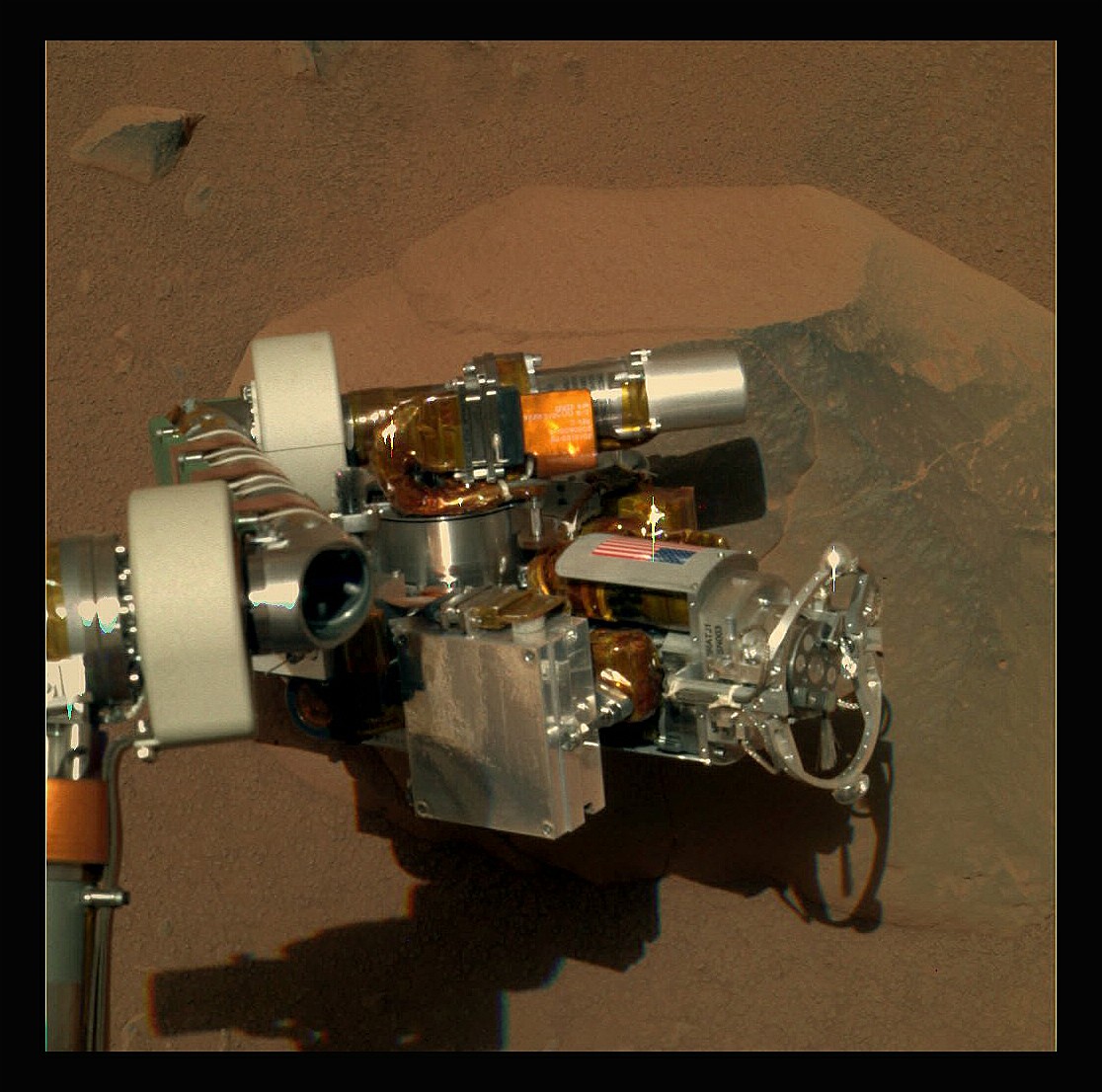
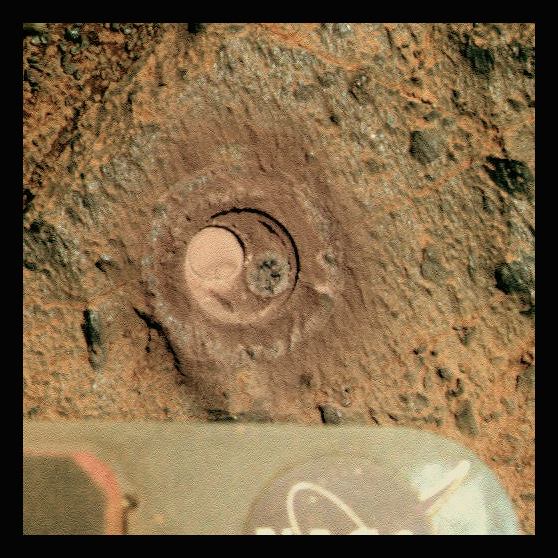
Today's Mars Photo was taken by Mars Exploration Rover Opportunity on a rock being called Salisbury. Oppy been brushing this area clean of dust and drilling into it with its rock abrasion tool for the past few days. This allow the rover to get a view of the 'raw' rock beneath the weathered, dust-covered surface. The rover is continuing to use its microscopic imager to determine what the rock is made of and learn more about its past. 

This photo was colored by The Road to Endeavour Blog, one of the leading authorities on everything related to MER Opportunity. Clicking on the image below will take you to the post where he discusses Salisbury in much more detail with numerous photos.


Using the International Space Station as a Launching Platform for Deep Space Missions

The International Space Station (ISS) will allow humanity to send much larger payloads into space and act as a launching platform for vehicles to Mars and other extraterrestrial bodies. Prior to the existence of the ISS we had been forced to limit the size and weight of everything we sent into space because we had to send it all in one piece. Now we can send everything in smaller pieces and have them dock with the ISS, at which point they can be put together. This means that rather than design a more powerful rocket to send out deep space missions we can assemble spacecraft in orbit.
The International Space Station
Source: NOVA

Once the craft has been put together it can launch from the space station using much less force than would be necessary from Earth's surface. This is because the ISS is in Low Earth Orbit (LEO) and already moving at around 8 km/s, thus the change in speed needed to reach Earth's escape velocity is much less. Escape velocity from Earth's surface is about 11.2 km/s, which means that a ship must accelerate to that velocity from a motionless state. Escape velocity from LEO is a little less than from the surface at about 10.9 km/s, but since the ISS is already moving at around 8 km/s a craft launching from it will only have to accelerate 2.9 km/s to reach escape velocity.

It is impractical for a spacecraft leaving from the surface to attempt to reach escape velocity because moving at that speed in the atmosphere would cause it to burn up due to friction or be destroyed by atmospheric pressure. While there are ways around these problems, they only add unnecessary cost and bulk to the spacecraft. Because the atmosphere is much thinner in LEO objects can attain escape velocity without encountering as much friction. Launching from the ISS will allow a spacecraft to escape Earth's gravity without as much wear on the craft itself.

With less acceleration needed and wear sustained, much larger ships could be pieced together, fueled, and launched from the ISS, thus eliminating the need to develop even more massive rocket boosters to launch from the surface into deep space.

A rocket could be launched from the surface to the ISS carrying part of the spacecraft inside it. The spacecraft itself would not experience any wear and could be offloaded at the Station. Once the pieces are put together and the spacecraft fueled, it could then propel itself, accelerating the additional 2.9 km/s and escape Earth's gravity. Once it does this the craft would be able to use momentum to take it where it needs to go. A reserve fuel supply could enable any needed course corrections and thrusters for landing on Mars or other terrestrial bodies. A separate unmanned ship full of fuel could have left prior to the manned mission and be waiting on the surface. It may even be possible to generate fuel from the environment of the extraterrestrial planet by converting it to Hydrogen gas, or other usable material. But that's a different topic entirely.

Whether we send humans to Mars and beyond or just more robots, the International Space Station will be instrumental in allowing us to deliver larger payloads further into space.

Mars Photo of the Day - Sept 21 2011

Today's Mars Photo is of gullies in Avire Crater as taken by Mars Reconnaissance Orbiter's HiRISE camera. There is a large amount of controversy as to how the gullies formed, but since the debris seems to be flowing down the crater it likely required carbon dioxide or water in a liquid state. The crater is under regular observation from HiRISE to note any changes.

This image links to a larger version of this image witth a caption provided by HiRISE.

Mars Photo of the Day - Sept 11 2011

Today's Mars Image of Mars is another photo with a lot of meaning. This photo was taken on Sol 30 of Mars Explorarion Rover Opportunity's exploration of the Martian surface. It was found, colored, and enhanced at The Road to Endeavour blog.

When Mars Exploration Rover's Spirit and Opportunity were being created the MER team wanted to pay tribute to those 2,977 lost during the 9/11 attacks, but how could they do that when their greatest achievement would be millions of miles away on Mars? It was decided that both rovers would contain pieces of the wreckage from the Twin Towers and that they would bear them forth to a new world, Mars. The pieces were shaped into rectangular plate covers for cables and placed on the robotic arm of each rover.  These plate covers are marked with the American flag.

 These small plate covers also symbolize human polarity. There will always be evil acts committed by members of our species, but there will also be magnificent achievements made, like the Mars travel and subsequent exploration that is happening every day. 9/11 will always be remembered, on two planets, not just one.

This image links to the original hi-res, colored image from The Road to Endeavour.

Mars Photo of the Day - Sept 10 2011

Today's Mars Photo will take us back to Sol 2347 of Mars Exploration Opportunity's time exploring Mars. This image is largely symbolic of Opportunity's overall experience on Mars. There have been many ups and down along the way, but the Mars Rover has stayed the course and continued doing science no matter the obstacles arrayed against it. We have learned more from Opportunity then anyone could have hoped. That little rover affectionately called Oppy, has continued to push the boundaries of human knowledge and exploration, even when most of humanity seems content staying on this little rock we called Earth.
The road behind us is full of hills and valleys and the road ahead promises more of the same, but if we stay the course and keep going no matter the impediments arrayed against us we will become stronger and wiser for it.
This image is larger even than the original, so clicking on the image will instead take you to a blog that has been dedicated to Oppy's Road To Endeavour for years. 

Mars Photo of the Day - Sept 2 2011

Today's Mars Photo shows the path taken by Mars Exploration Rover Opportunity in recent weeks. This photo was taken by Mars Reconnaissance Orbiter's HiRISE camera. I kept the labels added on by NASA because I know how hard it is to remember where everything is when you hear about Opportunity's discoveries. Hopefully you can use this image as a reference.
Clicking on this image will direct you to an article about Mars Exploration Rover Opportunity, its status and new mission. See the larger, original image.

China's First Mars Probe Set for October Launch

China's first Mars probe is on course to launch in October of this year. Yinghuo-1 (萤火一号) is a joint operation with Russia and will search for the causes behind the disappearance of water on Mars.

There is substantial evidence that water was once abundant on Mars (see below), but the precise reason for its disappearance has until now only been speculation.
Evidence of Water in Ravi Vallis
Areas where evidence for water is found
 in the form of outflow channels

Outflow channels, like this one seen in Ares Vallis are seen
as evidence that water once flowed on the Martian surface.

Mars Photo of the Day - Aug 24 2011

Today's Mars Photo is of  Ophir Chasma, the northern most connected valleys of Valles Marineris, a huge canyon system that is 5,000 km (~3106 mi) long. Ophir Chasma is about 100 km (62 mi) wide and 317 km (197 mi) long and bordered by high-walled cliffs, which are thought to be faults. For more details on the image and to view the original, just click the image. 
Taken by Viking 1 Orbiter
Credit: NASA/JPL/USGS

Earliest Life on Earth is Evidence Life Could Exist on Mars

Often it is discoveries made about life on Earth that allow us to draw new conclusions about potential life on other planets. This was the case with the discovery late last year that arsenic can support life, and it continues to be the case with the most recent discovery of 3.4 billion year old micro-fossils in the remote Strelley Pool region of Australia.

The discovery is significant not just because the fossils are the oldest ever found, but because 3.4 billion years ago there was little, if any oxygen in the atmosphere. Given the conditions of Earth at the time, it is thought that the life would  have thrived on sulphur, metabolizing it for energy. This is being taken as evidence that life can exist without oxygen, and so could conceivably exist on other planets that do not have oxygen rich atmospheres, like Mars. Learning that oxygen is not a prerequisite to life will force scientists to reassess the necessary parameters for what constitutes a hospitable environment.

What This Discovery Means About Life on Mars

The discovery that life existed without oxygen on Earth opens the door to the possibility that life existed, or still exists, on Mars. Martin Brasier of Oxford University, who was one of the scientists who made the discovery, speculates, "Could these sorts of things exist on Mars? It's just about conceivable. This evidence is certainly encouraging, and lack of oxygen on Mars is not a problem." With NASA having just discovered evidence of flowing water on Mars, there is hope that Mars has life as well.
If life existed on Earth without oxygen it is entirely conceivable that the same is true of Mars. Perhaps Mars Exploration Rover Opportunity will find life on Mars, though it is more likely we will have to wait until the Mars Science Laboratory Curiosity lands at Gale Crater and begins testing for signs of life.
This most recent discovery is just one of many that can now be added to the arguments for life on Mars. We can argue all we want about whether life exists on Mars and other planets, but until we find some there will be no winner of that debate.

Instigating a New Space Race

Is a new space race beginning?

With the head of the European Space Agency (ESA), Jean-Jacques Dordain, pledging to work together with the Russian Federal Space Agency (RKA) to send the first manned mission to Mars, one must wonder if the next space race has been initiated. [Europe and Russia Pledge to Send Man to Mars]

NASA recently cancelled their planned Constellation program, which would have attempted to put a permanent base on the moon in the 2020s in order to eventually use it as a launching platform for deep space missions. Instead they have made it their goal to put man on an asteroid by 2025 and a man on Mars by 2035.

Will actually beginning preparation for a joint European-Russian mission to Mars push up the priority of a similar mission in the United States? Will there be a competition between nations to get to Mars first?

ESA chief Dordain seems to have chosen the opportune time to announce this joint mission, as NASA's shuttle program just reached completion. The speculation is abound that this announcement will spark a new space race, with NASA on one end and the ESA and RKA on the other.
 VS


The benefits of sending the first men to Mars are immeasurable, as the organization to do so would be given great prestige throughout the scientific community. They would also be able to perform tests that rovers are unable to. The first organizations to accomplish sending men to Mars would also have a head start on all future Martian development.

The next few months may see the start of a new space race, as the ESA and RKA's joint plans mature more and a timeline is created. If they develop a reasonable plan of action it may drive NASA to push their program up in order to get to Mars first. For now this is all just hope and speculation, but we have nothing without hope.

I think the biggest question is the how big a role corporations like SpaceX will play in the upcoming space race and future Mars travel and development.


Mars Photo of the Day - Aug 21 2011

Today's Mars Photo was taken by Mars by the Mars Reconnaissance Orbiter's HiRISE camera on Oct 3 2007. The image is of Earth and the Moon, as seen from Mars. This would be very similar to the view a person on Mars would be able to have.
Click the Image to See More Details and Other Images from HiRISE


Mars Photo of the Day - Aug 20 2011

Today's Mars photo is of Santa Maria Crater. If you look closely enough you can see Mars Exploration Rover Opportunity on the crater's Southwest (lower right) rim. You can also clearly see rover tracks to the East left). Opportunity explored the crater from December 2010-March 2011, as it made its way toward Endeavour Crater. If you can't find Mars Rover Opportunity in this photo or want to learn more about this image, click the photo.
Taken by HiRISE on the Mars Reconnaissance Orbiter


Mars Photo of the Day - Aug 18 2011

Today's Mars photo is of a 'skylight,' or an opening to an underground cavern, located in a crater on the Pavonis Mons volcano. The opening is 35 meters (115 feet) in diameter. These types of underground caverns often form in volcanic regions where lava flows solidify near the surface, but continue flowing underneath (the resulting structure is commonly referred to as a lava tube). When the lava ceases flowing the caverns are left empty. In this particular instance the cavern has been determined to be approximately 20 meters (65 feet) deep.

Image taken by the HiRISE camera on the Mars Reconnaissance Orbiter (Click Image for More Details)


Why NASA's Manned Mission to Mars Will Happen

Most people know that NASA recently ended the shuttle program and abandoned all plans to return to the moon. but what you may not know is that NASA has launched a much more ambitious mission. a Manned Mission to Mars. Many people do not believe any such plans will ever come to fruition; they look at the recent cuts to NASA and feel that only more will come. Many people look at the scrapped lunar mission and fear that the same will become of any future attempts at manned Mars travel. So what is the difference? Why will the a manned mission to Mars become reality when so many other projects have gone out the window? And better yet, why travel to Mars?

Getting to Mars is More Important than Going Back to the Moon


VS


What's the point of taking a test that you already aced? What is there to prove by doing something you have already done? NASA going back to the Moon is the equivalent of you making your bed. You learned how to do that in your childhood, and it is expected that you should be able to do it now.

Mars Photo of the Day - Aug 15 2011

Today's Mars Photo is of Chasma Boreale, a long deep valley with walls that rise over 1400 meters (4600 feet) above the floor of the plain. The valley cuts deep into the Mars' north polar ice cap. The large valley was once covered in ice, but the ice caps have since retreated. To see the original source for this image just click the image itself. 
This image combines photos taken from December 2002 to February 2005 by the Thermal Emission Imaging System instrument on NASA's Mars Odyssey Orbiter.  


Mars Photo of the Day - Aug 14 2011

Today's Mars Photo was taken by Mars Exploration Rover Opportunity on Sol 821 (which was in early 2006) of its mission to Meridiani Planum. The photo shows ice on the Martian surface. For more information about the latest developments made by Mars Exploration Rover Opportunity click the photo.
Taken by Mars Exploration Rover Opportunity's Left Navigation Camera