Google+ Mars Travel: ISS
Showing posts with label ISS. Show all posts

Informative ISS Flier

Right now there are 6 people currently in space aboard the ISS, travelling at 5 miles per second (just over 8 km per second). They orbit the Earth once every 90 minutes. Remarkable huh? (Click to enlarge)

Please spread this and other space material far and wide so we can help raise public awareness and excitement for space exploration and discovery. A good starting point would be to use this image as a flier and post it within your local community, or on your social media. The more space advocates we create, the louder our voice will be!

Live Streaming: SpaceX Resupply of ISS

Watch below for live streaming coverage of the first commercial resupply of the International Space Station (ISS).

At 2035ET on 7 Oct 2012, the SpaceX's Falcon 9 is set to lift off carrying a Dragon capsule with 882 pounds of cargo for the ISS.

This live video feed comes from SpaceFlightNow.

 for live text updates on the launch!


Watch live streaming video from spaceflightnow at livestream.com

Live Stream: SpaceX Dragon Spacecraft Launch to International Space Station

SpaceX Falcon 9 launch was successful! See this SpaceRef article for further details!

Edit: Countdown reached 0, but the mission was aborted! A high chamber pressure reading was detected on Engine Number 5 of the first stage. Sometimes when a Falcon 9 experiences this it is a simple fix, but because the clock was at one second before discovery the rocket will have to go through the startup sequence again and all systems need to be rechecked prior.

New Launch Date and Time: 3:44:34 a.m. EDT, Tuesday 22 May 2012.

Watch live coverage of the SpaceX Dragon spacecraft on its way to the International Space Station. The Dragon capsule will launch aboard a Falcon 9 rocket at 0455 EST on May 19 2012. The video will play automatically at least one hour before the new launch. This video is hosted by SpaceFlightNow.


For tweeted updates on SpaceX's historic mission.

Watch live streaming video from spaceflightnow at livestream.com


Should this mission succeed (and we hope it does!) it will be the first time a commercial spacecraft has docked with the ISS. This unprecedented mission will bring the United States one step closer to eliminating reliance on Russia for launch vehicles to the ISS.

Mission Patch
Credit: SpaceX

Live Stream: ISS Hatch Opening and Welcome Ceremony

After a flawless docking, The ISS and Soyuz hatch opening coverage will begin at 2:30AM EST on November 16. The actual opening is scheduled to be for 2:55AM EST, but the docking ran ahead of schedule, so the hatch opening may do the same. 

A welcome ceremony will air following the hatch opening. 

Two cosmonauts, Anton Shkaplerov and Anatoly Ivanishin, as well as one astronaut, Daniel Burbank will be joining the current crew of the ISS, Mike Fossum, Satoshi Furukawa, and Sergei Volkov. (See below the video for an image of the full 6 person Expedition 29 crew)

For live updates of hatch opening and welcome ceremony


Watch live streaming video from spaceflightnow at livestream.com


Expedition 29 crew members pictured from the left on the front row are Commander Mike Fossum and Flight Engineer Dan Burbank. Pictured from the left on the back row are Flight Engineers Satoshi Furukawa, Sergei Volkov, Anatoly Ivanishin and Anton Shkaplerov. Photo credit: NASA
Image links to original NASA page
Image and Caption Credit: NASA


Live Stream of Launch to the ISS

Watch the first manned launch to the International Space Station (ISS) since the failed Soyuz launch in August. This video is a live feed from SpaceFlightNow! The launch begins at 11:14PM EST.

The feed should begin automatically. (EDIT: I disabled automatic playing since the launch ended - It was a complete success!)
Watch live streaming video from spaceflightnow at livestream.com
Two cosmonauts, Anton Shkaplerov and Anatoly Ivanishin, as well as one astronaut, Daniel Burbank will be ascending to the ISS in what is the first manned launch since the last Shuttle (Atlantis) docked on July 10 2011.

Vladimir Popovkin, the director of Roscosmos, the Russian Federal Space Agency is confident that the launch and docking will be carried out successfully. He was quoted as saying, "We have no doubt in our minds both the rocket and the vehicle are ready, all the activities have been done at the appropriate level of quality and reliability." Regardless, you can be sure that the world will watch with admiration as these three brave men ascend to the ISS.

If you view this after the launch the feed will just go to live NASA TV, if anything. I will make sure it doesn't start automatically following the Soyuz docking with the ISS.

Using the International Space Station as a Launching Platform for Deep Space Missions

The International Space Station (ISS) will allow humanity to send much larger payloads into space and act as a launching platform for vehicles to Mars and other extraterrestrial bodies. Prior to the existence of the ISS we had been forced to limit the size and weight of everything we sent into space because we had to send it all in one piece. Now we can send everything in smaller pieces and have them dock with the ISS, at which point they can be put together. This means that rather than design a more powerful rocket to send out deep space missions we can assemble spacecraft in orbit.
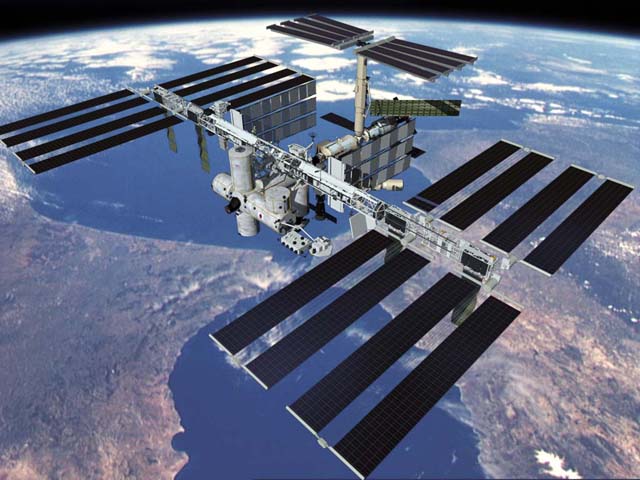
The International Space Station
Source: NOVA

Once the craft has been put together it can launch from the space station using much less force than would be necessary from Earth's surface. This is because the ISS is in Low Earth Orbit (LEO) and already moving at around 8 km/s, thus the change in speed needed to reach Earth's escape velocity is much less. Escape velocity from Earth's surface is about 11.2 km/s, which means that a ship must accelerate to that velocity from a motionless state. Escape velocity from LEO is a little less than from the surface at about 10.9 km/s, but since the ISS is already moving at around 8 km/s a craft launching from it will only have to accelerate 2.9 km/s to reach escape velocity.

It is impractical for a spacecraft leaving from the surface to attempt to reach escape velocity because moving at that speed in the atmosphere would cause it to burn up due to friction or be destroyed by atmospheric pressure. While there are ways around these problems, they only add unnecessary cost and bulk to the spacecraft. Because the atmosphere is much thinner in LEO objects can attain escape velocity without encountering as much friction. Launching from the ISS will allow a spacecraft to escape Earth's gravity without as much wear on the craft itself.

With less acceleration needed and wear sustained, much larger ships could be pieced together, fueled, and launched from the ISS, thus eliminating the need to develop even more massive rocket boosters to launch from the surface into deep space.

A rocket could be launched from the surface to the ISS carrying part of the spacecraft inside it. The spacecraft itself would not experience any wear and could be offloaded at the Station. Once the pieces are put together and the spacecraft fueled, it could then propel itself, accelerating the additional 2.9 km/s and escape Earth's gravity. Once it does this the craft would be able to use momentum to take it where it needs to go. A reserve fuel supply could enable any needed course corrections and thrusters for landing on Mars or other terrestrial bodies. A separate unmanned ship full of fuel could have left prior to the manned mission and be waiting on the surface. It may even be possible to generate fuel from the environment of the extraterrestrial planet by converting it to Hydrogen gas, or other usable material. But that's a different topic entirely.

Whether we send humans to Mars and beyond or just more robots, the International Space Station will be instrumental in allowing us to deliver larger payloads further into space.