Google+ Mars Travel: manned mission to mars
Showing posts with label manned mission to mars. Show all posts

The Radiation Dilemma

Data from Mars Science Laboratory's Radiation Assessment Detector (RAD) is enabling scientists to accurately assess the level of radiation exposure experienced during a mission to Mars. Understanding the risks faced by astronauts on future manned missions to Mars will help scientists mitigate those risks. But what exactly are the risks?

Scientists have determined that the crew on a round-trip human mission to Mars would be exposed to 100 times the amount of radiation the average person experiences on an annual basis. The amount of radiation exposure faced by the crew could increase their risk of cancer by 5%, which is outside NASA's acceptable parameters. The risk increases if the astronauts land on Mars because they will not be shielded by the ship and Mars lacks a magnetic field like Earth's to shield people from radiation. The below graphic from NASA compares the level of radiation exposure from several experiences, including a round-trip mission to Mars.

Comparing Radiation of a Manned Missioon to Mars with Other Activities (NASA)

While the level of radiation exposure is important to understand and mitigate, there is no reason why it should be a show-stopper for space missions. Just as a soldier signs up for the military knowing he could get shot at, an astronaut knows they could die from a spacecraft malfunction or radiation exposure, among other things. These risks, while not inconsequential, are acceptable, as long as before the mission the crew understands and accepts the risks.

Not only that, but governments have no standing to prevent astronauts from embarking on potentially hazardous missions. There are numerous legal activities that increase a person's risk of cancer exponentially more than a trip to Mars. According to a study at Oxford, cigarette smoking causes a "25-fold increase in lung cancer risk in men smoking 25 cigarettes a day or more, compared to lifelong non-smokers,"  (Cancer Research UK) yet the government still allows people to smoke as many cigarettes as they want. Why then should astronauts be limited on how much risk they can take?

If governments refuse to allow astronauts to take the risks inherent in their job, then it will be dependent on private corporations unhindered by unnecessary regulations to begin human exploration of the solar system in earnest.

Mars One: Marketing Manned Missions to Mars

Mars One intends to establish the first human settlement on Mars by 2023. 

With support from distinguished individuals like Physics Nobel Prize Laureate Gerard 't Hooft and best selling author Mary Roach, Mars One publicly announced their intentions on May 31 2012.

The process began in 2011 when Mars One worked on the mission in secret, contacting suppliers to determine feasibility and willingness. In 2013 some applicants will begin a broadcasted training and selection process. In 2014 the preparation will begin for a 2016 supply mission and communications satellite. In 2018 a rover will land on Mars in the desired settlement site. In 2021 all essential supplies and life support will have landed at the site. The rovers will begin preparing the site for human arrival. On September 14 2022 the first four settlers will launch to Mars, landing in 2023. Follow up groups will land every two years. Each settler will remain on Mars for the rest of their lives.


Mars One must be taken seriously because their marketing strategy has no precedent, and when led competently it cannot fail. But what is their strategy exactly?

Mars500 - Bringing a Manned Mission to Mars One Step Closer

How would astronauts cope with the prolonged isolation associated with a manned mission to Mars? This was one of the many questions Mars500 sought to answer when they embarked on their simulated mission to Mars on June 3 2010, around 17 months ago. Now, on November 4 2011, after 520 days of isolation, the six man crew of Mars500 will open their hatch to the eagerly awaiting public.


These brave men have made history and helped increase our knowledge of the human psyche and our ability to cope with long missions to extraterrestrial bodies.

The spacecraft's crew is led by 38 year old engineer Alexei Sitev, and also includes Russian surgeon Sukhrob Kamolov, 32, and Russian general practitioner Alexander Smolevsky, 33. Non-Russian crew members include Italian Diego Urbina, 27, China's Wang Yue, 27, and the Roman Charles from France, 31.
More information about the Mars500 crew
And so what did they find?

The Airline Precedent for Space Funding

Popular airlines Spirit in the US and Ryanair in Europe have been gaining millions in ad revenue for years by renting empty spaces on and in their aircraft. How does that work? Simple, they set a price and say "Hey, if you pay us $14 million we'll put your logo on the outside of all of our aircraft for a year." They even sell space inside the cabin. According to USA Today they charge "$196,000 for three months of ads on the overhead bins in Spirit's planes, $119,000 for ads on the tray tables or $18,500 for ads on air-sickness bags." The airlines get extra money and the advertisers get more exposure. The problem is that all those ads annoy passengers who don't like being inundated with ads while inside of a plane: one of the last 'safe havens' from the outside world. So while airlines and ad companies are happy, the customers are not.

Selling ad space on and in aircraft may or may not work out because the customers don't like being inundated on planes, but what about on spacecraft? While NASA might have nearly insurmountable restrictions on spacecraft advertising, what about the private industry? What is to stop SpaceX, Virgin Galactic, or any other private space company from renting space on, or in their spacecraft?


How many people follow every space launch? How much exposure and publicity would a company get if they had their logo on the outside of a spacecraft? How much would a company pay for to advertise on one launch? In order to find out we can look back at past advertisements in space.

Using the International Space Station as a Launching Platform for Deep Space Missions

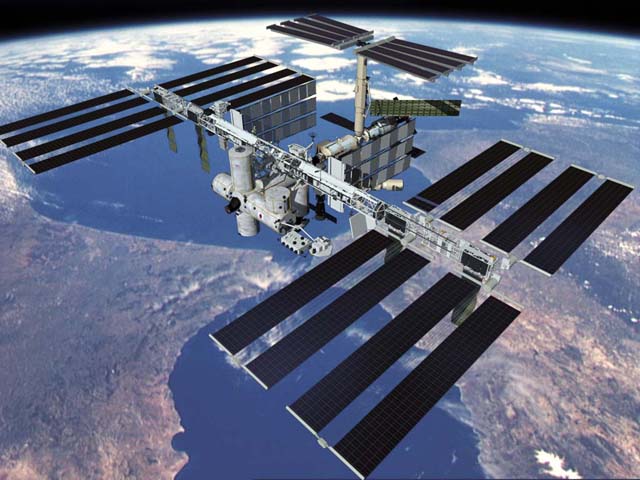
The International Space Station (ISS) will allow humanity to send much larger payloads into space and act as a launching platform for vehicles to Mars and other extraterrestrial bodies. Prior to the existence of the ISS we had been forced to limit the size and weight of everything we sent into space because we had to send it all in one piece. Now we can send everything in smaller pieces and have them dock with the ISS, at which point they can be put together. This means that rather than design a more powerful rocket to send out deep space missions we can assemble spacecraft in orbit.
The International Space Station
Source: NOVA

Once the craft has been put together it can launch from the space station using much less force than would be necessary from Earth's surface. This is because the ISS is in Low Earth Orbit (LEO) and already moving at around 8 km/s, thus the change in speed needed to reach Earth's escape velocity is much less. Escape velocity from Earth's surface is about 11.2 km/s, which means that a ship must accelerate to that velocity from a motionless state. Escape velocity from LEO is a little less than from the surface at about 10.9 km/s, but since the ISS is already moving at around 8 km/s a craft launching from it will only have to accelerate 2.9 km/s to reach escape velocity.

It is impractical for a spacecraft leaving from the surface to attempt to reach escape velocity because moving at that speed in the atmosphere would cause it to burn up due to friction or be destroyed by atmospheric pressure. While there are ways around these problems, they only add unnecessary cost and bulk to the spacecraft. Because the atmosphere is much thinner in LEO objects can attain escape velocity without encountering as much friction. Launching from the ISS will allow a spacecraft to escape Earth's gravity without as much wear on the craft itself.

With less acceleration needed and wear sustained, much larger ships could be pieced together, fueled, and launched from the ISS, thus eliminating the need to develop even more massive rocket boosters to launch from the surface into deep space.

A rocket could be launched from the surface to the ISS carrying part of the spacecraft inside it. The spacecraft itself would not experience any wear and could be offloaded at the Station. Once the pieces are put together and the spacecraft fueled, it could then propel itself, accelerating the additional 2.9 km/s and escape Earth's gravity. Once it does this the craft would be able to use momentum to take it where it needs to go. A reserve fuel supply could enable any needed course corrections and thrusters for landing on Mars or other terrestrial bodies. A separate unmanned ship full of fuel could have left prior to the manned mission and be waiting on the surface. It may even be possible to generate fuel from the environment of the extraterrestrial planet by converting it to Hydrogen gas, or other usable material. But that's a different topic entirely.

Whether we send humans to Mars and beyond or just more robots, the International Space Station will be instrumental in allowing us to deliver larger payloads further into space.

Mars Photo of the Day - Sept 14 2011

Today's Mars Photo is of Mars Exploration Rover Opportunity using its microscopic imager. It is important to understand how Oppy takes its microscopic photos so that we can understand the limitations of such a device. We can see from its size that it will not fit into small crevices and that it is not meant to be maneuvered into right spaces. The camera is primarily used for zooming in close on rocks on the surface of Mars, but not much else. 

Understanding the limitations of the Mars rover lets us see why it is important that we send a manned mission to Mars. Machines can only do so much and are not as adaptable as humans are, thus to truly understand and explore Mars we must send people. 

This image is larger than the original so clicking it will instead take you to all Mars Photo of the Day posts.
Taken on Sol 2715 by Mars Exploration Rover Opportunity's Front Hazcam

SpaceX is Winning the Race to Mars

In the race to the Moon the primary competitors were the Americans and the Soviets and their state funded space agencies. At the beginning of the space race the governments of both countries invested heavily in their respective space agencies because it was deemed in the best interest of their countries. America successfully sent a manned mission to the Moon on July 20, 1969 and after a few more landings, during which time the Soviets were unable to launch their own manned mission, they essentially declared victory and to this day humanity has never sent a man beyond low-Earth orbit. Thus the first space race led to one of mankind's greatest accomplishments, but culminated with disappointment for millions of space enthusiasts.

A government is a broad organization that is responsible for everything from the economy to national defense to food regulation. It makes sense that governments cannot focus on space travel and exploration when there are more pressing responsibilities closer to home it must deal with. Governments have so many tasks and responsibilities it is easy to see why exploring space has been relegated to the back burner. Space enthusiasts have long despaired over the lack of nationalistic fervor that once drove the space industry, fearing that further exploration and research would all but end in the years to come. That fear has been misplaced.

Instigating a New Space Race

Is a new space race beginning?

With the head of the European Space Agency (ESA), Jean-Jacques Dordain, pledging to work together with the Russian Federal Space Agency (RKA) to send the first manned mission to Mars, one must wonder if the next space race has been initiated. [Europe and Russia Pledge to Send Man to Mars]

NASA recently cancelled their planned Constellation program, which would have attempted to put a permanent base on the moon in the 2020s in order to eventually use it as a launching platform for deep space missions. Instead they have made it their goal to put man on an asteroid by 2025 and a man on Mars by 2035.

Will actually beginning preparation for a joint European-Russian mission to Mars push up the priority of a similar mission in the United States? Will there be a competition between nations to get to Mars first?

ESA chief Dordain seems to have chosen the opportune time to announce this joint mission, as NASA's shuttle program just reached completion. The speculation is abound that this announcement will spark a new space race, with NASA on one end and the ESA and RKA on the other.
 VS


The benefits of sending the first men to Mars are immeasurable, as the organization to do so would be given great prestige throughout the scientific community. They would also be able to perform tests that rovers are unable to. The first organizations to accomplish sending men to Mars would also have a head start on all future Martian development.

The next few months may see the start of a new space race, as the ESA and RKA's joint plans mature more and a timeline is created. If they develop a reasonable plan of action it may drive NASA to push their program up in order to get to Mars first. For now this is all just hope and speculation, but we have nothing without hope.

I think the biggest question is the how big a role corporations like SpaceX will play in the upcoming space race and future Mars travel and development.