
Showing posts with label Mars Travel. Show all posts
Showing posts with label Mars Travel. Show all posts

SpaceX Mars Travel Poster - Olympus Mons
SpaceX has come out with some vintage style Mars Travel posters. This one is for Olympus Mons, the highest peak in the Solar System.

SpaceX Mars Travel Poster - Valles Marineris
SpaceX has come out with some vintage style Mars Travel posters. This one is for Valles Marineris, known as the Grand Canyon of Mars.

A New Logo, A New Vision for Mars Travel
As you can probably see, I have changed the Mars Travel logo. I've been neglecting this blog for a while trying to figure out the direction I'd like to take it. I finally think I have an answer.

Essentially I want to help market the space industry, Mars Travel's piece of that is to create easy to distribute products showcasing and provoking discussion of space exploration and discovery. The new logo pairs with the name Mars Travel, and makes such a connection intuitive, just by looking at it.
One of my true passions is space exploration and discovery. When I was a kid I wanted to be an astronaut (what kid doesn't?). As I grew up I became more realistic, but I never lost my fascination with space and the literally limitless possibilities that it represents. As I grew older I started working in media relations and marketing, and later, logistics. After a few years I decided to apply my media relations skills to space, eventually becoming the Media Relations Director (a volunteer position) for The Mars Initiative, a position I held for the entirety for 2013.
But that's not enough. I want to market the space industry. This blog and related endeavors will be my attempt at doing so. I hope that you and others will join me in bringing the wonders and potential of space back into the public eye. Humans naturally crave exploration, we just have to remind them what it feels like to look into the great beyond and discover.
Win a 2012 HiRISE Calendar!
At the end of December Mars Travel will be giving away two 2012 HiRISE Calendars. Click here for examples of HiRISE Images of Mars (There are a lot).
Two quick and easy things you have to do to be entered:
1) Like Mars Travel on Facebook OR +1 and Follow Us on Google+ (Links are below)
Two quick and easy things you have to do to be entered:
1) Like Mars Travel on Facebook OR +1 and Follow Us on Google+ (Links are below)
OR
2) Find this post on the Facebook Page and Like it OR on the Google+ Page and +1 it.
Live Stream: Mars Science Laboratory Launch
Watch the Mars Science Laboratory (MSL) Curiosity launch on its mission to Mars live! The live coverage and commentary begin at 7:30AM EST and launch commences at 10:02AM EST. [Read More About MSL Curiosity's Launch and Mission]
Follow @MarsTravel
For live updates on Mars Science Laboratory Curiosity's Launch.
For live updates on Mars Science Laboratory Curiosity's Launch.
Watch live streaming video from spaceflightnow at livestream.com
This live stream is from Spaceflight Now
Not on Twitter? Follow the whole thing Live in this screen!
Mars Travel will be @NASA_Langley #NASATweetup!
Mars Travel will be taking part in the NASA Tweetup at NASA Langley! You can be sure that we will be updating everyone on the days events! The best way to keep up to date with the days events is to Follow @MarsTravel
I'll be sure to update as much as I can with pictures and descriptions!
As I get more details about the days events I'll let everyone know what they can expect! Thanks!
I'll be sure to update as much as I can with pictures and descriptions!
As I get more details about the days events I'll let everyone know what they can expect! Thanks!
Mars Travel - A New Company Seeking to Revolutionize the Commercial Space Industry
Like many space enthusiasts I despaired every time I heard another space project was cancelled or postponed due to funding issues. But what could I do? Even simple space projects and missions cost millions, if not billions of dollars. Most people don't have that kind of money lying around (no really?!), and I definitely don't.
Does that make us helpless? Should we have to accept that space is only the domain of the government or super rich? Can average people actually make an impact on this multi-billion dollar industry? Most people will say no, that such a thing is impossible, but are they right?
 |
| Mars Travel Logo |
Funding Space Missions and Projects Without NASA
These days NASA is on the congressional chopping block. Their budget was cut from $18.7 billion in 2010 to around $17.9 billion in 2011. Despite this, NASA has pledged to continue funding its most expensive flagship programs, the James Webb Space Telescope (JWST) and Space Launch System (SLS) with Orion Capsule, despite the JWST costing a third more than originally expected. The original price tag on the telescope was $6.5 billion, but that has since been revised to $8.7 billion. The senate has said JWST will get $530 million in 2012, which is around 3% of the annual budget. This is just for the JWST; the SLS will cost around $3 billion annually, which is 16.8% of the budget. These programs are immensely important for the advancement of science and discovery, but they will take up almost a fifth of NASA's overall budget annually. If NASA's funding is cut it will create uncertainty for the future of projects that were counting on NASA to fund them, but which may be deemed not important enough to continue.
If NASA funding smaller projects is such a liability, why don't those projects go elsewhere?
The simple answer: there is no real precedence. Who else has the money to fund space projects that cost millions, if not billions of dollars? If NASA decides it cannot afford to fund a sample-return mission from Mars, is there any other way for that important project to get funding? What about other important space missions and projects? If there was a viable alternative means of funding for space projects, wouldn't it have emerged already?
There are two answers, but they might take some time to digest:
If NASA funding smaller projects is such a liability, why don't those projects go elsewhere?
The simple answer: there is no real precedence. Who else has the money to fund space projects that cost millions, if not billions of dollars? If NASA decides it cannot afford to fund a sample-return mission from Mars, is there any other way for that important project to get funding? What about other important space missions and projects? If there was a viable alternative means of funding for space projects, wouldn't it have emerged already?
There are two answers, but they might take some time to digest:
Mars Photo of the Day - Sept 11 2011
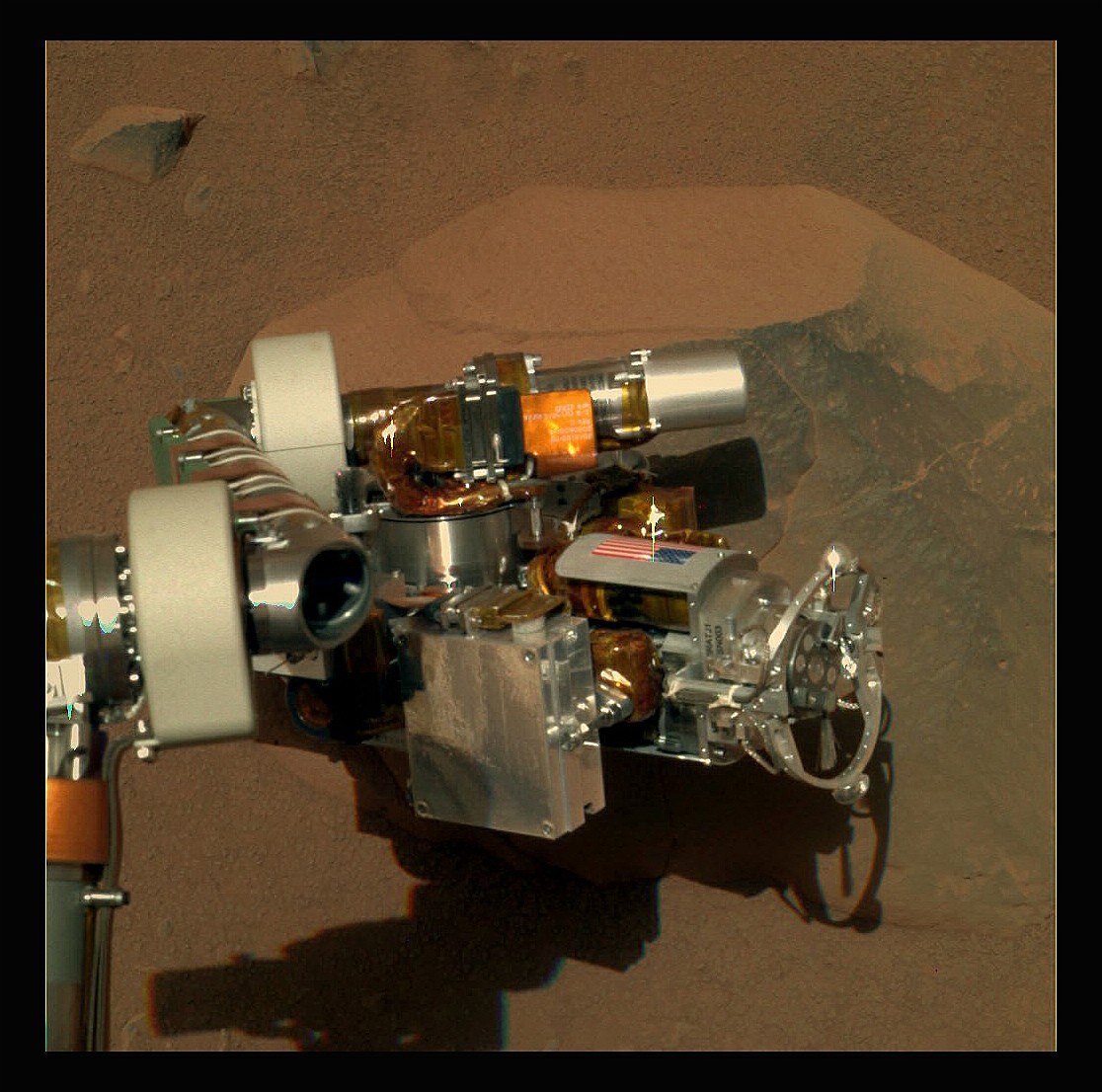
Today's Mars Image of Mars is another photo with a lot of meaning. This photo was taken on Sol 30 of Mars Explorarion Rover Opportunity's exploration of the Martian surface. It was found, colored, and enhanced at The Road to Endeavour blog.
When Mars Exploration Rover's Spirit and Opportunity were being created the MER team wanted to pay tribute to those 2,977 lost during the 9/11 attacks, but how could they do that when their greatest achievement would be millions of miles away on Mars? It was decided that both rovers would contain pieces of the wreckage from the Twin Towers and that they would bear them forth to a new world, Mars. The pieces were shaped into rectangular plate covers for cables and placed on the robotic arm of each rover. These plate covers are marked with the American flag.
These small plate covers also symbolize human polarity. There will always be evil acts committed by members of our species, but there will also be magnificent achievements made, like the Mars travel and subsequent exploration that is happening every day. 9/11 will always be remembered, on two planets, not just one.
 |
| This image links to the original hi-res, colored image from The Road to Endeavour. |
SpaceX is Winning the Race to Mars
In the race to the Moon the primary competitors were the Americans and the Soviets and their state funded space agencies. At the beginning of the space race the governments of both countries invested heavily in their respective space agencies because it was deemed in the best interest of their countries. America successfully sent a manned mission to the Moon on July 20, 1969 and after a few more landings, during which time the Soviets were unable to launch their own manned mission, they essentially declared victory and to this day humanity has never sent a man beyond low-Earth orbit. Thus the first space race led to one of mankind's greatest accomplishments, but culminated with disappointment for millions of space enthusiasts.
A government is a broad organization that is responsible for everything from the economy to national defense to food regulation. It makes sense that governments cannot focus on space travel and exploration when there are more pressing responsibilities closer to home it must deal with. Governments have so many tasks and responsibilities it is easy to see why exploring space has been relegated to the back burner. Space enthusiasts have long despaired over the lack of nationalistic fervor that once drove the space industry, fearing that further exploration and research would all but end in the years to come. That fear has been misplaced.
A government is a broad organization that is responsible for everything from the economy to national defense to food regulation. It makes sense that governments cannot focus on space travel and exploration when there are more pressing responsibilities closer to home it must deal with. Governments have so many tasks and responsibilities it is easy to see why exploring space has been relegated to the back burner. Space enthusiasts have long despaired over the lack of nationalistic fervor that once drove the space industry, fearing that further exploration and research would all but end in the years to come. That fear has been misplaced.
Mars Photo of the Day - Aug 29 2011
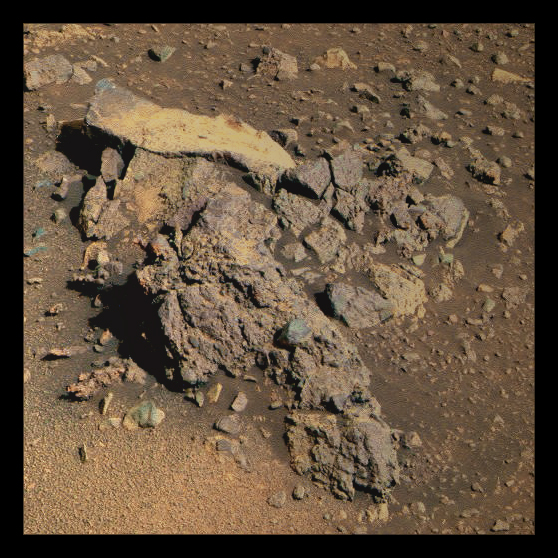
Today's Mars Photo is of Tisdale-5, a rock in close proximity to the original Tisdale. This rock is one of the more oddly shaped rocks in the area and seems to have been eroded significantly over the past millions (or billions) of years. We are left to wonder why the Mars Exploration Rover Opportunity's team decided to group many rocks under the name Tisdale, but it is likely because the team believes the rocks have similar composition. This photo came directly from The Road to Endeavour blog and the full size image can be seen just by clicking on the image below.
I failed to post a photo yesterday (Aug 28 2011) because I got caught up in Hurricane Irene and my power and Internet are out. I found a hot spot to post today's Mars Photo of the Day. Hopefully I'll be able to post more regarding developments toward Mars travel and exploration when my Internet is restored tomorrow. Thanks for your patience!
China's First Mars Probe Set for October Launch
China's first Mars probe is on course to launch in October of this year. Yinghuo-1 (萤火一号) is a joint operation with Russia and will search for the causes behind the disappearance of water on Mars.
There is substantial evidence that water was once abundant on Mars (see below), but the precise reason for its disappearance has until now only been speculation.
There is substantial evidence that water was once abundant on Mars (see below), but the precise reason for its disappearance has until now only been speculation.
 |
| Evidence of Water in Ravi Vallis |
 |
| Areas where evidence for water is found in the form of outflow channels |
 |
| Outflow channels, like this one seen in Ares Vallis are seen as evidence that water once flowed on the Martian surface. |
Instigating a New Space Race
Is a new space race beginning?
With the head of the European Space Agency (ESA), Jean-Jacques Dordain, pledging to work together with the Russian Federal Space Agency (RKA) to send the first manned mission to Mars, one must wonder if the next space race has been initiated. [Europe and Russia Pledge to Send Man to Mars]
NASA recently cancelled their planned Constellation program, which would have attempted to put a permanent base on the moon in the 2020s in order to eventually use it as a launching platform for deep space missions. Instead they have made it their goal to put man on an asteroid by 2025 and a man on Mars by 2035.
Will actually beginning preparation for a joint European-Russian mission to Mars push up the priority of a similar mission in the United States? Will there be a competition between nations to get to Mars first?
ESA chief Dordain seems to have chosen the opportune time to announce this joint mission, as NASA's shuttle program just reached completion. The speculation is abound that this announcement will spark a new space race, with NASA on one end and the ESA and RKA on the other.


 VS
VS
The benefits of sending the first men to Mars are immeasurable, as the organization to do so would be given great prestige throughout the scientific community. They would also be able to perform tests that rovers are unable to. The first organizations to accomplish sending men to Mars would also have a head start on all future Martian development.
The next few months may see the start of a new space race, as the ESA and RKA's joint plans mature more and a timeline is created. If they develop a reasonable plan of action it may drive NASA to push their program up in order to get to Mars first. For now this is all just hope and speculation, but we have nothing without hope.
I think the biggest question is the how big a role corporations like SpaceX will play in the upcoming space race and future Mars travel and development.
With the head of the European Space Agency (ESA), Jean-Jacques Dordain, pledging to work together with the Russian Federal Space Agency (RKA) to send the first manned mission to Mars, one must wonder if the next space race has been initiated. [Europe and Russia Pledge to Send Man to Mars]
NASA recently cancelled their planned Constellation program, which would have attempted to put a permanent base on the moon in the 2020s in order to eventually use it as a launching platform for deep space missions. Instead they have made it their goal to put man on an asteroid by 2025 and a man on Mars by 2035.
Will actually beginning preparation for a joint European-Russian mission to Mars push up the priority of a similar mission in the United States? Will there be a competition between nations to get to Mars first?
ESA chief Dordain seems to have chosen the opportune time to announce this joint mission, as NASA's shuttle program just reached completion. The speculation is abound that this announcement will spark a new space race, with NASA on one end and the ESA and RKA on the other.


 VS
VSThe benefits of sending the first men to Mars are immeasurable, as the organization to do so would be given great prestige throughout the scientific community. They would also be able to perform tests that rovers are unable to. The first organizations to accomplish sending men to Mars would also have a head start on all future Martian development.
The next few months may see the start of a new space race, as the ESA and RKA's joint plans mature more and a timeline is created. If they develop a reasonable plan of action it may drive NASA to push their program up in order to get to Mars first. For now this is all just hope and speculation, but we have nothing without hope.
I think the biggest question is the how big a role corporations like SpaceX will play in the upcoming space race and future Mars travel and development.
Europe and Russia Pledge to Send Man to Mars
On Aug 17 2011 the head of the European Space Agency (ESA), Jean-Jacques Dordain, announced that they would partner with the Russian Federal Space Agency (RKA) to "carry out the first flight to Mars together." The head of the RKA, Vladimir Popovkin welcomed the pledge.
This commitment comes as the Euro-Russian Mars500 experiment comes to completion in November. Dordain does not set a time frame, but says that the Mars500 experiment has been a factor in the decision for the ESA and RKA's pledge to send a manned mission to Mars.
The Mars500 program was initiated on June 03 2010 by the Moscow Institute of Medical and Biological Problems in order to simulate a mission to Mars. The experiment simulates a 250 day journey to Mars, a 30 day stay on The Red Planet, and a 240 day return flight. Mars500 simulates emergency situations that a manned mission to Mars might encounter and attempts to accurately determine how well humans can cope with a trip to and from Mars.
The spacecraft's crew is led by 38 year old engineer Alexei Sitev, and also includes Russian surgeon Sukhrob Kamolov, 32, and Russian general practitioner Alexander Smolevsky, 33. Non-Russian crew members include Italian Diego Urbina, 27, China's Wang Yue, 27, and the Roman Charles from France, 31.
 |
| The Crew of Mars500 in their mock spacecraft Source: ESA |
Dordain's commitment to Mars travel is something to be expected, as the United States' NASA has set a goal of setting a man on Mars by the mid 2030s. The competition that this new announcement might bring could help increase the priority of a manned mission to Mars and push up the date. It would bring great prestige to the nation that could land the first man on Mars, much like the moon landing helped to solidify NASA's leadership in space.
A time frame for a joint Euro-Russian mission to Mars has yet to be set by the ESA or RKA, but as Mars500 culminates there will likely be an announcement on the matter. Igor Lisov, an analyst for the Moscow-based journal Novosti Kosmonavtike (Cosmonautic News) gave his own estimation of the time frame to the Voice of Russia saying "If they decide to implement an emergency program, the mission may be carried out in 10 years. If it is an ordinary one, then it will take 20 years. This is a long period of time." While this is not an official statement from either agency, it provides hope for those hoping to see a man on Mars in their lifetime.
Cooperation between the two space agencies when it comes to Mars is not unprecedented. Both agencies, as well as NASA, have worked together since 2006 to develop EkzoMars (ExoMars), a Mars rover that will be launched from a Russian Proton Rocket in 2013 and supplied with both Russian and European equipment.
 |
| ExoMars Rover |
Why NASA's Manned Mission to Mars Will Happen
Most people know that NASA recently ended the shuttle program and abandoned all plans to return to the moon. but what you may not know is that NASA has launched a much more ambitious mission. a Manned Mission to Mars. Many people do not believe any such plans will ever come to fruition; they look at the recent cuts to NASA and feel that only more will come. Many people look at the scrapped lunar mission and fear that the same will become of any future attempts at manned Mars travel. So what is the difference? Why will the a manned mission to Mars become reality when so many other projects have gone out the window? And better yet, why travel to Mars?


What's the point of taking a test that you already aced? What is there to prove by doing something you have already done? NASA going back to the Moon is the equivalent of you making your bed. You learned how to do that in your childhood, and it is expected that you should be able to do it now.
Getting to Mars is More Important than Going Back to the Moon

VS
What's the point of taking a test that you already aced? What is there to prove by doing something you have already done? NASA going back to the Moon is the equivalent of you making your bed. You learned how to do that in your childhood, and it is expected that you should be able to do it now.
The Importance of Mars Rover Opportunity's New Mission
A few days ago Mars Exploration Rover Opportunity finally reached Odyssey Crater, which lies within the much larger Endeavour Crater. This is a huge milestone for the Mars rover, which has performed longer and traveled further on the Martian surface than anyone would have though possible when it landed in January 2004.
The question now is, what is so significant about Endeavour Crater? Why has Mars Rover Opportunity spent the last three years trying to get there? NASA and other people following the mission are excited, but the average person probably has no idea why. How is Mars Rover Opportunity's new location any different than its previous ones? What is its mission?
Endeavour Crater is the largest crater ever explored by Mars Rover Opportunity and contains older geological deposits than it has ever encountered. This will allow Opportunity to get a better sense of how long there was water on the Martian surface and will even provide insight as to the quantity. That is simple enough; as the Mars rover did that in other craters as well; what is exceptional about Endeavour Crater is found around its rim.
What Makes This Mission Different
Mars Rover Opportunity has examined a large number of rocks and samples of Martian soil since it landed in January of 2004, but it has never encountered rocks like those found around Endeavour Crater. In the past Opportunity has examined clays that show signs of being formed under wet conditions, but when the Mars rover determined their chemical composition it was determined that they were very acidic. What makes Endeavour crater different is the composition of the clays surrounding it.
The question now is, what is so significant about Endeavour Crater? Why has Mars Rover Opportunity spent the last three years trying to get there? NASA and other people following the mission are excited, but the average person probably has no idea why. How is Mars Rover Opportunity's new location any different than its previous ones? What is its mission?
 |
| Endeavour Crater |
What Makes This Mission Different
Mars Rover Opportunity has examined a large number of rocks and samples of Martian soil since it landed in January of 2004, but it has never encountered rocks like those found around Endeavour Crater. In the past Opportunity has examined clays that show signs of being formed under wet conditions, but when the Mars rover determined their chemical composition it was determined that they were very acidic. What makes Endeavour crater different is the composition of the clays surrounding it.
The Significance of Mars Travel and Exploration
We live in a world that continually shows us the worst of humanity; whether it be tyrants killing civilians, riots in London, or childish bickering among legislators in Washington. Every day we are told that something bad, or even horrible has happened, but rarely are we reminded of humanity's strength and magnificence. Rarely are we reminded that we have and continue to accomplish amazing feats every single day. There are so many great, fantastic, and unbelievably selfless things that humanity has done and achieved. Some of these remarkable achievements can be seen in our exploration of Mars.
Humanity designed a pair of rovers (Mars Exploration Rovers Spirit and Opportunity) and sent them to Mars. We have used them to traverse miles of the alien terrain for years. It is remarkable enough that we have set objects on another planet, but the fact that we are using them to send footage of that planet back to Earth is astounding. We can now examine rocks on another planet. That would have been unimaginable less than a century ago. Is this not a remarkable feat?
 We have also sent the Mars Reconnaissance Orbiter to Mars where it has taken thousands of high definition photos of the planet. These photos, along with those from other orbiters, have been put together to allow the average person to explore Mars from the comfort of their living room through revolutionary software like Google Mars. Is this not an amazing accomplishment? Just 10 years ago NASA didn't have the images of Mars that every person has access to on their personal computer today. This in and of itself is an unbelievable accomplishment.
There have been many more accomplishments made by exploring Mars, all of which show the enduring and determined nature of the human spirit. These accomplishments show that humanity can accomplish anything we set our minds to, but more importantly they show that, as a species, we are better than some of our less exemplary individuals.
You must not lose faith in humanity. Humanity is an ocean; if a few drops of the ocean are dirty, the ocean does not become dirty. - Mohandas Gandhi
 | |
| Mars Exploration Rover Opportunity |
Humanity designed a pair of rovers (Mars Exploration Rovers Spirit and Opportunity) and sent them to Mars. We have used them to traverse miles of the alien terrain for years. It is remarkable enough that we have set objects on another planet, but the fact that we are using them to send footage of that planet back to Earth is astounding. We can now examine rocks on another planet. That would have been unimaginable less than a century ago. Is this not a remarkable feat?
 |
| Mars Reconnaissance Orbiter |
We have also sent the Mars Reconnaissance Orbiter to Mars where it has taken thousands of high definition photos of the planet. These photos, along with those from other orbiters, have been put together to allow the average person to explore Mars from the comfort of their living room through revolutionary software like Google Mars. Is this not an amazing accomplishment? Just 10 years ago NASA didn't have the images of Mars that every person has access to on their personal computer today. This in and of itself is an unbelievable accomplishment.
The fact that we now have evidence that salt water is currently flowing on Mars is testament to the remarkable discoveries and accomplishments that humanity is capable of making.
There have been many more accomplishments made by exploring Mars, all of which show the enduring and determined nature of the human spirit. These accomplishments show that humanity can accomplish anything we set our minds to, but more importantly they show that, as a species, we are better than some of our less exemplary individuals.
It is unfortunate that humanity's achievements are not heralded as much as our failings are broadcast, but this disproportionate representation does not mean that our accomplishments are less than our shortcomings. If ever you start despairing about the current state of humanity, take a look at Google Mars or the images from Spirit and Opportunity and remember that the human race is performing countless great feats every single day.
You must not lose faith in humanity. Humanity is an ocean; if a few drops of the ocean are dirty, the ocean does not become dirty. - Mohandas Gandhi
Mars Rover Opportunity Set to Begin Exploring Endeavour Crater
Two Rovers a Planet Away
When Mars Exploration Rovers Spirit and Opportunity landed on opposite sides of The Red Planet in January of 2004 they had missions that were to last 90 sol (~92.47 days). These missions were extended numerous times as the lifespans of both rovers far exceeded the wildest dreams of the mission coordinators. The two Mars Rovers have traversed and analyzed more Martian terrain than anyone believed they would, observing and discovering remarkable things about the Martian planet, everywhere from observation of astronomical phenomena from Mars to discovering water-altered rocks and even carbonates. It was thus with great sadness that NASA lost contact with and aborted Spirit on May 25, 2011. Even though its twin was lost, there is still Opportunity to analyze Mars and give humanity a better understanding of The Red Planet and its current environment. It is Opportunity's latest venture that we follow today.
 | |
| An Artist's Rendering of Mars Exploration Rover Opportunity |
Endeavour Crater
Opportunity's journey toward Endeavour Crater began in August 2008. It has been a long three years, but now the Mars Rover is just days from reaching its target at the rim of Endeavour Crater, code named Spirit Point in memory of Mars Rover Spirit.
 | ||||||||
| Panoramic sent back to Earth by Mars Rover Opportunity Aug 6 2011 - Labeled by The Road to Endeavour |
Press Release: NASA Announces News Briefing On Mars Orbiter Science Finding
NASA has released this press release saying they will have a News conference on Aug 04, 2011 at 2PM EDT about new findings by the Mars Reconnaissance Orbiter.
August 03, 2011
WASHINGTON -- NASA will host a news briefing on Thursday, Aug. 4, at 2 p.m. EDT about a significant new Mars science finding. The briefing will be held in the NASA Headquarters James E. Webb Auditorium, 300 E St. SW in Washington.
The new finding is based on observations from NASA's Mars Reconnaissance Orbiter (MRO), which has been orbiting the Red Planet since 2006. MRO is managed by the Jet Propulsion Laboratory, a division of the California Institute of Technology in Pasadena, Calif., for NASA's Science Mission Directorate in Washington.
The briefing panelists are:
- Philip Christensen, geophysicist, Arizona State University, Tempe
- Colin Dundas, research geologist, U.S. Geological Survey, Flagstaff, Ariz.
- Alfred McEwen, planetary geologist, University of Arizona, Tucson
- Michael Meyer, Mars Exploration Program lead scientist, NASA Headquarters
- Lisa Pratt, biogeochemist, Indiana University, Bloomington
Reporters unable to attend in person may ask questions from participating NASA centers or by telephone. To participate by phone, reporters must contact Grey Hautaluoma at 202-358-0668 or grey.hautaluoma-1@nasa.gov by 11 a.m. on Aug. 4.
The news briefing will air live on NASA Television and the agency's website. For NASA TV streaming video, downlink and scheduling information, visit:
The event also will be carried live on Ustream, with a live chat box available, at:
- end -
SOURCE; NASA
Subscribe to:
Posts (Atom)
