Google+ Mars Travel: NASA Mars
Showing posts with label NASA Mars. Show all posts

People Throw Rocks at Things That Shine - Like NASA's Mars Program

People throw rocks at things that shine - Taylor Swift

One of the most successful and inspiring NASA programs has been the Mars program. The United States is the only country to have successfully navigated a rover on the Martian surface, and most of our missions have long outlasted their expiration date. It could even be said that NASA's Mars program has been the shining jewel of the space agency, making numerous discoveries and expanding our knowledge of The Red Planet beyond any expectations. Unfortunately it seems that Taylor Swift's lyric "People throw rocks at things that shine" is true even for NASA and the space industry.

In order to maintain flagship programs like the Space Launch System (SLS) and James Webb Space Telescope (JWST), The White House's NASA Budget request for 2013 has disproportionately cut 20% of the planetary science funding. The 2013 budget allocates only $1.2 billion a year, down from $1.5 billion, with more cuts expected to come. This severely limits NASA's ability to send missions that would further study different bodies in our solar system, including Mars.

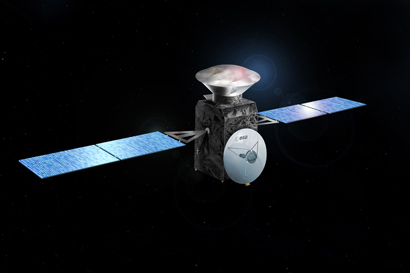
ExoMars Trace Gas Orbiter Concept
Credit: ESA

Because of these cuts to the planetary science funding, NASA has been forced to back out of the joint ExoMars mission to Mars with the European Space Agency. The mission was set to launch the ExoMars Trace Gas Orbiter in 2016 and a rover in 2018, but now the entire mission is in jeopardy. 

Fortunately, Russia may be willing to take a more central role in the mission, thus giving hope that it will be able to continue and collect valuable information about the Martian atmosphere and surface.


It's depressing to hear that one of NASA's forefront programs is losing a disproportionate amount of funds, but there is still hope for the future of Mars travel and exploration! [The following comes from a previous article called SpaceX is Winning the Race to Mars.]

---

The emergence of private space corporations with ambitions beyond low-Earth orbit gives hope to humanity because they can focus solely on space exploration and development and are not limited by bureaucratic procedures like government agencies are.

The future of space exploration is in the hands of ambitious companies like SpaceX whose sole focus is space development and exploration. Hopefully SpaceX can achieve their stated goal of setting a man on Mars in the next 10-20 years, thus starting a new era of private, competitively priced space travel and exploration. The developments in space made by private companies, not governments, will usher in a new era of human exploration and expansion throughout the known universe.
---

Hopefully SpaceX will still continue working with NASA on the proposed Red Dragon Mission to Mars. Either way the future is sure to be full of more discoveries on Mars by the machines we already have in place and the Mars Science Laboratory (MSL), which is set to land in Gale Crater in August 2012! 


Who knows, maybe MSL will discover something that reinvigorates the nation's love of space and increases funding for NASA's planetary science division!

Mars Photo of the Day - Nov 26 2011

Today's Image of Mars shows part of Mars at the boundary between night and day. You can see Gale Crater is beginning to feel the first rays of morning light. It is the crater in the center with the large central mound.

This will be the landing spot for Mars Science Laboratory Curiosity when it touches down in August 2012. [Learn More About Mars Science Laboratory's Mission]

This image was created using information from Mars Orbiter Laser Altimeter, which flew on NASA's Mars Global Surveyor orbiter.

Clicking on this image will take you to the original NASA Image of the Day. I highly recommend that you click on it because theirs is much larger.


Mars Photo of the Day - Oct 22 2011

Today's Image of Mars is from the Mars Pathfinder mission and shows the Sojourner rover taking an Alpha X-ray spectrometer measurement of Yogi Rock. This image was taken on July 4, 1997.

Yogi Rock was the first basalt rock discovered on Mars. Basalt is an igneous rock, which implies previous volcanic activity in the region. But that is not all that makes Yogi Rock memorable; images of Sojourner driving up to Yogi Rock were aired in the opening credits of Star Trek: Enterprise. This was the first time that images from another planet were used in a science fiction television or film production.


Mars Photo of the Day - Oct 20 2011

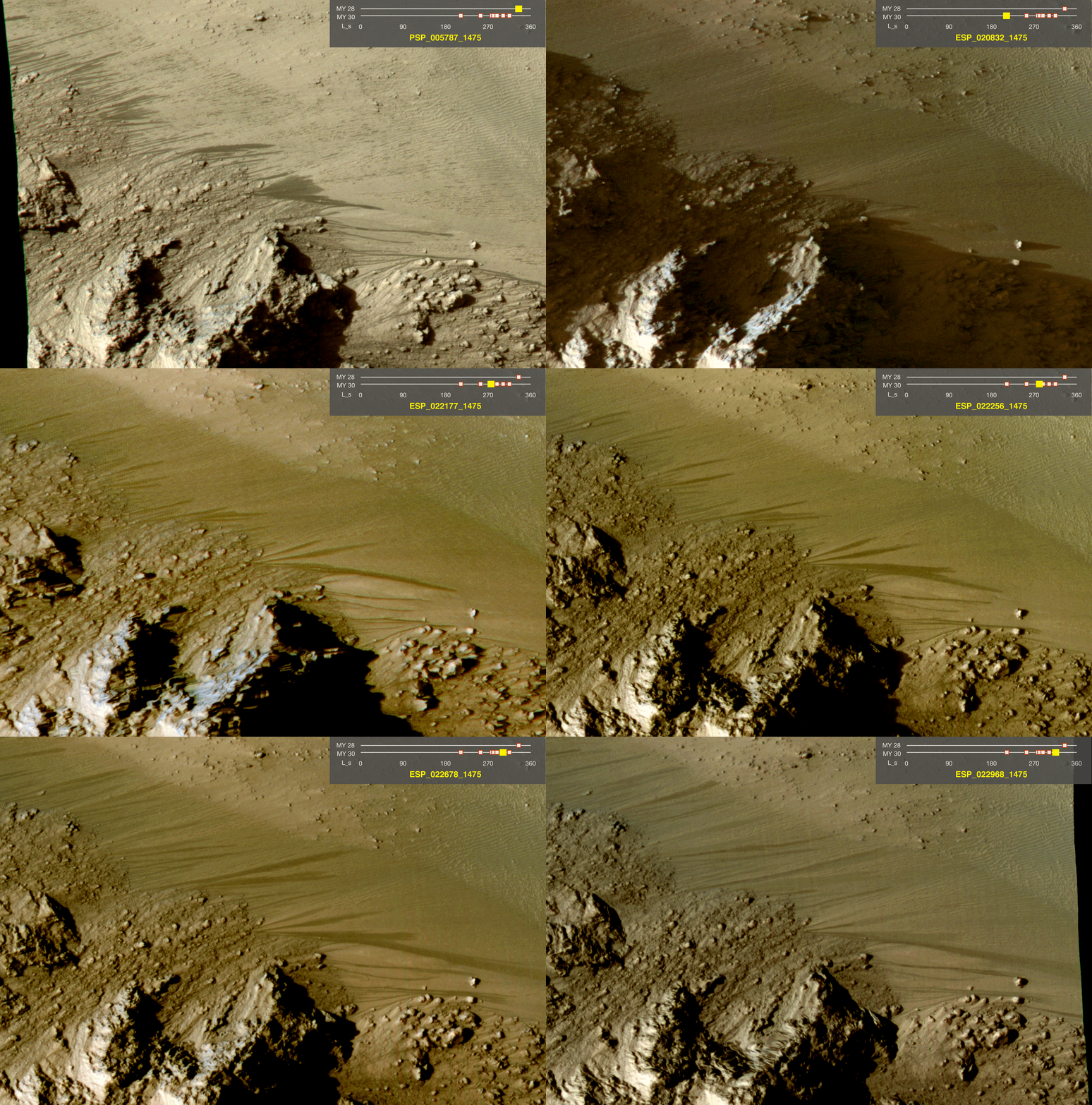
Today we have a compilation of images from Mars taken by HiRISE. These images all show the same central structures in Horowitz Crater.  The images span over a period of close to two years and show changes in slope features. These changes are thought to be indicative of flowing water on Mars. 

The features that seem to extend down the slope are called Recurring Slope Linae (RSL). Repeated imaging has shown that these features appear and gradually grow during the warm season on Mars, only to fade during the cold season. It is thought that the best explanation for these recurring features is the existence of briny water just below the surface, but that is unconfirmed as of yet.

Mars Travel wrote an article about these findings the day they were released. [View This Article]

This series of photos was published with many others and an article in the journal Science on August 5 2011. This photo will link to the larger high resolution images, but if you want to see the HiRISE article and abstract from Science on these features, you can find them here.
Image credit: NASA/JPL-Caltech/Univ. of Arizona


Mars Photo of the Day - Sept 4 2011

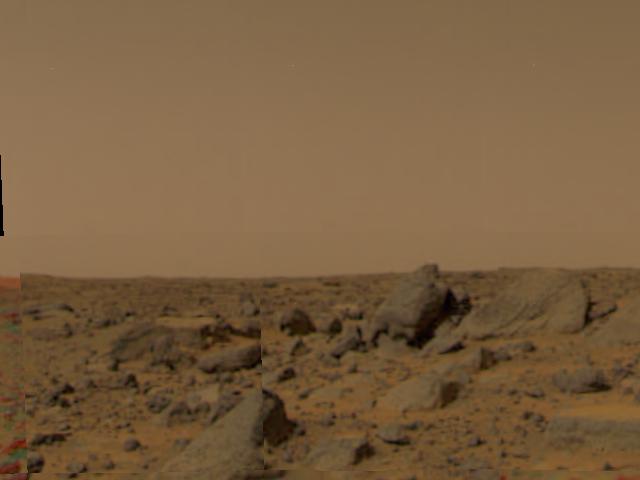
Todays Mars Photo was taken by the Mars Pathfinder in Ares Valles on July 4 1997. The large boulders in the image were most likely deposited by the catastrophic floods that created the valley. The sky is reddish brown because of the dust particles abundant the atmosphere.

Mars Photo of the Day - Sept 3 2011

Today's Mars Photo was taken by Viking I shortly after landing on July 20 1976. It was the first photo ever taken from the Martian surface. When we compare this image to a more modern photo of Mars like this one, it is amazing how far our technology has come. Could you imagine getting photos from Mars Exploration Rover Opportunity that looked like this? How disappointing would that be?
The image here is as large as the original, so I have linked it to the NASA's informative page on the image.

Mars Photo of the Day - Sept 2 2011

Today's Mars Photo shows the path taken by Mars Exploration Rover Opportunity in recent weeks. This photo was taken by Mars Reconnaissance Orbiter's HiRISE camera. I kept the labels added on by NASA because I know how hard it is to remember where everything is when you hear about Opportunity's discoveries. Hopefully you can use this image as a reference.
Clicking on this image will direct you to an article about Mars Exploration Rover Opportunity, its status and new mission. See the larger, original image.

Press Release: Media Teleconference About Mars Rover Opportunity Set for Sept 1


Dwayne Brown     
Headquarters, Washington
202-358-1726
dwayne.c.brown@nasa.gov
 
Guy Webster
Jet Propulsion Laboratory, Pasadena, Calif.
818-354-5011
guy.webster@jpl.nasa.gov  

Aug. 30, 2011


MEDIA ADVISORY : M11-181
 
 
NASA Announces Media Teleconference About Opportunity Rover
 
 
PASADENA, Calif. -- NASA will host a media teleconference on Thursday, Sept. 1, at 12:30 p.m. PDT to discuss progress of NASA's Mars Exploration Rover Opportunity. Opportunity reached the Martian Endeavour crater earlier this month after years of driving.

The teleconference participants are:

-- Dave Lavery, program executive, Mars Exploration Rovers, NASA Headquarters, Washington
-- Steve Squyres, principal investigator, Mars Exploration Rovers, Cornell University, Ithaca, N.Y.
-- Ray Arvidson, deputy principal investigator, Mars Exploration Rovers, Washington University in St. Louis.
-- John Callas, project manager, Mars Exploration Rovers, Jet Propulsion Laboratory (JPL), Pasadena, Calif.

To participate in the teleconference, reporters must contact the JPL Media Relations Office at 818-354-5011 not later than 11 a.m. on Thursday for the call-in number and passcode.

Opportunity and its twin, Spirit, completed their three-month prime missions on Mars in April 2004. They continued to work for years in bonus mission extensions. Spirit finished communicating in 2010, after six years of operation.

Opportunity, still very active, reached the rim of Endeavour crater on Aug. 9. The arrival gives the rover access to geology different from any it explored during its first 90 months on Mars.

For live audio streaming of the teleconference, visit:

More information about the twin rovers, visit:
 
- end -

Mars Photo of the Day - Aug 30 2011

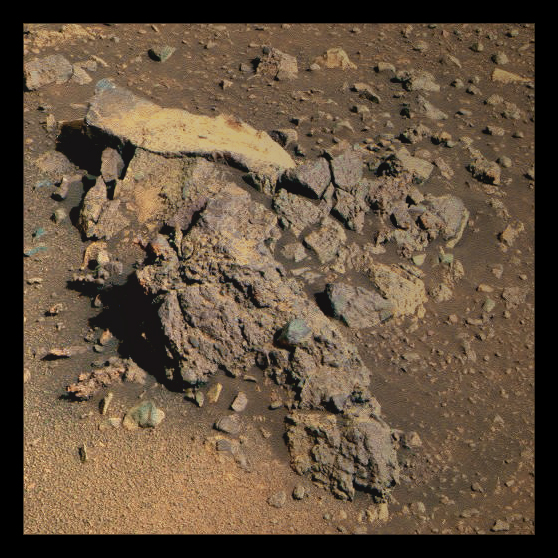
Today's Mars Photo is of Tisdale-1 as taken by the Mars Exploration Rover Opportunity on Sol 2694. The right side of Tisdale-1 seems to be very smooth, though broken up by the veins that scar the entire rock. This implies a high level of heat (likely from impact by the meteorite that created Endeavour Crater) may have fused different rocks together, thus making this a composite rock like the other Tisdales, which is likely why it is in that category in the first place. The veins on the surface throughout imply some form of erosion that took place after the formation of the rock, but by what we can only speculate.

Click the image to see the enlarged version from NASA.

Mars Photo of the Day - Aug 29 2011

Today's Mars Photo is of Tisdale-5, a rock in close proximity to the original Tisdale. This rock is one of the more oddly shaped rocks in the area and seems to have been eroded significantly over the past millions (or billions) of years. We are left to wonder why the Mars Exploration Rover Opportunity's team decided to group many rocks under the name Tisdale, but it is likely because the team believes the rocks have similar composition. This photo came directly from The Road to Endeavour blog and the full size image can be seen just by clicking on the image below.

I failed to post a photo yesterday (Aug 28 2011) because I got caught up in Hurricane Irene and my power and Internet are out. I found a hot spot to post today's Mars Photo of the Day. Hopefully I'll be able to post more regarding developments toward Mars travel and exploration when my Internet is restored tomorrow. Thanks for your patience!

Mars Photo of the Day - Aug 27 2011

Today's Mars Photo was taken by Mars Exploration Rover Opportunity back on Sol 712. I feel it is important to remember that Opportunity has taken a long winding road to get to Endeavour Crater. This photo shows one of the many paths made by Opportunity. To see the original image simply click on it.

Mars Photo of the Day - Aug 22 2011

Today's Mars Photo is of Tisdale rock again, but this time the image shows just how close NASA's Mars Exploration Rover Opportunity is to the rock. The photo was taken yesterday (Sol 2692). The Mars rover has likely begun performing tests as it attempts to learn more about the mysterious rock.
Photo of Tisdale Taken by MER Opportunity's Front HazCam on Sol 2692

Why NASA's Manned Mission to Mars Will Happen

Most people know that NASA recently ended the shuttle program and abandoned all plans to return to the moon. but what you may not know is that NASA has launched a much more ambitious mission. a Manned Mission to Mars. Many people do not believe any such plans will ever come to fruition; they look at the recent cuts to NASA and feel that only more will come. Many people look at the scrapped lunar mission and fear that the same will become of any future attempts at manned Mars travel. So what is the difference? Why will the a manned mission to Mars become reality when so many other projects have gone out the window? And better yet, why travel to Mars?

Getting to Mars is More Important than Going Back to the Moon


VS


What's the point of taking a test that you already aced? What is there to prove by doing something you have already done? NASA going back to the Moon is the equivalent of you making your bed. You learned how to do that in your childhood, and it is expected that you should be able to do it now.

Mars Photo of the Day - Aug 13 2011

Today's Mars photo is of Olympus Mons, the tallest known mountain and volcano in the solar system. At an estimated height of anywhere between 21-29 km, Olympus Mons is about three times as tall as Mount Everest. The whole mountain covers an area that is approximately the size of Arizona. 
Olympus Mons photo originally taken by Viking 1 on June 22 1978

Mars Photo of the Day- Aug 5 2011

The following series of images was taken from early spring of one Mars year to mid-summer of the following year. They show features on the slope of Newton Crater that might be evidence of salt water flowing on Mars today. The photos were taken during the warm season on Mars by the Mars Reconnaissance Orbiter. 


Warm
The features lengthen during the warm season and diminish in the cold season.
NASA - Warm-Season Flows on Slope in Newton Crater


NASA has Discovered Substantial Evidence that Water is Flowing on Mars

"It is our first chance to see an environment on Mars that might allow for the expression of an active biological process, if there is presently life on Mars."  - Lisa Pratt at NASA news briefing on the discovery of flowing water on Mars (04 Aug 2011)


In NASA's news briefing about findings by the Mars Reconnaissance Orbiter they announced that they have significant evidence that liquid water is currently flowing on Mars. They used Newton Crater (below) as their focal point in the discussion and showed gullies that have gotten larger over the course of two and a half sol (Martian years) of observation. 
Newton Crater and an adjacent trough- both with gullies
Newton Crater is about 10 km in diameter and a few hundred million years old (relatively new). It is just one of seven places that have distinct evidence of flowing water.


Live Blogging NASA's News Briefing on Mars Orbiter Findings


1451 EDT
The news briefing is over.
1450 EDT
We have to assume that if there are organisms on Mars they are highly adapted to radiation and other parts of the extreme environment.

1448 EDT
Newton Crater is 10km in diameter and probably a few hundred million years old. It has steep crater walls and exposed bedrock.
1444 EDT
Mars could have life that is dormant during colder seasons. They would live in the brine when it is liquid, but become dormant when it freezes
1443 EDT
Could be fluids of brine that create a column in the crust and can support life.
1442 EDT
Life with a sulfur based metabolism is possible.
We find life on Earth in many extreme environments. NASA believes such life is possible in the brine on Mars.

1440 EDT
Best evidence we have to-date of liquid water forming on Mars
1439 EDT
This is warmer water that is more hospitable to life than has ever been found on Mars
1439 EDT
How does this stack up with other discoveries on Mars.
1437 EDT
Many questions yet to be asked to confirm or deny.
1436 EDT
It will be a slow process to confirm or deny these findings.
1434 EDT
Gullies on Mars were discovered a bit over 10 years ago. Have been taken for liquid water. Current activity being seen is in winter when it is colder
1433 EDT
This is the first time we have found liquid water on Mars. Liquid water can sustain life better than ice. It is a haven for life
1432 EDT
Ice would be more usable than the brine for producing fuel, drinking, etc.
1430 EDT
Clarification - Brine water is extremely salty water. It can depress the freezing point many degrees. Not located on Earth because this is a watery planet.
1428 EDT
Laboratory experiments on Earth that will give best confirmation or refutation

1427 EDT
Curiosity would not be allowed to go near liquid water on the surface if it was found because it could "contaminate it 'Earth-life'"
1426 EDT
Mars Science Laboratory, Curiosity will have the sensitivity to detect methane being released by possible lifeforms that may live in the brine located in the Martian crust
1425 EDT
Possible there are pockets of brine in the crust.
1424 EDT
Gives us a chance to see an environment on Mars that could provide a hospitable envirnoment for life on Mars
Give opportunity to focus future orbiting equipment.
1423 EDT
Could provide a conduit to a larger, deeper brine pool. Could sustain life.
Briny water could be liquid even when permafrost is very cold because of salt content
1421 EDT
Take what they know about severe environments on Earth and the life they sustain to speculate about possible life on Mars and its ability to survive even on Mars
"Mars is simply too large a planet to keep an eye on every place all the time"
1420 EDT

Christensen - "One of the reasons we are interested in water is the potential for life." - Passes mic off


There is a nice correlation between where salt pockets and where water is. Mid-latitudes are turning out to be very important. Warm enough for liquid water to exist.
1419 EDT
Previously found ice at higher, colder latitudes, but now we are finding water near the equator at mid latitudes
1416 EDT
Christensen says -New observations occur at lower latitudes where it is much warmer and where liquid water could exist.
Phil Christensen is now speaking.
1415 EDT
Scale of gullies can be kilometer scaled
1414 EDT
There are many gullies that have been active. A dark deposit seems to form. Usually active in the winter when it is much cooler.
1413 EDT
Colin Dundras is talking about Martian gullies, which are often called evidence for water on Mars. Look like water carved features on Earth.
1412 EDT
Laboratory experiments will help to determine if this really is water. We have the ability to simulate Martian environment.
1411 EDT
HRISM does not see water, just the evidence of its recent flowing. Belief is that the water evaporates very quickly and so there is no standing water on Mars for long periods of time.
1410 EDT
Salt is lowering the freezing temperature of water so that it can remain in liquid form at temperatures below freezing.
1409
Slopes far too warm for carbon dioxide frost. -23 - +7 Centigrade.
1408 EDT
All of these "behaviors suggest some sort of volatile material to us"
They zoom in on the crater and show that there seems to be liquid water pooling slightly.
1406 EDT
About a thousand flows in Newton Crater. Seven sites and 20 candidates with other flows.
1405 EDT
The feature is in Newton Crater and it shows that there is flowing water on Mars presently. These observations have been taken over the course of 2.5 Martian Sol (Martian years)
1404 EDT
"Have found repeated and predictable evidence of water flowing on Mars"

Mars Reconnaissance Orbiter (MRO) has found many spectacular images in the past few years.
1403 EDT
Water plays a large role in many things, including life. We have found on Earth that if there is water there is life.
1402 EDT
Announcing the presenters as listed in the Press Release About News Briefing
1401 EDT
'Following the water on The Red Planet" - This is about water on Mars, or so it seems
1400 EDT
The news briefing should be beginning any second now!
1357 EDT
Be sure to check the streaming video on NASA TV if you can. I will be writing updates as fast as I can!
1300 EDT
With one hour to go before NASA's big announcement, many people and news agencies are making speculations about the contents of NASA's news briefing.
Many people feel that it will be a big let down, something that will be big in the scientific community, but not as important in the public eye. This kind of letdown happened in December of last year when NASA had a news briefing just like this and announced the discovery of life on Earth that relies on arsenic rather than phosphorous. While many in the public didn't take well to this because they were hoping for something much 'bigger,' it upset many of our understandings of life and the environments it could exist in. This discovery of arsenic reliant lifeforms on Earth has helped reinforce arguments for life on Mars.
The most optimistic speculation is that NASA has discovered evidence of microbial life on the surface of Mars, whereas most people think that NASA will tell us they have found further evidence that there is liquid water on Mars, or beneath its surface.
We can all hope or speculate, but we won't know until 1400 (2PM) EDT.

1053 EDT:
I will be live blogging NASA's  news briefing on findings by the Mars Reconnaissance Orbiter (MRO). It takes place at 1400. For more information about the briefing please see the Press Release About News Briefing. Keep checking back for the latest from the briefing!
Just in case you don't know what the MRO looks like.
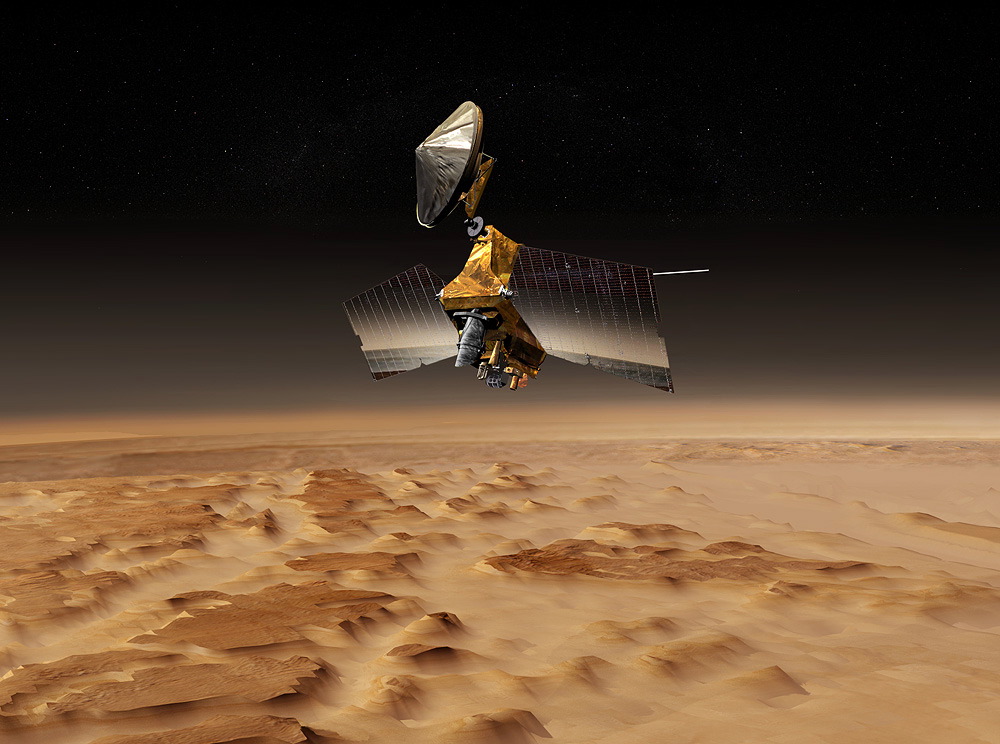
Mars Reconnaissance Orbiter
Source: NASA

Press Release: NASA Announces News Briefing On Mars Orbiter Science Finding


NASA has released this press release saying they will have a News conference on Aug 04, 2011 at 2PM EDT about new findings by the Mars Reconnaissance Orbiter.

Steve Cole
Headquarters, Washington     
202-358-0918
stephen.e.cole@nasa.gov  

August 03, 2011
MEDIA ADVISORY : 11-159

NASA Announces News Briefing On Mars Orbiter Science Finding
Science Journal Has Embargoed Details Until 2 p.m. EDT on Aug. 4

WASHINGTON -- NASA will host a news briefing on Thursday, Aug. 4, at 2 p.m. EDT about a significant new Mars science finding. The briefing will be held in the NASA Headquarters James E. Webb Auditorium, 300 E St. SW in Washington.

The new finding is based on observations from NASA's Mars Reconnaissance Orbiter (MRO), which has been orbiting the Red Planet since 2006. MRO is managed by the Jet Propulsion Laboratory, a division of the California Institute of Technology in Pasadena, Calif., for NASA's Science Mission Directorate in Washington.

The briefing panelists are:
- Philip Christensen, geophysicist, Arizona State University, Tempe
- Colin Dundas, research geologist, U.S. Geological Survey, Flagstaff, Ariz.
- Alfred McEwen, planetary geologist, University of Arizona, Tucson
- Michael Meyer, Mars Exploration Program lead scientist, NASA Headquarters
- Lisa Pratt, biogeochemist, Indiana University, Bloomington

Reporters unable to attend in person may ask questions from participating NASA centers or by telephone. To participate by phone, reporters must contact Grey Hautaluoma at 202-358-0668 or grey.hautaluoma-1@nasa.gov by 11 a.m. on Aug. 4.

The news briefing will air live on NASA Television and the agency's website. For NASA TV streaming video, downlink and scheduling information, visit:


The event also will be carried live on Ustream, with a live chat box available, at:


- end -
SOURCE; NASA

Arguments for Life on Mars

Was there ever life on Mars? Is there still life on Mars?

These are the questions that millions of people have asked since Percival Lowell first announced in 1895 that the deep ravines and 'canals' on Mars were created by intelligent beings. As humanity began studying The Red Planet they were ultimately able to refute this popular assertion, but whole generations grew up with tales of Martians and little green men. It led to fascination and hope that humanity was not alone in the universe.

The hope that intelligent beings lived on Mars was dashed in July 1965 when Mariner 4 flew past Mars and took the first close-up photographs of the Martian surface. Those pictures showed a desolate planet that resembles the Moon with its barren landscape and essential lack of atmosphere. 
For those that still had hope that intelligent life once existed on Mars they became excited by the clear pictures taken by Mariner 9 in 1972, which gave evidence that water had once been abundant on the Martian surface. In the years since photos from other satellites orbiting Mars also led scientists to the same conclusion, that liquid water had once covered much of the Martian surface, but that it was now unable to exist on the surface. So while it was concluded that intelligent life was not present on Mars, the scientific community and the world at large still held out hope that some form of life existed on The Red Planet.

Evidence that Liquid Water Once Existed on the Martian Surface.


Evidence of Past Water Provides Hope

The evidence that water had one existed on the Martian surface gave scientists and the populous hope that life might have existed on Mars as well. However, scientists briefly had their hopes dashed when NASA's Viking Program brought soil samples from the Martian surface back to Earth. They could not discover any microbial life or evidence that life could actually exist in the soil of Mars. These findings were disputed though; many people believed that the method used to bring the samples back to Earth had killed any proof of life. Scientists and people everywhere were once again hopeful.
So if water had once existed on the Martian surface, perhaps it was possible that microbial life had existed as well. And if it was possible that microbial life had existed, why couldn't it still exist? Scientists were doubtful that it could still exist because the conditions are Mars were so severe that no known life could tolerate them.

The Discovery of New Life

This was the common consensus until a discovery on Earth led scientists to redefine the necessary parameters for life. In late 2010 NASA discovered bacteria in Mono Lake, California that did not use all the elements previously thought necessary to sustain life. The bacterium replaced phosphorous with arsenic, an element that was previously considered toxic and an impediment to life.
Credit: Washington Post