Google+ Mars Travel: Gale Crater Central Mound
Showing posts with label Gale Crater Central Mound. Show all posts

Weekend Feature: Gale Crater

Looking down on Mars we see Gale Crater as a crater among many craters, but even from this distant perspective Gale Crater is unique, special, and above all, intriguing. In the image below we can spot the 150km in diameter Gale Crater because of its massive central uplift, Mount Sharp, which rises 5.5 km above the northern crater floor and 4.5 km above the southern crater floor. It is Mount Sharp that makes Gale Crater so intriguing and worthy of future study.


Mount Sharp's base is thought to be at least 2 billion years old. It is comprised of clays and sulfates, two materials that are only known to form in the presence of water. The layers directly on top of those are comprised primarily of sulfates, with very few clays, which implies that they were formed in an environment where Mars was becoming drier and water was evaporating. See the next image for an idea of what these intriguing layers look like.

Mars Photo of the Day - Apr 1 2012

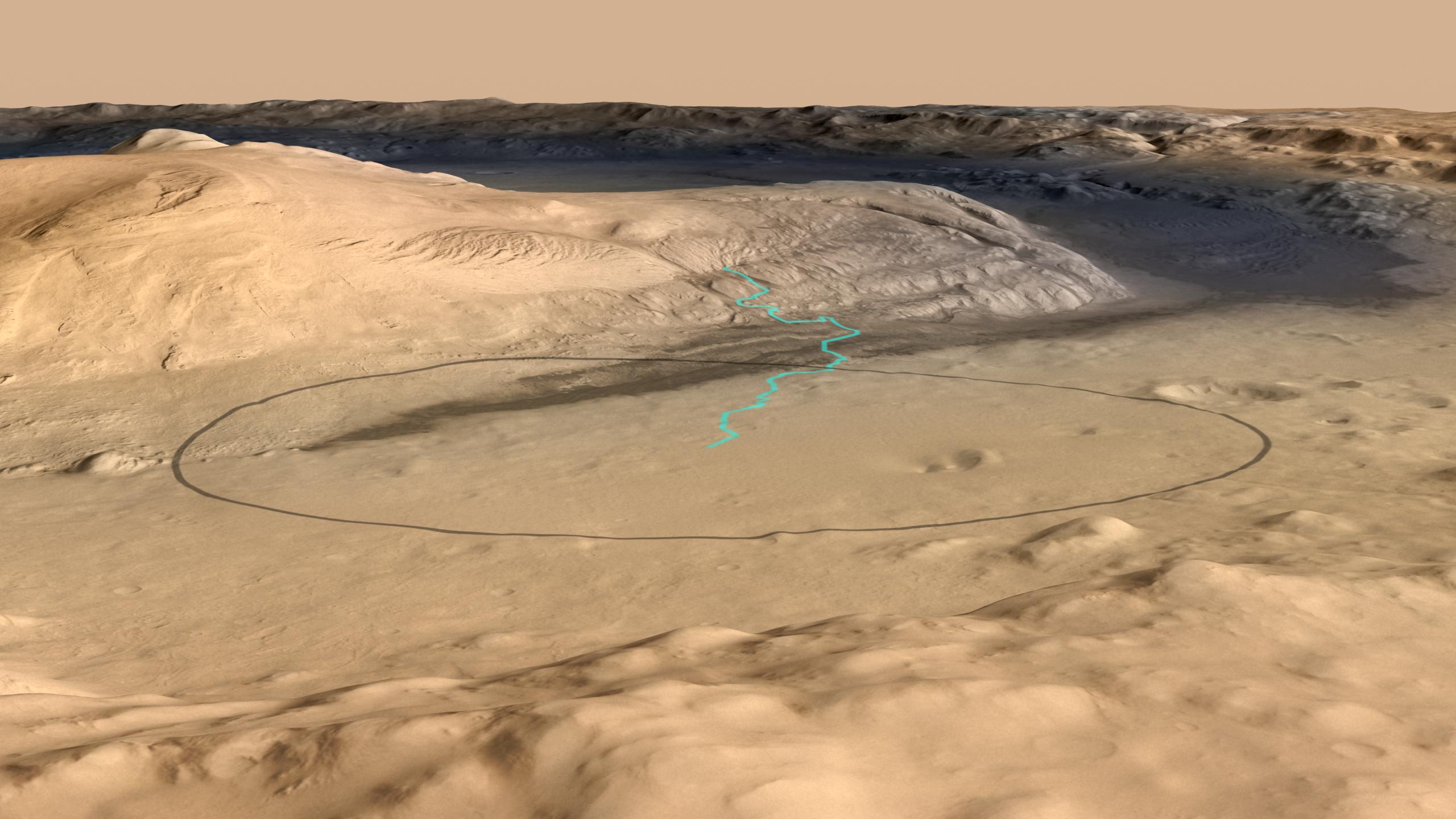
Today's Image of Mars shows the landing site for Mars Science Laboratory Curiosity at the foot of Mount Sharp, the 5km high central mound in Gale Crater. The turquoise line shows the expected path of MSL after it lands and begins navigating its way up Mount Sharp. The black oval measures about 20km by 25km and is the area in which MSL Curiosity has a 99% probability of landing.

The lowest portion of Mount Sharp is comprised of clays and sulfates, materials which are formed in the presence of water. The overlying layers contain sulfates, but very little clay, indicative of an environment in which water was evaporating and Mars was becoming drier. Scientists hope that studying Mount Sharp's layers can provide insights into the past Martian climate and give them a better idea as to whether Mars was once, or may still be habitable.

This image combines data from the High Resolution Stereo Camera on the European Space Agency's Mars Express orbiter, with data from the Context Camera on NASA's Mars Reconnaissance Orbiter, and color information from the Viking Orbiter. Clicking on this image will take you to the original higher resolution image from NASA. [See the NASA article on Mount Sharp]


Mars Photo of the Day - Nov 26 2011

Today's Image of Mars shows part of Mars at the boundary between night and day. You can see Gale Crater is beginning to feel the first rays of morning light. It is the crater in the center with the large central mound.

This will be the landing spot for Mars Science Laboratory Curiosity when it touches down in August 2012. [Learn More About Mars Science Laboratory's Mission]

This image was created using information from Mars Orbiter Laser Altimeter, which flew on NASA's Mars Global Surveyor orbiter.

Clicking on this image will take you to the original NASA Image of the Day. I highly recommend that you click on it because theirs is much larger.


Mars Science Laboratory Mission

Now that we have a successful launch of Mars Science Laboratory Curiosity, here is a repost about its mission!


MSL Curiosity will be the most complex and scientifically advanced robot to ever explore the surface of another planet. See below for a diagram of MSL Curiosity and all of its instruments.

For a description of everything on the payload click the image.
Source: NASA/JPL


For specifics on the launch and navigation I highly recommend you read Universe Today's How Will MSL Navigate to Mars? Very Precisely

But where on Mars with MSL Curiosity land?

Curiosity is set to land in Gale Crater on Mars between August 6 and August 20, 2012 and has an expected operation time of 668 Martian sols (686 Earth Days). Gale Crater is 150 kilometers (~93.21 miles) in diameter, so there is a lot of space for Curiosity to land, but fortunately NASA has given us a better idea! See below for approximately where in Gale Crater MSL Curiosity will land.

Gale Crater with Landing Site Outlined
Image Credit: NASA/JPL/HiRISE
What will Mars Science Laboratory Curiosity study in Gale Crater?

Gale Crater contains an enormous mound near the center that rises even higher than the southern rim of the crater. It rises 5.5 km above the northern crater floor and 4.5 km above the southern crater floor. The mound contains many layers; it is estimated that its foundation may be as old as 2 billion years old. Curiosity will be able to examine these different layers and determine at which point, if any, Mars was able to support life. It is speculated that the mound is what remains of sedimentary layers that once filled the entire crater and that these were initially deposited on a lake bed. 

A look at the lower portion of Gale Crater's central mound
Image Source: NASA
As you can see from the labels, the lowest portion of the mound is comprised of clays and sulfates, materials which are formed in the presence of water. The overlying layers contain sulfates, but very little clay, implying they were formed in an environment in which water was evaporating and Mars was becoming drier. 

What does the MSL Team hope to find?

Michael Meyer, lead scientist for NASA's Mars Exploration Program claims that Gale Crater was chosen from all candidate landing sites because "the site holds a diversity of features and layers for investigating changing environmental conditions, some of which could inform a broader understanding of habitability on ancient Mars." He also states that "Gale gives us attractive possibilities for finding organics," but points out that it is still unlikely we will find organic life still living on Mars.

Regardless of whether Curiosity discovers past or present life on Mars it is a great step toward manned exploration of Mars. The discoveries that Curiosity makes will at the very least give us a better understanding of the Martian past and its habitability. Knowing this will enable us to plan for future missions to Mars.

Mars Science Laboratory's Launch and Mission

NASA's Mars Science Laboratory (MSL) Curiosity will launch on Saturday morning at 10:02 EST aboard a United Launch Alliance's (ULA) Atlas V. Curiosity will launch from Cape Canaveral Air Force Station at Space Launch Complex 41.

MSL Curiosity will be the most complex and scientifically advanced robot to ever explore the surface of another planet. See below for a diagram of MSL Curiosity and all of its instruments.

For a description of everything on the payload click the image.
Source: NASA/JPL


For specifics on the launch and navigation I highly recommend you read Universe Today's How Will MSL Navigate to Mars? Very Precisely

But where on Mars with MSL Curiosity land?

Curiosity is set to land in Gale Crater on Mars between August 6 and August 20, 2012 and has an expected operation time of 668 Martian sols (686 Earth Days). Gale Crater is 150 kilometers (~93.21 miles) in diameter, so there is a lot of space for Curiosity to land, but fortunately NASA has given us a better idea! See below for approximately where in Gale Crater MSL Curiosity will land.

Gale Crater with Landing Site Outlined
Image Credit: NASA/JPL/HiRISE
What will Mars Science Laboratory Curiosity study in Gale Crater?

Gale Crater contains an enormous mound near the center that rises even higher than the southern rim of the crater. It rises 5.5 km above the northern crater floor and 4.5 km above the southern crater floor. The mound contains many layers; it is estimated that its foundation may be as old as 2 billion years old. Curiosity will be able to examine these different layers and determine at which point, if any, Mars was able to support life. It is speculated that the mound is what remains of sedimentary layers that once filled the entire crater and that these were initially deposited on a lake bed. 

A look at the lower portion of Gale Crater's central mound
Image Source: NASA
As you can see from the labels, the lowest portion of the mound is comprised of clays and sulfates, materials which are formed in the presence of water. The overlying layers contain sulfates, but very little clay, implying they were formed in an environment in which water was evaporating and Mars was becoming drier. 

What does the MSL Team hope to find?

Michael Meyer, lead scientist for NASA's Mars Exploration Program claims that Gale Crater was chosen from all candidate landing sites because "the site holds a diversity of features and layers for investigating changing environmental conditions, some of which could inform a broader understanding of habitability on ancient Mars." He also states that "Gale gives us attractive possibilities for finding organics," but points out that it is still unlikely we will find organic life still living on Mars.

Regardless of whether Curiosity discovers past or present life on Mars it is a great step toward manned exploration of Mars. The discoveries that Curiosity makes will at the very least give us a better understanding of the Martian past and its habitability. Knowing this will enable us to plan for future missions to Mars.

Watch MSL Curiosity Launch Live!

I'll make sure to post a live stream of Mars Science Laboratory Curiosity's launch, so check back for that on Saturday morning! Don't forget the launch is scheduled for 10:02 AM EST! This is one you won't want to miss.


Mars Photo of the Day - Nov 21 2011

Today's Image of Mars is a color image of Gale Crater with Mars Science Laboratory (MSL) Curiosity's approximate landing spot outlined. You can see that MSL Curiosity will be landing close to the base of Gale Crater's central mound, which contains an abundance of sulfates and clays formed in a wet environment. Curiosity will land in a flat ares of the crater (as indicated in the image) and work its war up the mound, determining the conditions in which each layered deposit was formed. 

The MSL Curiosity team hopes to determine whether Mars was ever habitable. They believe examining clays formed in wet conditions provides them the best chance of determining whether there was ever life on Mars.

Clicking on this image will take you to all previous posts related to Gale Crater.
Image Credit: NASA/JPL


Mars Photo of the Day - Nov 20 2011

Today's Image of Mars is of the lower portion of the central mound in Gale Crater. The central mound rises 5.5km above the northern crater floor and 4.5km above the southern crater floor and will be a prime target for Mars Science Laboratory Curiosity. The bottom of this image is actually the floor of the crater. 

What's so special about Gale Crater's central mound? 

Well the central mound is larger than any observed by a Mars rover before, which means that it contains more layers of deposits and will be able to tell scientists more about the ancient Martian past than ever before.

As you can see from the labels, the lowest portion of the mound is comprised of clays and sulfates, materials which are formed in the presence of water. The overlying layers contain sulfates, but very little clay, indicative of an environment in which water was evaporating and Mars was becoming drier. 

Mars Science Laboratory Curiosity will examine these layers in an attempt to determine whether Mars was ever able to support life.

Clicking on this image will take you to the original image page from NASA
Image Credit: NASA/JPL-Caltech/University of Arizona/USGS