Google+ Mars Travel: water on Mars
Showing posts with label water on Mars. Show all posts

Mars Photo of the Day - Dec 6 2012

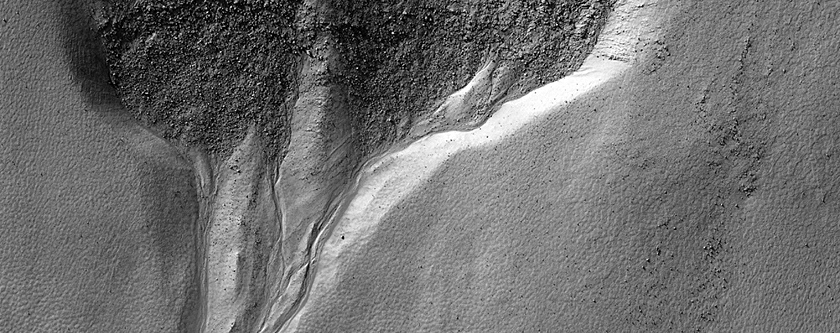
Today's Image of Mars shows defrosting dunes and gullies during late summer in Mars' southern hemisphere. Mars Reconnaissance Orbiter's HiRISE monitors defrosting sites in hopes of learning about the defrosting process on Mars. It might sound mundane, but this knowledge may one day help explorers survive by helping them to follow one of the many gullies on Mars to its source. One of the primary needs of explorers will be water and being able to find it if no satellite coverage is available could mean the difference between life and death.

Clicking on this image will take you to the original captioned image from HiRISE.


Mars Science Laboratory Mission

Now that we have a successful launch of Mars Science Laboratory Curiosity, here is a repost about its mission!


MSL Curiosity will be the most complex and scientifically advanced robot to ever explore the surface of another planet. See below for a diagram of MSL Curiosity and all of its instruments.

For a description of everything on the payload click the image.
Source: NASA/JPL


For specifics on the launch and navigation I highly recommend you read Universe Today's How Will MSL Navigate to Mars? Very Precisely

But where on Mars with MSL Curiosity land?

Curiosity is set to land in Gale Crater on Mars between August 6 and August 20, 2012 and has an expected operation time of 668 Martian sols (686 Earth Days). Gale Crater is 150 kilometers (~93.21 miles) in diameter, so there is a lot of space for Curiosity to land, but fortunately NASA has given us a better idea! See below for approximately where in Gale Crater MSL Curiosity will land.

Gale Crater with Landing Site Outlined
Image Credit: NASA/JPL/HiRISE
What will Mars Science Laboratory Curiosity study in Gale Crater?

Gale Crater contains an enormous mound near the center that rises even higher than the southern rim of the crater. It rises 5.5 km above the northern crater floor and 4.5 km above the southern crater floor. The mound contains many layers; it is estimated that its foundation may be as old as 2 billion years old. Curiosity will be able to examine these different layers and determine at which point, if any, Mars was able to support life. It is speculated that the mound is what remains of sedimentary layers that once filled the entire crater and that these were initially deposited on a lake bed. 

A look at the lower portion of Gale Crater's central mound
Image Source: NASA
As you can see from the labels, the lowest portion of the mound is comprised of clays and sulfates, materials which are formed in the presence of water. The overlying layers contain sulfates, but very little clay, implying they were formed in an environment in which water was evaporating and Mars was becoming drier. 

What does the MSL Team hope to find?

Michael Meyer, lead scientist for NASA's Mars Exploration Program claims that Gale Crater was chosen from all candidate landing sites because "the site holds a diversity of features and layers for investigating changing environmental conditions, some of which could inform a broader understanding of habitability on ancient Mars." He also states that "Gale gives us attractive possibilities for finding organics," but points out that it is still unlikely we will find organic life still living on Mars.

Regardless of whether Curiosity discovers past or present life on Mars it is a great step toward manned exploration of Mars. The discoveries that Curiosity makes will at the very least give us a better understanding of the Martian past and its habitability. Knowing this will enable us to plan for future missions to Mars.

Mars Science Laboratory's Launch and Mission

NASA's Mars Science Laboratory (MSL) Curiosity will launch on Saturday morning at 10:02 EST aboard a United Launch Alliance's (ULA) Atlas V. Curiosity will launch from Cape Canaveral Air Force Station at Space Launch Complex 41.

MSL Curiosity will be the most complex and scientifically advanced robot to ever explore the surface of another planet. See below for a diagram of MSL Curiosity and all of its instruments.

For a description of everything on the payload click the image.
Source: NASA/JPL


For specifics on the launch and navigation I highly recommend you read Universe Today's How Will MSL Navigate to Mars? Very Precisely

But where on Mars with MSL Curiosity land?

Curiosity is set to land in Gale Crater on Mars between August 6 and August 20, 2012 and has an expected operation time of 668 Martian sols (686 Earth Days). Gale Crater is 150 kilometers (~93.21 miles) in diameter, so there is a lot of space for Curiosity to land, but fortunately NASA has given us a better idea! See below for approximately where in Gale Crater MSL Curiosity will land.

Gale Crater with Landing Site Outlined
Image Credit: NASA/JPL/HiRISE
What will Mars Science Laboratory Curiosity study in Gale Crater?

Gale Crater contains an enormous mound near the center that rises even higher than the southern rim of the crater. It rises 5.5 km above the northern crater floor and 4.5 km above the southern crater floor. The mound contains many layers; it is estimated that its foundation may be as old as 2 billion years old. Curiosity will be able to examine these different layers and determine at which point, if any, Mars was able to support life. It is speculated that the mound is what remains of sedimentary layers that once filled the entire crater and that these were initially deposited on a lake bed. 

A look at the lower portion of Gale Crater's central mound
Image Source: NASA
As you can see from the labels, the lowest portion of the mound is comprised of clays and sulfates, materials which are formed in the presence of water. The overlying layers contain sulfates, but very little clay, implying they were formed in an environment in which water was evaporating and Mars was becoming drier. 

What does the MSL Team hope to find?

Michael Meyer, lead scientist for NASA's Mars Exploration Program claims that Gale Crater was chosen from all candidate landing sites because "the site holds a diversity of features and layers for investigating changing environmental conditions, some of which could inform a broader understanding of habitability on ancient Mars." He also states that "Gale gives us attractive possibilities for finding organics," but points out that it is still unlikely we will find organic life still living on Mars.

Regardless of whether Curiosity discovers past or present life on Mars it is a great step toward manned exploration of Mars. The discoveries that Curiosity makes will at the very least give us a better understanding of the Martian past and its habitability. Knowing this will enable us to plan for future missions to Mars.

Watch MSL Curiosity Launch Live!

I'll make sure to post a live stream of Mars Science Laboratory Curiosity's launch, so check back for that on Saturday morning! Don't forget the launch is scheduled for 10:02 AM EST! This is one you won't want to miss.


Mars Photo of the Day - Sept 13 2011

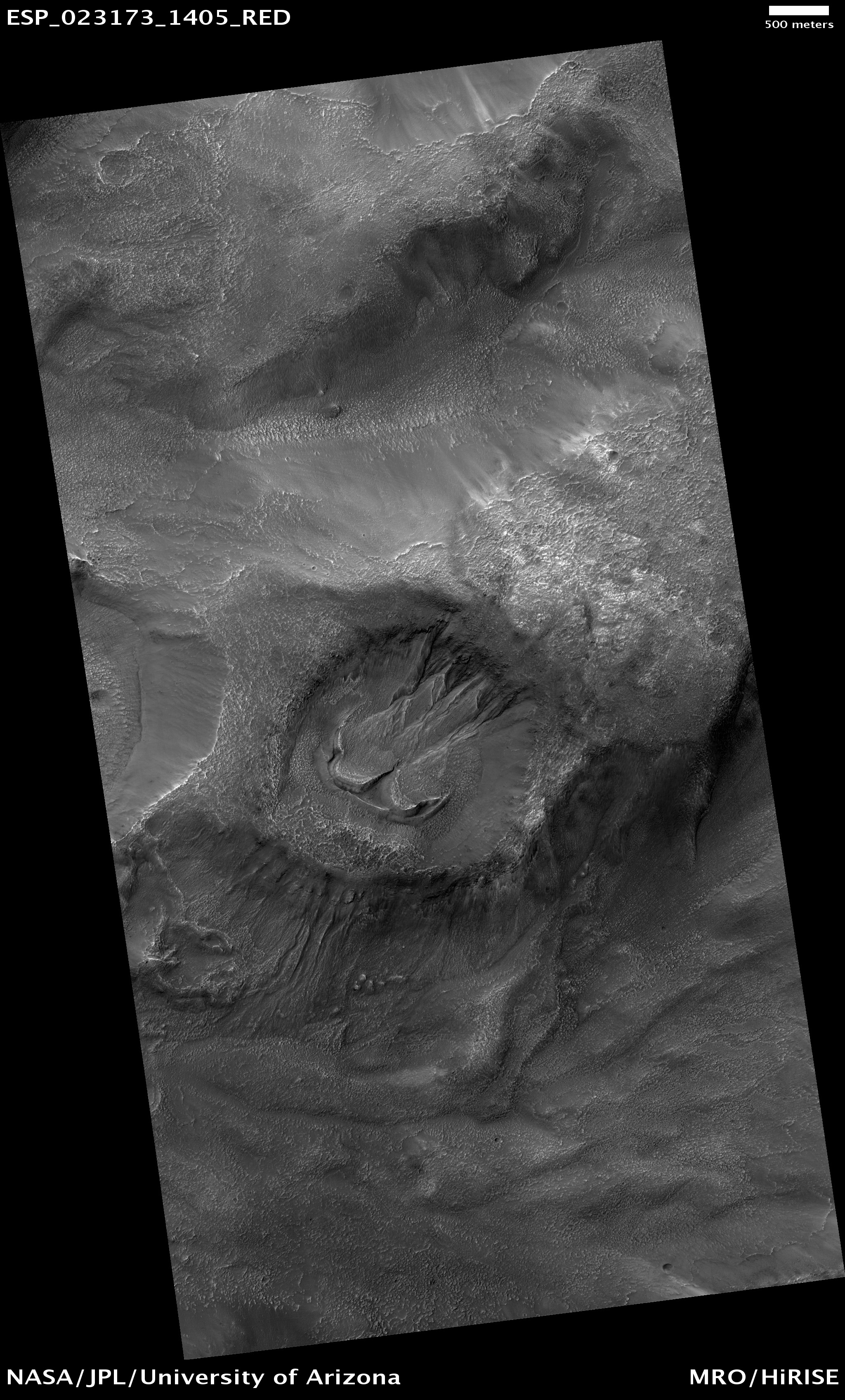
Today's Mars Photo is of a crater in Nereidum Montes as taken by the CTX camera on the Mars Reconnaissance Orbiter. The crater has numerous gullies on its southwest walls and rim. There are also two instances of ear-shaped (lobate) material that is associated with gullies within the crater. This features provide additional evidence that water once existed in excess on Mars. It is hoped that a link between the lobate material and interior gullies can be firmly established when HiRISE takes more hi-resolution images of the crater.

Click on the image below to see the original, full page photo from the HiRISE site.

Mars Photo of the Day - Sept 5 2011

Today's Mars Photo was taken by the European Science Agency (ESA)'s Mars Express. This photo of Mars is evidence that a massive lake once existed within Eberswalde Crater, which measures 65 km in diameter.

The delta is thought to have formed 3.7 billion years ago during the Hesperian Epoch, when an asteroid struck the Martian surface. Prior to this discovery it was thought that Mars was a barren, frozen planet, during the Hesperian Epoch, but the existence of this lake proves that there was liquid water present on the planet.
To see the enlarged photo click on the image. See a related, more in-depth article at The Daily Galaxy


A Rock on Mars Unlike Any Other

Today NASA held a teleconference on the current status of Mars Exploration Rover Opportunity and its new mission. Opportunity has traveled much further, and lasted much longer than anyone could have hoped (see below for its path). Its original mission was to last about three months, but it has lasted more than 30 times longer.
Mars Exploration Rover Opportunity's  path is marked in yellow. The path is marked with numbers which represent the sol when Opportunity was at the labeled location.
Source: NASA
The Mars rover recently reached Endeavour Crater, which Mars Reconnaissance Orbiter's HiRISE and CRISM cameras determined has clay minerals along the rim that are of different from any previously examined by Mars rovers.

In recent days Opportunity has been examining Tisdale-2, a rock unlike any ever encountered by a Mars rover.

China's First Mars Probe Set for October Launch

China's first Mars probe is on course to launch in October of this year. Yinghuo-1 (萤火一号) is a joint operation with Russia and will search for the causes behind the disappearance of water on Mars.

There is substantial evidence that water was once abundant on Mars (see below), but the precise reason for its disappearance has until now only been speculation.
Evidence of Water in Ravi Vallis
Areas where evidence for water is found
 in the form of outflow channels

Outflow channels, like this one seen in Ares Vallis are seen
as evidence that water once flowed on the Martian surface.

Mars Photo of the Day - Aug 14 2011

Today's Mars Photo was taken by Mars Exploration Rover Opportunity on Sol 821 (which was in early 2006) of its mission to Meridiani Planum. The photo shows ice on the Martian surface. For more information about the latest developments made by Mars Exploration Rover Opportunity click the photo.
Taken by Mars Exploration Rover Opportunity's Left Navigation Camera

Opportunity Begins Exploration of Odyssey Crater

Mars Exploration Rover Opportunity has reached the rim of Endeavour Crater culminating a journey that has lasted three years. It went directly past Spirit Point, the rally point named after its twin rover Spirit and immediately to Odyssey Crater. Odyssey Crater is small (~20 meter) and at the lowest point along the rim of the much larger Endeavour Crater.
Odyssey Crater
It is now only a matter of days until Opportunity starts making discoveries about the rocks around Odyssey Crater, which are different than the rocks on Mars that have been examined thus far. As I explained in a  previous post:

The clays present in an around Endeavour Crater  are different than any found by a Mars Rover before. They imply a warm and wet environment, much like clays examined by Opportunity at other sites, but what makes them different is their low-acidity level. It is thought that warmth, moisture, and low-acidity levels provide a suitable environment for the development of life. So while Mars Rover Opportunity will examine the clay and determine its properties, it will also be looking for signs of tiny fossils, which would provide evidence of past life on Mars. While no one expects to find evidence of past life in the clays around Endeavour Crater, it would be foolish of us not to look for it.

Something Remarkable Found Already?

Despite the fact that Mars Exploration Rover Opportunity just arrived at Odyssey Crater last night, it has already discovered an anomaly that might end up being an amazing discovery.

Mars Rover Opportunity Set to Begin Exploring Endeavour Crater

Two Rovers a Planet Away

When Mars Exploration Rovers Spirit and Opportunity landed on opposite sides of The Red Planet in January of 2004 they had missions that were to last 90 sol (~92.47 days). These missions were extended numerous times as the lifespans of both rovers far exceeded the wildest dreams of the mission coordinators. The two Mars Rovers have traversed and analyzed more Martian terrain than anyone believed they would, observing and discovering remarkable things about the Martian planet, everywhere from observation of astronomical phenomena from Mars to discovering water-altered rocks and even carbonates. It was thus with great sadness that NASA lost contact with and aborted Spirit on May 25, 2011. Even though its twin was lost, there is still Opportunity to analyze Mars and give humanity a better understanding of The Red Planet and its current environment. It is Opportunity's latest venture that we follow today.
An Artist's Rendering of Mars Exploration Rover Opportunity

Endeavour Crater

Opportunity's journey toward Endeavour Crater began in August 2008. It has been a long three years, but now the Mars Rover is just days from reaching its target at the rim of Endeavour Crater, code named Spirit Point in memory of Mars Rover Spirit. 

Panoramic sent back to Earth by Mars Rover Opportunity Aug 6 2011 - Labeled by The Road to Endeavour


Mars Photo of the Day- Aug 5 2011

The following series of images was taken from early spring of one Mars year to mid-summer of the following year. They show features on the slope of Newton Crater that might be evidence of salt water flowing on Mars today. The photos were taken during the warm season on Mars by the Mars Reconnaissance Orbiter. 


Warm
The features lengthen during the warm season and diminish in the cold season.
NASA - Warm-Season Flows on Slope in Newton Crater


NASA has Discovered Substantial Evidence that Water is Flowing on Mars

"It is our first chance to see an environment on Mars that might allow for the expression of an active biological process, if there is presently life on Mars."  - Lisa Pratt at NASA news briefing on the discovery of flowing water on Mars (04 Aug 2011)


In NASA's news briefing about findings by the Mars Reconnaissance Orbiter they announced that they have significant evidence that liquid water is currently flowing on Mars. They used Newton Crater (below) as their focal point in the discussion and showed gullies that have gotten larger over the course of two and a half sol (Martian years) of observation. 
Newton Crater and an adjacent trough- both with gullies
Newton Crater is about 10 km in diameter and a few hundred million years old (relatively new). It is just one of seven places that have distinct evidence of flowing water.


Arguments for Life on Mars

Was there ever life on Mars? Is there still life on Mars?

These are the questions that millions of people have asked since Percival Lowell first announced in 1895 that the deep ravines and 'canals' on Mars were created by intelligent beings. As humanity began studying The Red Planet they were ultimately able to refute this popular assertion, but whole generations grew up with tales of Martians and little green men. It led to fascination and hope that humanity was not alone in the universe.

The hope that intelligent beings lived on Mars was dashed in July 1965 when Mariner 4 flew past Mars and took the first close-up photographs of the Martian surface. Those pictures showed a desolate planet that resembles the Moon with its barren landscape and essential lack of atmosphere. 
For those that still had hope that intelligent life once existed on Mars they became excited by the clear pictures taken by Mariner 9 in 1972, which gave evidence that water had once been abundant on the Martian surface. In the years since photos from other satellites orbiting Mars also led scientists to the same conclusion, that liquid water had once covered much of the Martian surface, but that it was now unable to exist on the surface. So while it was concluded that intelligent life was not present on Mars, the scientific community and the world at large still held out hope that some form of life existed on The Red Planet.

Evidence that Liquid Water Once Existed on the Martian Surface.


Evidence of Past Water Provides Hope

The evidence that water had one existed on the Martian surface gave scientists and the populous hope that life might have existed on Mars as well. However, scientists briefly had their hopes dashed when NASA's Viking Program brought soil samples from the Martian surface back to Earth. They could not discover any microbial life or evidence that life could actually exist in the soil of Mars. These findings were disputed though; many people believed that the method used to bring the samples back to Earth had killed any proof of life. Scientists and people everywhere were once again hopeful.
So if water had once existed on the Martian surface, perhaps it was possible that microbial life had existed as well. And if it was possible that microbial life had existed, why couldn't it still exist? Scientists were doubtful that it could still exist because the conditions are Mars were so severe that no known life could tolerate them.

The Discovery of New Life

This was the common consensus until a discovery on Earth led scientists to redefine the necessary parameters for life. In late 2010 NASA discovered bacteria in Mono Lake, California that did not use all the elements previously thought necessary to sustain life. The bacterium replaced phosphorous with arsenic, an element that was previously considered toxic and an impediment to life.
Credit: Washington Post


Curiosity to Land at Gale Crater

"Mars is firmly in our sights. Curiosity not only will return a wealth of important science data, but it will serve as a precursor mission for human exploration to the Red Planet." -NASA Administrator Charles Bolden

The Mars Science Laboratory, or Curiosity, is set to launch between November 25 and December 18, 2011. Its primary mission is to determine whether Mars is, or ever was, habitable. Curiosity will examine soil and rock samples to determine whether there is any sign of past or present microbial life. It will also try to determine the past and present extent of water on Mars.

Introduction to Curiosity


Curiosity is five times larger than any other rover sent to Mars. The new rover weighs 600 kg (2000 lbs) and carries more than ten times the amount of scientific equipment of previous rovers.

Mars Rover Curiosity, Mars Science Laboratory Mission - 24"x36" Poster
Mars Science Laboratory Curiosity