Google+ Mars Travel: Athabasca Valles
Showing posts with label Athabasca Valles. Show all posts

Mars Photo of the Day - Jan 3 2012

Today's Image of Mars shows a volcanic vent in Elysium Planitia, but what it also shows is two distinctly different types of lava. To the north (top) you can see a darker lava flow. This is actually the edge of one of the youngest lava flows on Mars, which coursed through the Athabasca Valles channel system.

The rest of the image is covered in lighter lava that is much older and worn than the dark lava encroaching from the north. The most prominent feature in this image is the volcanic vent in the center of the image. It was through these pits and troughs that enormous amounts of lava was once expelled. The strange depressions surrounding the vent are likely the result of erosion from lava pooling and draining back into the vent.

Clicking on this image will take you to the original hi-resolution image from HiRISE. I highly recommend exploring it! [See the HiRISE caption for a subimage of the one below]


Mars Photo of the Day - Oct 15 2011

Today's Image of Mars is of Athabasca Valles, an outflow channel on Mars created by catastrophic flooding. The source of water for the flooding is most likely Cerberus Fossae, a series of fissures and scarps on the surface of Mars. 

It's difficult to tell how long ago the floods in Athabasca Valles occurred because they have almost entirely been covered by a lava flow the size of Oregon. This lava flow is considered the youngest discovered on Mars and is believed to have developed during the Amazonian Epoch, around 3 billion years ago.

This image links to the original captioned image from Mars Odyssey Orbiter's Thermal Emission Imaging System (THEMIS).


Mars Photo of the Day - Oct 14 2011

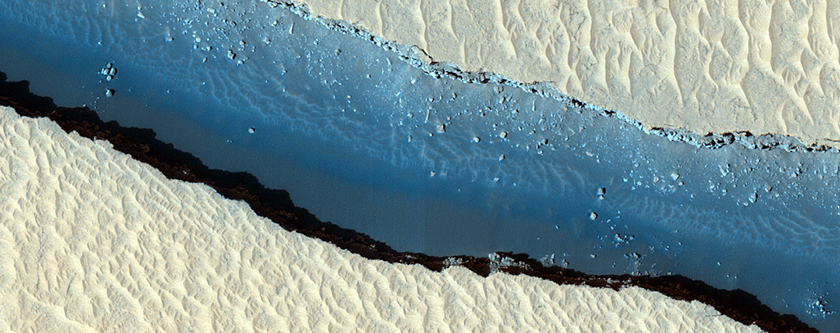
Today's Image of Mars shows what is possibly the newest part of Cerberus Fossae. And what exactly is Cerberus Fossae? 

Cerberus Fossae is a series of roughly parallel fissures created by faults which pulled the Martian crust apart in the Cerberus region, which is located at around 9°N, 197°W. These faults are the result of the formation of the Elysium Volcanic Field. They pass through preexisting features, like hills, which indicates that the faults are relatively recent.

Research suggests that the formation of these fossae released massive amounts of pressurized underground water, which led to the creation of Athabasca Valles, a large outflow channel on Mars.

Clicking on this photo of Mars will take you to the original HiRISE image, but they have yet to provide a caption.