Google+ Mars Travel: lava on Mars
Showing posts with label lava on Mars. Show all posts

Mars Photo of the Day - Feb 9 2012

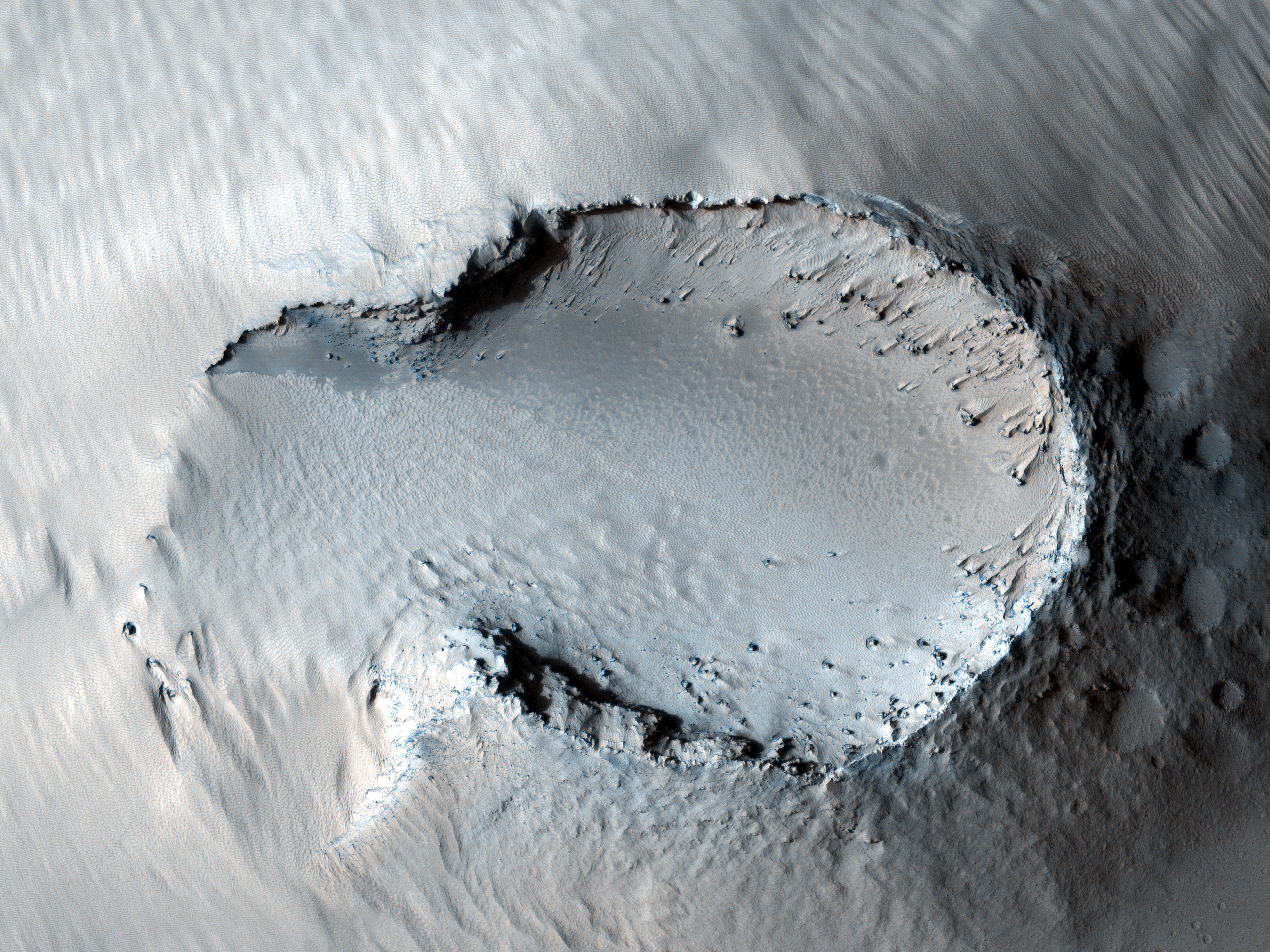
Today's Image of Mars comes from HiRISE and shows a 700 x 1100m cinder cone on the southern flank of Pavonis Mons, a large shield volcano. The cinder cone has some layers of hard rock, but most of it is made up of relatively soft material. Cinder cones are thought to be composed of pieces of lava hitting the ground during a small eruption. 

Generally, eruptions would spew large amounts of lava, which would cool and produce a loose pile of lava rocks. It seems that in this case some pulses of the eruption let the lava land without cooling first. This allowed the lava to meld together and create the hard layers that are visible today. 

I recommend checking this HiRISE photo out in high resolution, which you can access by clicking on the image below. [See the original HiRISE caption for this image]


Mars Photo of the Day - Jan 3 2012

Today's Image of Mars shows a volcanic vent in Elysium Planitia, but what it also shows is two distinctly different types of lava. To the north (top) you can see a darker lava flow. This is actually the edge of one of the youngest lava flows on Mars, which coursed through the Athabasca Valles channel system.

The rest of the image is covered in lighter lava that is much older and worn than the dark lava encroaching from the north. The most prominent feature in this image is the volcanic vent in the center of the image. It was through these pits and troughs that enormous amounts of lava was once expelled. The strange depressions surrounding the vent are likely the result of erosion from lava pooling and draining back into the vent.

Clicking on this image will take you to the original hi-resolution image from HiRISE. I highly recommend exploring it! [See the HiRISE caption for a subimage of the one below]


Mars Photo of the Day - Dec 8 2011

Today's Image of Mars shows fractured mounds on the southern edge of Elysium Planitia. These are just some of the many mounds found in the south of Elysium Plantilla. On average these mounds measure a few kilometers wide and about 60 meters high. By analyzing the fractures that appear on the mounds scientists have been able to determine that the mounds were pushed up from below. 

These mounds are peculiar for Elysium Planitia, which is a generally flat area, owing to large lava flows that have covered most crater and land forms (but not all). Scientists speculate that these mounds are actually solidified lava because they join and share a common texture with the flood lavas that cover all of Elysium Planitia. 

This image was taken by HiRISE in 2008. if it looks strange, that's because it is actually a 3-D image. To see it in 3-D relief you will need to use red-blue glasses. Don't have 3-D glasses? Fortunately Amazon has them for only $0.16 (Plus S&H)! Viewing images of Mars in 3-D allows you to see just how magnificent Mars really is! It is definitely worth the small investment!

Clicking on the image below will take you to a brief article on the image from NASA.


Mars Photo of the Day - Nov 9 2011

Today's Image of Mars is from Kasei Valles, a 1780 km (1100 mi) long set of flood carved channels on Mars. This image focuses on a much narrower channel that was carved into Kasei Valles.

Many channels carved by water on Mars are covered by a more recent layer of lava. In many cases the fissures that released the water, later release the lava that covers the channels, but in the case of Kasei Valles, the lava came from a different location than the water. 

Kasei Valles was carved by floods from Echus Chasma, but the lava came from a source between the Tharsis Volcanoes and only covers the lowlands of the valleys. 

This image links to the original captioned image by HiRISE.


Mars Photo of the Day - Nov 2 2011

Today's Image of Mars is of a lava flow coming from the southwest that has been constricted between two obstacles. These two obstacles could be ridges or hills. 

Scientists can determine the viscosity, thickness, and strength of the lava flow by how it reacts with obstacles. By determining the properties of the lava flow scientists can then determine the composition of the lava.

This image links to the larger image by HiRISE.

Mars Photo of the Day - Sept 15 2011

Today's Mars Photo was recently taken by Mars Reconnaissance Orbiter's HiRISE camera. The image shows an impact crater in  eastern Elysium Planitia, a relatively flat expanse of land. Lava flows have filled in most of the plains, thus removing evidence of most impact craters in the area. This crater is so remarkable because it is surrounded by the youngest ever large lava flow discovered on Mars, the Athabasca Valles flood lava. Scientists can watch this crater as it becomes completely filled, like thousands before it in Elysium Planitia. The lava flow has created the channel seen here, through which more lava travels as it fills the crater.

This photo is almost the same size as the original image, so instead clicking on it will take you to the brief explanation of the photo found on the HiRISE website.