Google+ Mars Travel: Mars Reconnaissance Orbiter
Showing posts with label Mars Reconnaissance Orbiter. Show all posts

Counting Impact Craters on Mars

NASA has recently finished a study in which they determined the approximate number of asteroid and comet impacts on Mars every year. Using data collected by Mars Reconnaisance Orbiter (MRO) scientists have estimated there are 200 small craters formed every year on Mars as a result of asteroid and comet impacts. These craters measure at least 3.9 meters (12.8 feet) across.

MRO was able to image craters previously detected by itself and other Mars orbiters. Images of the same spots on Mars are taken at different times, thus if an older image does not show a crater, but a more recent one does, we know the impact occured before the most recent image, but after the one previous. This technique allows scientists to more accurately determine the age of craters on the surface.

Understanding the frequency of impacts is important to our understanding of Mars' past and allows scientists to more accurately determine the age of features on the planet. A feature or region with less impact craters is much younger than one with more craters because we know that overtime a feature on Mars will accumulate more impacts. The science will never be perfect, but can at least give us a better understanding of Mars and its development.

For example, scientists will be better able to determine the age of Hadley Crater based on the number of small craters within it. Just look at the image below and you will see that even within Hadley Crater there are multiple smaller craters.

Click to see the original high resolution image from Mars Express [See ESA article]

Previous estimates placed the number of yearly impacts on the Martian surface at 3 to 10 times the amount recently calculated. Those previous studies were done in the 1960s and 1970s and based off studies of lunar craters. MRO's HiRISE Principal Investigator Alfred McEwen says that this new study means "Mars now has the best-known current rate of cratering in the solar system," meaning that of all the bodies in the solar system, Mars is the one we are best able to determine the frequency of asteroid and comet impacts on.

Source:
Dwayne Brown, Guy Webster, Daniel Stolte. NASA Probe Counts Space Rock Impacts on Mars. 15 May 2013.NASA http://www.nasa.gov/home/hqnews/2013/may/HQ_13-142_Mars_MRO_Craters.html (accessed 15 May 2013) 

Mars Travel's Mars Photo of the Day - 15 Sept 2012
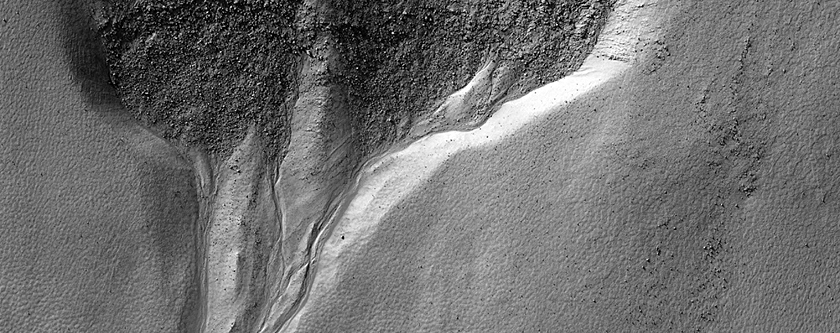
Mars Photo of the Day - Dec 6 2012

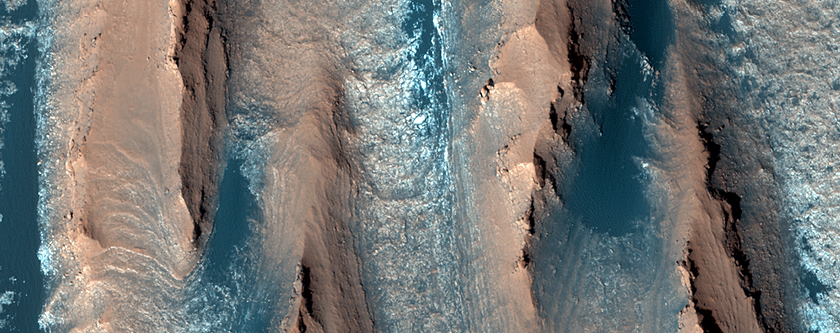
Today's Image of Mars shows defrosting dunes and gullies during late summer in Mars' southern hemisphere. Mars Reconnaissance Orbiter's HiRISE monitors defrosting sites in hopes of learning about the defrosting process on Mars. It might sound mundane, but this knowledge may one day help explorers survive by helping them to follow one of the many gullies on Mars to its source. One of the primary needs of explorers will be water and being able to find it if no satellite coverage is available could mean the difference between life and death.

Clicking on this image will take you to the original captioned image from HiRISE.


Mars Photo of the Day - Nov 27 2011

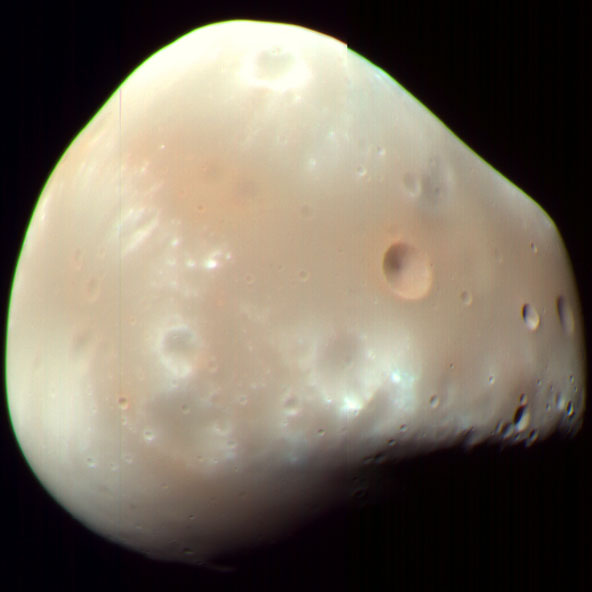
Today's Image of Mars is of Deimos, the smaller and furthest of Mars' two moons. As you can see Deimos is lopsided, but it has an average diameter of only 12.4km. Unlike Earth's moon, if you were looking up into the sky from Mars, Deimos would never appear brighter than Venus does from Earth. Deimos cannot be seen on Mars at latitudes greater than 82.7° because it orbits Mars almost exactly around its equator. 


This image was taken by Mars Reconnaissance Orbiter on Feb 12 2009. Clicking on it will take you to the very detailed Wikipedia page. 

Mars Photo of the Day - Sept 28 2011

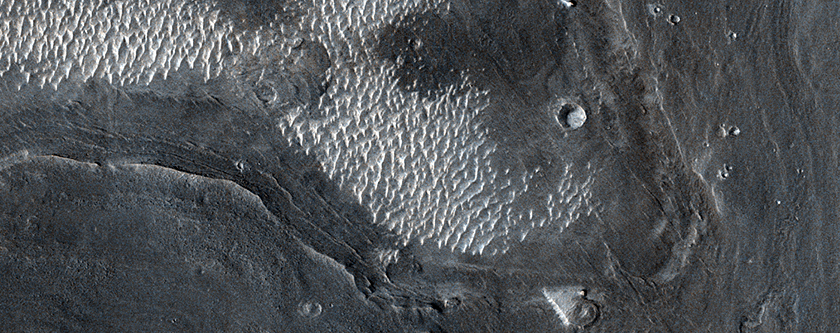
Today's Mars Photo was taken by Mars Reconnaissance Orbiter's HiRISE camera and shows the floor of a large degraded crater. But what are you seeing? The terrain seen is called yardangs which form when erosion is primarily caused by wind. 
Yardangs are identifiable by the multiple sharp ridges that are oriented in a similar way. The darker areas are low areas where dark sand is present in between the ridges. The sharp ridges are shaped by the heavy wind that has eroded them over millions of years.
Clicking the image will take you to the original image with a caption provided by the HiRISE team.

Mars Photo of the Day - Sept 21 2011

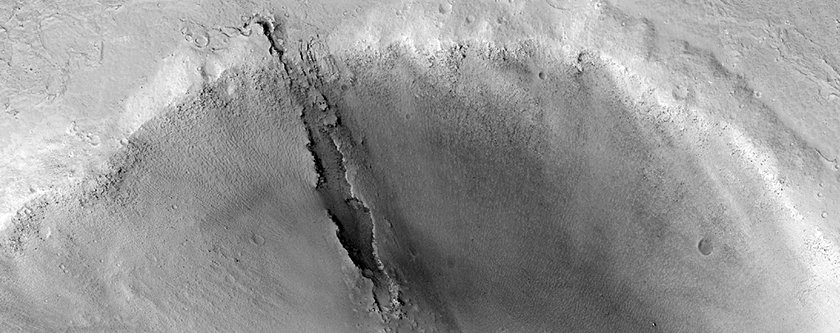
Today's Mars Photo is of gullies in Avire Crater as taken by Mars Reconnaissance Orbiter's HiRISE camera. There is a large amount of controversy as to how the gullies formed, but since the debris seems to be flowing down the crater it likely required carbon dioxide or water in a liquid state. The crater is under regular observation from HiRISE to note any changes.

This image links to a larger version of this image witth a caption provided by HiRISE.

Mars Photo of the Day - Sept 16 2011

Today's Mars Photo is of banded features imaged by the HiRISE camera aboard the Mars Reconnaissance Orbiter. No one is sure what caused the features you see, but they may be expressions of layered rock, shorelines from an ancient lake or ocean, the result of ejecta from an impact, or simply terraces. 

The Martian landscape is just as varied and beautiful as our own. I can't wait until the day humanity steps foot on Mars and can see everything with out own eyes. That will be a remarkable sight for sure. 

The image links to the HiRISE page which discusses this image and its location on Mars. 

Mars Photo of the Day - Sept 15 2011

Today's Mars Photo was recently taken by Mars Reconnaissance Orbiter's HiRISE camera. The image shows an impact crater in  eastern Elysium Planitia, a relatively flat expanse of land. Lava flows have filled in most of the plains, thus removing evidence of most impact craters in the area. This crater is so remarkable because it is surrounded by the youngest ever large lava flow discovered on Mars, the Athabasca Valles flood lava. Scientists can watch this crater as it becomes completely filled, like thousands before it in Elysium Planitia. The lava flow has created the channel seen here, through which more lava travels as it fills the crater.

This photo is almost the same size as the original image, so instead clicking on it will take you to the brief explanation of the photo found on the HiRISE website.

Mars Photo of the Day - Sept 13 2011

Today's Mars Photo is of a crater in Nereidum Montes as taken by the CTX camera on the Mars Reconnaissance Orbiter. The crater has numerous gullies on its southwest walls and rim. There are also two instances of ear-shaped (lobate) material that is associated with gullies within the crater. This features provide additional evidence that water once existed in excess on Mars. It is hoped that a link between the lobate material and interior gullies can be firmly established when HiRISE takes more hi-resolution images of the crater.

Click on the image below to see the original, full page photo from the HiRISE site.

Mars Photo of the Day - Sept 2 2011

Today's Mars Photo shows the path taken by Mars Exploration Rover Opportunity in recent weeks. This photo was taken by Mars Reconnaissance Orbiter's HiRISE camera. I kept the labels added on by NASA because I know how hard it is to remember where everything is when you hear about Opportunity's discoveries. Hopefully you can use this image as a reference.
Clicking on this image will direct you to an article about Mars Exploration Rover Opportunity, its status and new mission. See the larger, original image.

Mars Photo of the Day - Sept 1 2011

Today's Mars Photo is of of a large rock named Trailbraker that is located in the vicinity of Odyssey Crater and the Tisdale rock clan. This rock is larger than any of the rocks in the area, but will not be further investigated since Mars Exploration Rover Opportunity is set to leave the Tisdale site and head north where the Mars Reconnaissance Orbiter has detected clays with a chemical composition never before examined.

This photo is as large as the original image, but you can still click it to see it hosted by NASA.

Mars Photo of the Day - Aug 23 2011

Today's Mars Photo is of the floor of Hellas Basin, as taken by Mars Reconnaissance Orbiter's HiRISE camera on December 26, 2009. These are just some of the many fascinating landforms found on Mars. Click the image to see the original HiRISE Image.


Mars Photo of the Day - Aug 21 2011

Today's Mars Photo was taken by Mars by the Mars Reconnaissance Orbiter's HiRISE camera on Oct 3 2007. The image is of Earth and the Moon, as seen from Mars. This would be very similar to the view a person on Mars would be able to have.
Click the Image to See More Details and Other Images from HiRISE


Mars Photo of the Day - Aug 20 2011

Today's Mars photo is of Santa Maria Crater. If you look closely enough you can see Mars Exploration Rover Opportunity on the crater's Southwest (lower right) rim. You can also clearly see rover tracks to the East left). Opportunity explored the crater from December 2010-March 2011, as it made its way toward Endeavour Crater. If you can't find Mars Rover Opportunity in this photo or want to learn more about this image, click the photo.
Taken by HiRISE on the Mars Reconnaissance Orbiter


Mars Photo of the Day - Aug 18 2011

Today's Mars photo is of a 'skylight,' or an opening to an underground cavern, located in a crater on the Pavonis Mons volcano. The opening is 35 meters (115 feet) in diameter. These types of underground caverns often form in volcanic regions where lava flows solidify near the surface, but continue flowing underneath (the resulting structure is commonly referred to as a lava tube). When the lava ceases flowing the caverns are left empty. In this particular instance the cavern has been determined to be approximately 20 meters (65 feet) deep.

Image taken by the HiRISE camera on the Mars Reconnaissance Orbiter (Click Image for More Details)


Mars Photo of the Day- Aug 5 2011

The following series of images was taken from early spring of one Mars year to mid-summer of the following year. They show features on the slope of Newton Crater that might be evidence of salt water flowing on Mars today. The photos were taken during the warm season on Mars by the Mars Reconnaissance Orbiter. 


Warm
The features lengthen during the warm season and diminish in the cold season.
NASA - Warm-Season Flows on Slope in Newton Crater


Live Blogging NASA's News Briefing on Mars Orbiter Findings


1451 EDT
The news briefing is over.
1450 EDT
We have to assume that if there are organisms on Mars they are highly adapted to radiation and other parts of the extreme environment.

1448 EDT
Newton Crater is 10km in diameter and probably a few hundred million years old. It has steep crater walls and exposed bedrock.
1444 EDT
Mars could have life that is dormant during colder seasons. They would live in the brine when it is liquid, but become dormant when it freezes
1443 EDT
Could be fluids of brine that create a column in the crust and can support life.
1442 EDT
Life with a sulfur based metabolism is possible.
We find life on Earth in many extreme environments. NASA believes such life is possible in the brine on Mars.

1440 EDT
Best evidence we have to-date of liquid water forming on Mars
1439 EDT
This is warmer water that is more hospitable to life than has ever been found on Mars
1439 EDT
How does this stack up with other discoveries on Mars.
1437 EDT
Many questions yet to be asked to confirm or deny.
1436 EDT
It will be a slow process to confirm or deny these findings.
1434 EDT
Gullies on Mars were discovered a bit over 10 years ago. Have been taken for liquid water. Current activity being seen is in winter when it is colder
1433 EDT
This is the first time we have found liquid water on Mars. Liquid water can sustain life better than ice. It is a haven for life
1432 EDT
Ice would be more usable than the brine for producing fuel, drinking, etc.
1430 EDT
Clarification - Brine water is extremely salty water. It can depress the freezing point many degrees. Not located on Earth because this is a watery planet.
1428 EDT
Laboratory experiments on Earth that will give best confirmation or refutation

1427 EDT
Curiosity would not be allowed to go near liquid water on the surface if it was found because it could "contaminate it 'Earth-life'"
1426 EDT
Mars Science Laboratory, Curiosity will have the sensitivity to detect methane being released by possible lifeforms that may live in the brine located in the Martian crust
1425 EDT
Possible there are pockets of brine in the crust.
1424 EDT
Gives us a chance to see an environment on Mars that could provide a hospitable envirnoment for life on Mars
Give opportunity to focus future orbiting equipment.
1423 EDT
Could provide a conduit to a larger, deeper brine pool. Could sustain life.
Briny water could be liquid even when permafrost is very cold because of salt content
1421 EDT
Take what they know about severe environments on Earth and the life they sustain to speculate about possible life on Mars and its ability to survive even on Mars
"Mars is simply too large a planet to keep an eye on every place all the time"
1420 EDT

Christensen - "One of the reasons we are interested in water is the potential for life." - Passes mic off


There is a nice correlation between where salt pockets and where water is. Mid-latitudes are turning out to be very important. Warm enough for liquid water to exist.
1419 EDT
Previously found ice at higher, colder latitudes, but now we are finding water near the equator at mid latitudes
1416 EDT
Christensen says -New observations occur at lower latitudes where it is much warmer and where liquid water could exist.
Phil Christensen is now speaking.
1415 EDT
Scale of gullies can be kilometer scaled
1414 EDT
There are many gullies that have been active. A dark deposit seems to form. Usually active in the winter when it is much cooler.
1413 EDT
Colin Dundras is talking about Martian gullies, which are often called evidence for water on Mars. Look like water carved features on Earth.
1412 EDT
Laboratory experiments will help to determine if this really is water. We have the ability to simulate Martian environment.
1411 EDT
HRISM does not see water, just the evidence of its recent flowing. Belief is that the water evaporates very quickly and so there is no standing water on Mars for long periods of time.
1410 EDT
Salt is lowering the freezing temperature of water so that it can remain in liquid form at temperatures below freezing.
1409
Slopes far too warm for carbon dioxide frost. -23 - +7 Centigrade.
1408 EDT
All of these "behaviors suggest some sort of volatile material to us"
They zoom in on the crater and show that there seems to be liquid water pooling slightly.
1406 EDT
About a thousand flows in Newton Crater. Seven sites and 20 candidates with other flows.
1405 EDT
The feature is in Newton Crater and it shows that there is flowing water on Mars presently. These observations have been taken over the course of 2.5 Martian Sol (Martian years)
1404 EDT
"Have found repeated and predictable evidence of water flowing on Mars"

Mars Reconnaissance Orbiter (MRO) has found many spectacular images in the past few years.
1403 EDT
Water plays a large role in many things, including life. We have found on Earth that if there is water there is life.
1402 EDT
Announcing the presenters as listed in the Press Release About News Briefing
1401 EDT
'Following the water on The Red Planet" - This is about water on Mars, or so it seems
1400 EDT
The news briefing should be beginning any second now!
1357 EDT
Be sure to check the streaming video on NASA TV if you can. I will be writing updates as fast as I can!
1300 EDT
With one hour to go before NASA's big announcement, many people and news agencies are making speculations about the contents of NASA's news briefing.
Many people feel that it will be a big let down, something that will be big in the scientific community, but not as important in the public eye. This kind of letdown happened in December of last year when NASA had a news briefing just like this and announced the discovery of life on Earth that relies on arsenic rather than phosphorous. While many in the public didn't take well to this because they were hoping for something much 'bigger,' it upset many of our understandings of life and the environments it could exist in. This discovery of arsenic reliant lifeforms on Earth has helped reinforce arguments for life on Mars.
The most optimistic speculation is that NASA has discovered evidence of microbial life on the surface of Mars, whereas most people think that NASA will tell us they have found further evidence that there is liquid water on Mars, or beneath its surface.
We can all hope or speculate, but we won't know until 1400 (2PM) EDT.

1053 EDT:
I will be live blogging NASA's  news briefing on findings by the Mars Reconnaissance Orbiter (MRO). It takes place at 1400. For more information about the briefing please see the Press Release About News Briefing. Keep checking back for the latest from the briefing!
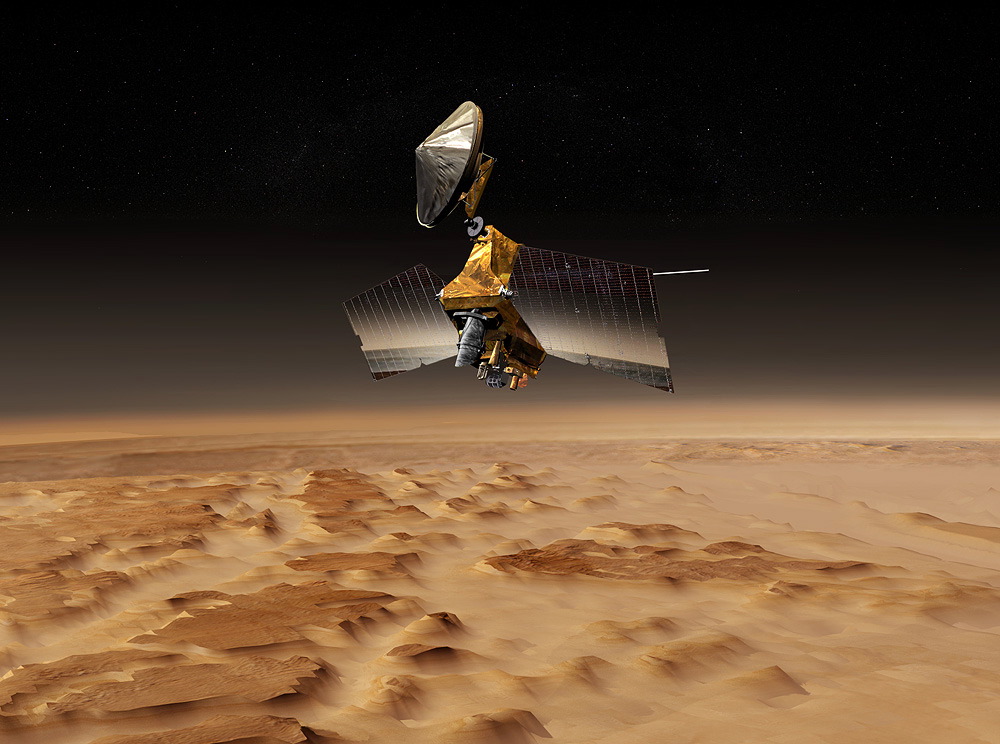
Just in case you don't know what the MRO looks like.
Mars Reconnaissance Orbiter
Source: NASA