Google+ Mars Travel: Elysium Planitia
Showing posts with label Elysium Planitia. Show all posts

Mars Photo of the Day - Apr 5 2012

Today's Image of Mars shows what we call a pareidolia, where you see something that isn't really there. This happens because the mind tries to associate everything it sees with something familiar so that it can understand it better. In this case many people looking at this will see an elephant (or if you didn't you probably do now).

Click on this image to see the original image from HiRISE.
[See the HiRISE caption for the image]

One the most famous pareidolia on Mars is the Face on Mars.

This image is actually a lava flow in Elysium Planitia, the youngest lava-flood province on Mars. Elysium Planitia is almost entirely covered by lava flows, which made the the region almost entirely flat. The lava flows are so young that the surface has not been checkered with numerous impact craters like most of the Martian surface. The lava flows erased all evidence of prior impacts by filling in the craters.
Mars Photo of the Day - Feb 27 2012

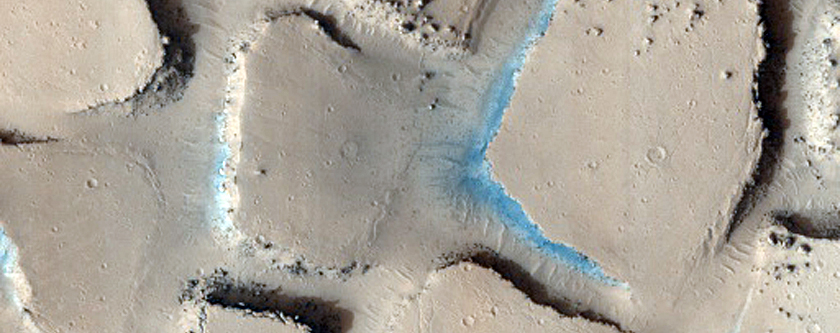
Today's Image of Mars comes from HiRISE and shows part of Cerberus Palus that is broken up and blocky. What you see was likely once a flat surface that broke apart; just under the surface was probably a freezing mudflow. The pieces of that flat surface began flowing apart on top of slushy material. When the slushy material eventually froze it would have expanded and forced its way up between broken, drifting pieces, pushing them even farther apart.

Cerberus Palus is 480km across and located in the Elysium quadrangle of Mars. Clicking on this image will take you to a similar image showcased by Mars Travel, since the original HiRISE image does not currently have a caption.


Mars Photo of the Day - Jan 3 2012

Today's Image of Mars shows a volcanic vent in Elysium Planitia, but what it also shows is two distinctly different types of lava. To the north (top) you can see a darker lava flow. This is actually the edge of one of the youngest lava flows on Mars, which coursed through the Athabasca Valles channel system.

The rest of the image is covered in lighter lava that is much older and worn than the dark lava encroaching from the north. The most prominent feature in this image is the volcanic vent in the center of the image. It was through these pits and troughs that enormous amounts of lava was once expelled. The strange depressions surrounding the vent are likely the result of erosion from lava pooling and draining back into the vent.

Clicking on this image will take you to the original hi-resolution image from HiRISE. I highly recommend exploring it! [See the HiRISE caption for a subimage of the one below]


Mars Photo of the Day - Dec 8 2011

Today's Image of Mars shows fractured mounds on the southern edge of Elysium Planitia. These are just some of the many mounds found in the south of Elysium Plantilla. On average these mounds measure a few kilometers wide and about 60 meters high. By analyzing the fractures that appear on the mounds scientists have been able to determine that the mounds were pushed up from below. 

These mounds are peculiar for Elysium Planitia, which is a generally flat area, owing to large lava flows that have covered most crater and land forms (but not all). Scientists speculate that these mounds are actually solidified lava because they join and share a common texture with the flood lavas that cover all of Elysium Planitia. 

This image was taken by HiRISE in 2008. if it looks strange, that's because it is actually a 3-D image. To see it in 3-D relief you will need to use red-blue glasses. Don't have 3-D glasses? Fortunately Amazon has them for only $0.16 (Plus S&H)! Viewing images of Mars in 3-D allows you to see just how magnificent Mars really is! It is definitely worth the small investment!
Clicking on the image below will take you to a brief article on the image from NASA.


Mars Photo of the Day - Sept 15 2011

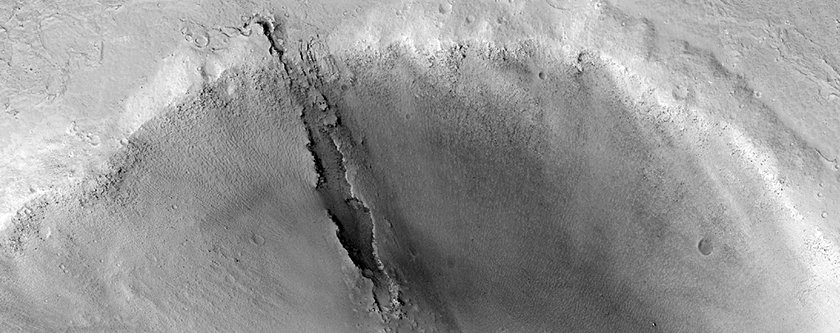
Today's Mars Photo was recently taken by Mars Reconnaissance Orbiter's HiRISE camera. The image shows an impact crater in  eastern Elysium Planitia, a relatively flat expanse of land. Lava flows have filled in most of the plains, thus removing evidence of most impact craters in the area. This crater is so remarkable because it is surrounded by the youngest ever large lava flow discovered on Mars, the Athabasca Valles flood lava. Scientists can watch this crater as it becomes completely filled, like thousands before it in Elysium Planitia. The lava flow has created the channel seen here, through which more lava travels as it fills the crater.

This photo is almost the same size as the original image, so instead clicking on it will take you to the brief explanation of the photo found on the HiRISE website.