Google+ Mars Travel: Fracture on Mars
Showing posts with label Fracture on Mars. Show all posts

Mars Photo of the Day - Dec 8 2011

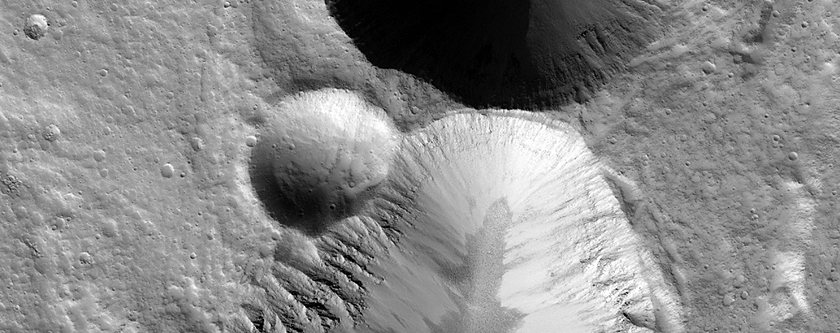
Today's Image of Mars shows fractured mounds on the southern edge of Elysium Planitia. These are just some of the many mounds found in the south of Elysium Plantilla. On average these mounds measure a few kilometers wide and about 60 meters high. By analyzing the fractures that appear on the mounds scientists have been able to determine that the mounds were pushed up from below. 

These mounds are peculiar for Elysium Planitia, which is a generally flat area, owing to large lava flows that have covered most crater and land forms (but not all). Scientists speculate that these mounds are actually solidified lava because they join and share a common texture with the flood lavas that cover all of Elysium Planitia. 

This image was taken by HiRISE in 2008. if it looks strange, that's because it is actually a 3-D image. To see it in 3-D relief you will need to use red-blue glasses. Don't have 3-D glasses? Fortunately Amazon has them for only $0.16 (Plus S&H)! Viewing images of Mars in 3-D allows you to see just how magnificent Mars really is! It is definitely worth the small investment!

Clicking on the image below will take you to a brief article on the image from NASA.


Mars Photo of the Day - Nov 12 2011

Today's Image of Mars is of Nili Fossae in perspective, as taken by Mars Express Orbiter on Feb 8 2008. Nili Fossae is a graben system on Mars. 'Graben' is the term used to identify the lowered terrain in the area between two parallel faults or fractures. The area collapses when tectonic forces pull the area apart. 

Nili Fossae contains many grabens and is located "northeast of the Syrtis Major volcanic province, on the northwestern edge of the giant Isidis impact basin." (ESA) Some of the fractures and faults in the Martian crust extend up to 500 meters deep.

One of the intriguing things about Nili Fossae lies above the surface. Earth-based telescopes have detected that the atmosphere around Nili Fossae contains an increased amount of methane. This leads scientists to believe that methane may be produced in the area, a theory which the ExoMars Trace Gas Orbiter will attempt to verify if/when it launches. The orbiter is currently expected to launch in 2016, but has suffered numerous setbacks, some of which I detailed in the October article, Russia Looks Set to Become Partner in ExoMars Mission.

Clicking on this image will take you to the full page high resolution image taken by Mars Express' High Resolution Stereo Camera (HRSC)
Credits: ESA/DLR/FU Berlin (G. Neukum)

Mars Photo of the Day - Oct 25 2011

Today's Image of Mars shows a chain of pits along the northwestern flank of the volcano, Alba Patera. Those pits form a fracture at the volcano's southern most point. The fracture is part of a larger fracture system that is radial to the volcano and suggests that it is somehow related to the volcano's formation.

The fracture system could have formed when subsurface magma ceased flowing and the overlying ground collapsed. Another possibility is that water-ice could have formed along the fractures and the subsequent sublimation of the ice resulted in a partial collapse.

This image links to the original captioned image by HiRISE.