Google+ Mars Travel: ExoMars Mission
Showing posts with label ExoMars Mission. Show all posts

Mars Photo of the Day - Apr 3 2012

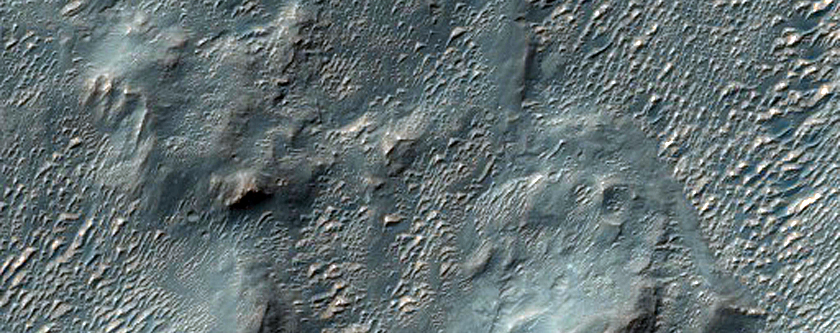
Today's Image of Mars shows a potential landing site in Holden Crater for the 2018 joint ExoMars rover, as taken by HiRISE. Holden Crater is 140km in diameter and numerous clays and sediments that could only have formed in the presence of water.

Holden Crater was one of the top four candidate landing sites for the Mars Science Laboratory, which is landing in August 2012. The crater holds some of the best exposed lake deposits yet discovered on Mars, which makes it a prime landing site for any and all future missions to Mars that hope to determine whether Mars once did, or still does support life.

NASA recently backed out of the ExoMars mission due to budgetary cuts, which forced the Russian Space Agency (Roscosmos) to take a much larger role in the mission. The joint ESA-Roscosmos mission appears to be going ahead on schedule with an orbiter expected to launch in 2016 and the rover expected to launch in 2018, but at this point anything could happen.

It remains to be determined where on Mars the ExoMars rover will be sent, but we can be sure that Holden Crater is among the top candidates! Clicking on this image will take you to all Mars Travel posts related to Holden Crater because the original HiRISE image is not yet captioned.


Mars Photo of the Day - Nov 12 2011

Today's Image of Mars is of Nili Fossae in perspective, as taken by Mars Express Orbiter on Feb 8 2008. Nili Fossae is a graben system on Mars. 'Graben' is the term used to identify the lowered terrain in the area between two parallel faults or fractures. The area collapses when tectonic forces pull the area apart. 

Nili Fossae contains many grabens and is located "northeast of the Syrtis Major volcanic province, on the northwestern edge of the giant Isidis impact basin." (ESA) Some of the fractures and faults in the Martian crust extend up to 500 meters deep.

One of the intriguing things about Nili Fossae lies above the surface. Earth-based telescopes have detected that the atmosphere around Nili Fossae contains an increased amount of methane. This leads scientists to believe that methane may be produced in the area, a theory which the ExoMars Trace Gas Orbiter will attempt to verify if/when it launches. The orbiter is currently expected to launch in 2016, but has suffered numerous setbacks, some of which I detailed in the October article, Russia Looks Set to Become Partner in ExoMars Mission.

Clicking on this image will take you to the full page high resolution image taken by Mars Express' High Resolution Stereo Camera (HRSC)
Credits: ESA/DLR/FU Berlin (G. Neukum)