Google+ Mars Travel: Underground Cavern
Showing posts with label Underground Cavern. Show all posts

McLaughlin Crater - A Once Lively Lake?

McLaughlin Crater on Mars may have once been home to a massive lake! That's according to new spectrometer date from NASA's Mars Reconnaissance Orbiter (MRO).

McLaughlin is a 92 kilometers (57 miles) in diameter and 2.2 kilometers (1.4 miles) deep. The crater's extreme depth tapped into typically unexposed underground channels of water, which then filled the crater.

Click to see larger, annotated, and captioned version from NASA
MRO discovered clays and carbonates, which only form in the presence of water, on the floor of McLaughlin Crater. We know small underground channels fed this massive lake because there is no evidence of any large outflow channels leading into the crater. Additionally, small channels within the crater end at a certain point on the crater wall, which was likely the level of of the lake.

This new discovery of clays and carbonates in McLaughlin Crater has added even more hope that life once, or maybe still does, exist on Mars. The presence of carbonates in particular indicates that the lake likely had low-acid content because carbonates generally do not remain preserved in high-acid environments. Life as we know is most likely to exist in low-acid environments, so having this knowledge makes scientists think this crater and the underground tributary channels may be the ideal place to search for evidence of past and/or present life.


Weekend Feature: Arsia Mons

Arsia Mons measures nearly 16km (12mi) high and over 435km (270mi) wide, with a caldera (opening) measuring 110km (72mi) in diameter It is the southernmost of the Tharsis Trio, which also consists of Pavonis Mons to the north and Ascraeus Mons to the north of that.

While Arsia Mons may be larger than any volcano on Earth, it pales in comparison to the largest volcano yet discovered in the solar system, Olympus Mons, which measures 22km (16mi) high. Coincidentally Olympus Mons is relatively close to the Tharsis Trio (right).

These volcanoes lie in the Tharsis Quadrangle on Mars, which contains an abundance of volcanoes. The region is thought to have been volcanically active as recently as 100-250 million years ago, which is relatively recent in geological terms.Scientists believe that the abundance of volcanoes in this region had an astronomical impact on the climate of Mars because the carbon dioxide and water vapor emitted from them would have been enough to create an atmosphere thicker than that on Earth!

This means that the environment we currently see on Mars may be drastically different than what it used to be! The Tharsis volcanoes would have had a direct impact on that, so determining how long ago they were active will help scientists to determine at which point the Martian climate changed!

Mars Photo of the Day - Feb 11 2012

Today's Images of Mars come from the Mars Odyssey Orbiter and show seven different pits on Mars that scientists believe lead to underground caverns. These pits were found over 700km along the side of Arsia Mons, the second largest mountain on Mars, after Olympus Mons.

Cavern entrances like these ones are called skylights. They have no raised rim or ejecta, which differentiates them from impact craters. Can you see the seventh one?

In recent years scientists have suggested that underground caverns like these are likely to be much more suitable to life than the surface, which many believe is presently hostile to life as we know it.

Caverns like the ones below are likely destinations for future manned and unmanned missions to Mars! Some scientists speculate that colonies could be set up inside of caverns because they act as a natural shield to space radiation and the harsh Martian environment.

There are two skylights located in the image labeled "E", making the total number of skylights imaged below seven.

The entrances imaged below are only some of many potential cavern entrances discovered and imaged on Mars. Clicking the images will take you to other Mars Travel posts about skylights. These images were compiled by National Geographic. [See their original short caption for the images]

Images courtesy NASA/JPL/LPI


Mars Photo of the Day - Feb 4 2012

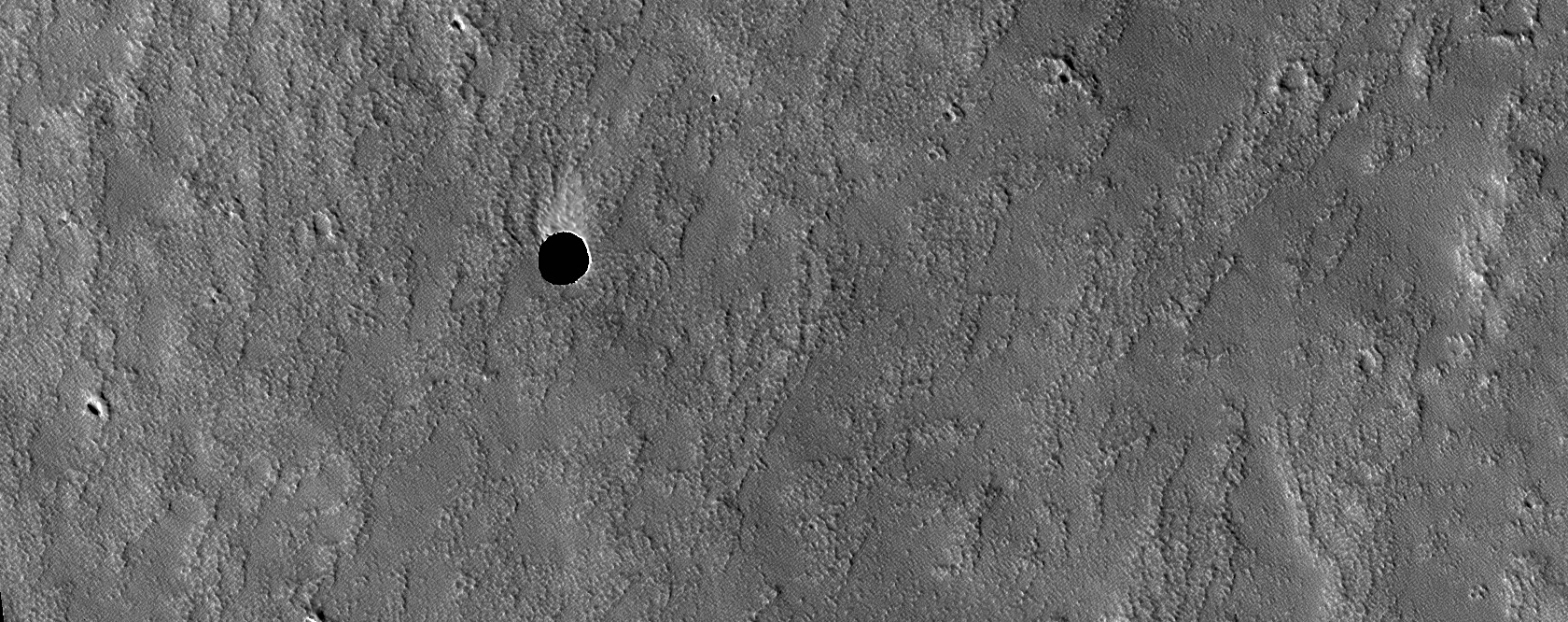
Today's Image of Mars shows what is very likely the entrance to an underground cavern on Mars. The cavern is located Northeast of Arsia Mons and can be seen at the top of this image.

Cavern entrances like this one are called skylights. They have no raised rim or ejecta, which differentiates them from impact craters. This skylight is so special because even the extremely sensitive HiRISE camera cannot detect what lies within the shadow if the skylight. In fact, HiRISE cannot see inside the shadows of this pit at all; it can't even see the walls of the pit.

Scientists speculate that this skylight must have overhanging or completely vertical walls, which brings them to the conclusion that this is a collapse pit into an underground cavern. This pit must be very deep for sunlight not to illuminate the bottom.

In recent years it has been suggested that underground caverns like this one are probably much more suitable to life than the surface, which has been irradiated and is hostile to life as we know it. Caverns like the one below are likely to be prime targets for future manned and unmanned missions to Mars! Some scientists even speculate that colonies could be set up inside of caverns because they act as a natural shield to space radiation and the harsh Martian environment.

Clicking on this image will take you to the original, captioned image from HiRISE.


Mars Photo of the Day - Aug 18 2011

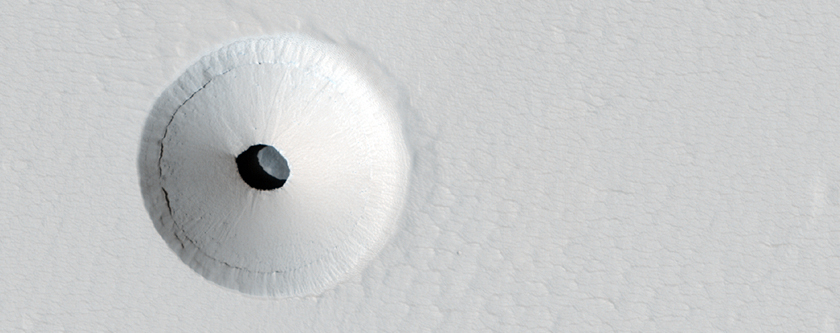
Today's Mars photo is of a 'skylight,' or an opening to an underground cavern, located in a crater on the Pavonis Mons volcano. The opening is 35 meters (115 feet) in diameter. These types of underground caverns often form in volcanic regions where lava flows solidify near the surface, but continue flowing underneath (the resulting structure is commonly referred to as a lava tube). When the lava ceases flowing the caverns are left empty. In this particular instance the cavern has been determined to be approximately 20 meters (65 feet) deep.

Image taken by the HiRISE camera on the Mars Reconnaissance Orbiter (Click Image for More Details)