Google+ Mars Travel: Clays on Mars
Showing posts with label Clays on Mars. Show all posts

McLaughlin Crater - A Once Lively Lake?

McLaughlin Crater on Mars may have once been home to a massive lake! That's according to new spectrometer date from NASA's Mars Reconnaissance Orbiter (MRO).

McLaughlin is a 92 kilometers (57 miles) in diameter and 2.2 kilometers (1.4 miles) deep. The crater's extreme depth tapped into typically unexposed underground channels of water, which then filled the crater.

Click to see larger, annotated, and captioned version from NASA
MRO discovered clays and carbonates, which only form in the presence of water, on the floor of McLaughlin Crater. We know small underground channels fed this massive lake because there is no evidence of any large outflow channels leading into the crater. Additionally, small channels within the crater end at a certain point on the crater wall, which was likely the level of of the lake.

This new discovery of clays and carbonates in McLaughlin Crater has added even more hope that life once, or maybe still does, exist on Mars. The presence of carbonates in particular indicates that the lake likely had low-acid content because carbonates generally do not remain preserved in high-acid environments. Life as we know is most likely to exist in low-acid environments, so having this knowledge makes scientists think this crater and the underground tributary channels may be the ideal place to search for evidence of past and/or present life.


Mars Photo of the Day - 15 Aug 2012

Today's Image of Mars shows Mars Science Laboratory and the surrounding terrain in color, as taken by Mars Reconnaissance Orbiter's HiRISE camera. The blue in this image would look grey to the human eye, but the color was enhanced to make differentiating terrain easier.

Mount Sharp, MSL's ultimate destination is outside of this frame to the southeast, where up is North. To give you an idea of scale, MSL is about 300m from the bottom of the image. As MSL moves south toward Mount Sharp, it will encounter much different terrain, including dune fields. In the days, weeks, and months to come MSL will study this terrain and the material that makes it up, providing us an unprecedented close up look at the clays and sulfates making up the base of Mount Sharp.


What is Mars Science Lab Looking for?

Below is an image pointing out clays and sulfates in the lower portion of Mount Sharp within Gale Crater. Mars Science Laboratory (MSL) Curiosity is set to land in Gale Crater on Monday 6 Aug at 0100ET.  From there MSL will begin examining the surrounding terrain, with special emphasis on the clay minerals and sulfates because those were likely formed during a period when Mars was more hospitable to life as we know it.

Source: Space.com
We know this because clays and sulfates are formed in the presence of water. Orbital studies of Gale Crater have indicated that the water that once filled the crater was less acidic than in other areas previously studied on Mars. Water is more hospitable to life when it is less acidic, so scientists hope that examining the clays and sulfates formed in that water will tell them whether Mars was, or still is a conducive environment to life as we know it. 

A lot of people think that Mars Science Laboratory was sent to Mars to find life, but this isn't the case. It is landing on Mars to determine if the conditions on Mars were or still are favorable to life. That doesn't mean MSL couldn't find life, it just means that it isn't searching for it.

Source: NASA/JPL

So why does Mars Science Laboratory's mission matter? If we find out that Mars was or still is an environment that can sustain life, it will raise our hopes that it did once contain life. The mission will examine the layers in Mount Sharp, giving us a better understanding of the timeframe during which the water on Mars disappeared. If we know when the water on Mars disappeared we can better determine why and perhaps learn how to prevent such a catastrophe from happening to us on Earth!

When we determine how long ago water was abundant on Mars we can start narrowing down our search for life by only examining sediments and other material formed during those time periods since water is generally thought to be necessary for the development of life. So Mars Science Laboratory is key to understanding more about the past on Mars and in the solar system!

Mars Photo of the Day - Jun 8 2012

Today's Image of Mars shows possible clays and sulfates in Gale Crater, which is where Mars Science Laboratory (MSL) Curiosity will be landing on August 6 2012. Clays and sulfates are formed in the presence of water on Earth, and scientists use their abundance on Mars as proof that water once covered much of the Red Planet.

Click to see the original hi-res image
Credit: HiRISE


When MSL lands in Gale Crater it will examine other clays and sulfates within the 150km wide crater, in hopes of determining if Mars was ever capable of sustaining life. The age of the clays and sulfates will give us a better understanding of when water was present on the surface of Mars. Examining the exact composition of those clays will show us the acidity of that water, which is an important factor in determining if life as we know it could have existed on Mars.

If water is too acidic than most life that we've encountered on Earth would not be able to survive. Orbital instruments aboard Mars Reconnaissance Orbiter, Mars Express, Mars Odyssey Orbiter and other past and present orbiters has indicated that Mars contains some clays formed in highly acidic water, but it also contains some formed in more tolerable (neutral) water. Examinations of Gale Crater have led scientists to believe that the water once contained within it was close to neutral, and thus much more hospitable to life as we know it.

But only by further examination of the clays, sulfates, and other materials in Gale Crater will we know for sure! That is why Mars Science Laboratory Curiosity was sent! We have only to wait until August before the discoveries begin!

Weekend Feature: Gale Crater

Looking down on Mars we see Gale Crater as a crater among many craters, but even from this distant perspective Gale Crater is unique, special, and above all, intriguing. In the image below we can spot the 150km in diameter Gale Crater because of its massive central uplift, Mount Sharp, which rises 5.5 km above the northern crater floor and 4.5 km above the southern crater floor. It is Mount Sharp that makes Gale Crater so intriguing and worthy of future study.


Mount Sharp's base is thought to be at least 2 billion years old. It is comprised of clays and sulfates, two materials that are only known to form in the presence of water. The layers directly on top of those are comprised primarily of sulfates, with very few clays, which implies that they were formed in an environment where Mars was becoming drier and water was evaporating. See the next image for an idea of what these intriguing layers look like.

Mars Photo of the Day - Apr 8 2012

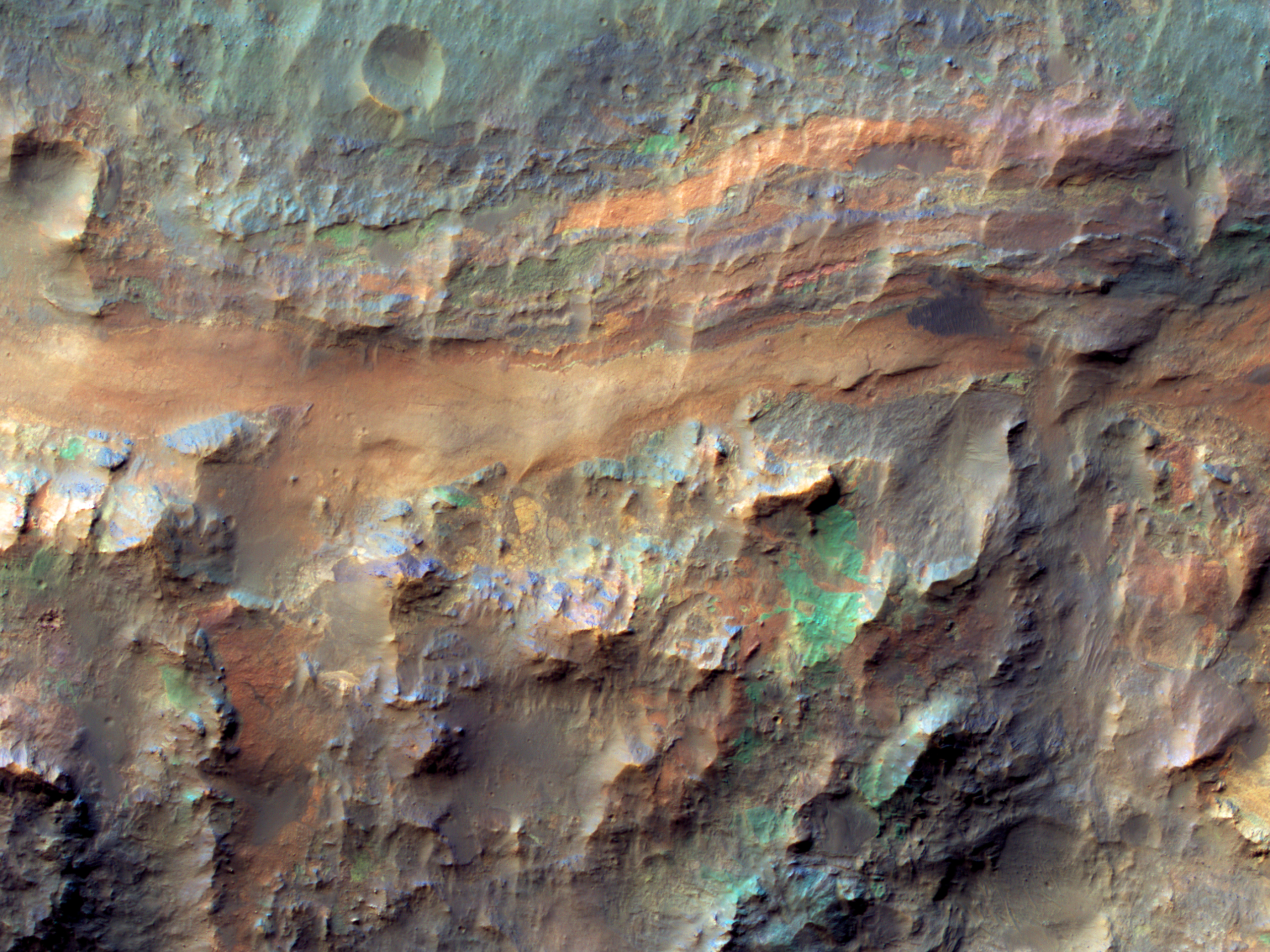
Today's Image of Mars comes from HIRISE and shows distinct sedimentary layers on the floor of Ritchey Crater. These layered deposits help to provide insight about the past climate on Mars and the periods of change The Red Planet went through.

The blues and greens in the image are indicative of dry periods where the minerals were not altered by the presence of water. Examples of minerals that would fall into this category are olivine and pyroxene. The warmer colors, like the oranges and yellows, are minerals like sulfates and clays that were formed in the presence of water. 

Clicking on this image will take you to the original high resolution image from HiRISE. [See their caption for this image]


Mars Photo of the Day - Nov 20 2011

Today's Image of Mars is of the lower portion of the central mound in Gale Crater. The central mound rises 5.5km above the northern crater floor and 4.5km above the southern crater floor and will be a prime target for Mars Science Laboratory Curiosity. The bottom of this image is actually the floor of the crater. 

What's so special about Gale Crater's central mound? 

Well the central mound is larger than any observed by a Mars rover before, which means that it contains more layers of deposits and will be able to tell scientists more about the ancient Martian past than ever before.

As you can see from the labels, the lowest portion of the mound is comprised of clays and sulfates, materials which are formed in the presence of water. The overlying layers contain sulfates, but very little clay, indicative of an environment in which water was evaporating and Mars was becoming drier. 

Mars Science Laboratory Curiosity will examine these layers in an attempt to determine whether Mars was ever able to support life.

Clicking on this image will take you to the original image page from NASA
Image Credit: NASA/JPL-Caltech/University of Arizona/USGS

Mars Photo of the Day - Oct 29 2011

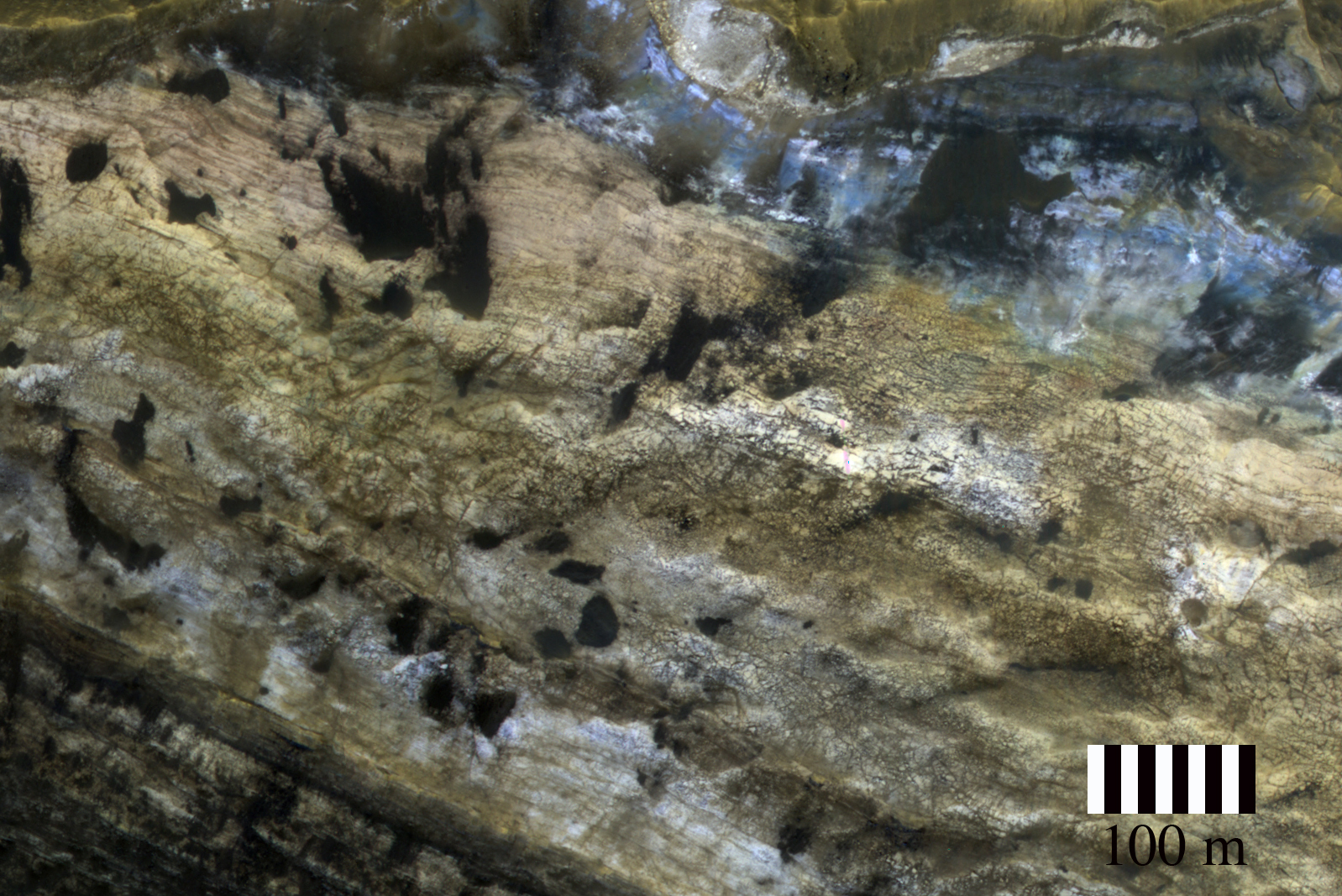
Today's Image of Mars is a close-up view of the layered deposits near Mawrth Vallis, a channel that was most likely carved by water at some point in the past. The varying tones of each layer is likely reflective of differences in mineral content. The dark patches that you see on the layers are sand dunes. 

CRISM has detected clays in the Mawrth Vallis region, so the layers may be rich in clays. Clays are another indication of past water on Mars because they are only known to form by interaction with water. Needless to say, Mawrth Vallis has consistently been a landing site candidate for proposed missions to Mars. 

This image is a subimage of a larger, captioned image by HiRISE, which you can view by clicking on this image. 

Mars Photo of the Day - Sept 19 2011

Today's Mars Photo shows a part of Cape Tribulation as taken by Mars Exploration Rover Opportunity on Sol 2720 (today is Sol 2721). Cape Tribulation contains a large amount of exposed clay mineral much like the low-acidic clays found along the rim of Endeavour Crater. These clays are thought to be indications of an environment that was more suitable to life.

This image is larger than the original, so instead it will link to a full-color photo of Cape Tribulation taken in August 2011.

Mars Photo of the Day - Sept 7 2011

Today's Mars Photo is from Mars Exploration Rover Opportunity as it leaves behind the grouping of Tisdale rocks around Odyssey Crater. This comes after Opportunity spent a few days examining the various ejecta and determined that the rocks were unlike any others examined on Mars. Opportunity is now headed off to Cape York as it continues its search for the clay minerals discovered by the Mars Reconnaissance Orbiter that indicate Mars may have once been habitable to life. 
The photo links to the original.

Mars Photo of the Day - Sept 6 2011

Today's Mars Photo is of Cape Tribulation. The image was taken by Mars Exploration Rover Opportunity as it rolled up to Spirit Point in August 2011. Data from Mars Reconnaissance Orbiter's CRISM camera indicates that there is a large quantity of exposed clay minerals on Cape Tribulation. NASA has stated their current mission with MER Opportunity is to explore Cape York, after which they will attempt to climb Cape Tribulation. This is all assuming the aging Mars Rover remains operable throughout its new mission. 
This image is from The Planetary Society and their monthly update on Opportunity. The image was rendered in color by Stuart Atkinson, author of The Road to Endeavour. To see the full hi-def image simply click on the one below. 

A Rock on Mars Unlike Any Other

Today NASA held a teleconference on the current status of Mars Exploration Rover Opportunity and its new mission. Opportunity has traveled much further, and lasted much longer than anyone could have hoped (see below for its path). Its original mission was to last about three months, but it has lasted more than 30 times longer.
Mars Exploration Rover Opportunity's  path is marked in yellow. The path is marked with numbers which represent the sol when Opportunity was at the labeled location.
Source: NASA
The Mars rover recently reached Endeavour Crater, which Mars Reconnaissance Orbiter's HiRISE and CRISM cameras determined has clay minerals along the rim that are of different from any previously examined by Mars rovers.

In recent days Opportunity has been examining Tisdale-2, a rock unlike any ever encountered by a Mars rover.

Mars Photo of the Day - Sept 1 2011

Today's Mars Photo is of of a large rock named Trailbraker that is located in the vicinity of Odyssey Crater and the Tisdale rock clan. This rock is larger than any of the rocks in the area, but will not be further investigated since Mars Exploration Rover Opportunity is set to leave the Tisdale site and head north where the Mars Reconnaissance Orbiter has detected clays with a chemical composition never before examined.

This photo is as large as the original image, but you can still click it to see it hosted by NASA.

The Importance of Mars Rover Opportunity's New Mission

A few days ago Mars Exploration Rover Opportunity finally reached Odyssey Crater, which lies within the much larger Endeavour Crater. This is a huge milestone for the Mars rover, which has performed longer and traveled further on the Martian surface than anyone would have though possible when it landed in January 2004.

The question now is, what is so significant about Endeavour Crater? Why has Mars Rover Opportunity spent the last three years trying to get there? NASA and other people following the mission are excited, but the average person probably has no idea why. How is Mars Rover Opportunity's new location any different than its previous ones? What is its mission?

Endeavour Crater
Endeavour Crater is the largest crater ever explored by Mars Rover Opportunity and contains older geological deposits than it has ever encountered. This will allow Opportunity to get a better sense of how long there was water on the Martian surface and will even provide insight as to the quantity. That is simple enough; as the Mars rover did that in other craters as well; what is exceptional about Endeavour Crater is found around its rim.

What Makes This Mission Different


Mars Rover Opportunity has examined a large number of rocks and samples of Martian soil since it landed in January of 2004, but it has never encountered rocks like those found around Endeavour Crater. In the past Opportunity has examined clays that show signs of being formed under wet conditions, but when the Mars rover determined their chemical composition it was determined that they were very acidic. What makes Endeavour crater different is the composition of the clays surrounding it.