Google+ Mars Travel: Pavonis Mons
Showing posts with label Pavonis Mons. Show all posts

Mars Photo of the Day - May 15 2012

Today's Image of Mars shows the Tharsis Trio (Arsia, Pavonis, and Ascraeus Mons) and Olympus Mons off to the Northwest. This image is very similar to one previously showcased by Mars Travel from the European Space Agency's Mars Express.

The Tharsis Trio are aligned in almost a perfect line pointing Northeast. Scientists speculate that all these volcanoes formed from a larger fracture/vent system that caused the three initial eruptions that created the Tharsis Trio. In other images you can see the vents pointing Northeast from Arsia Mons toward Pavonis and Ascraeus Mons, which lend credence to this theory. 

As far as I can tell this image was taken by Mars Odyssey Orbiter's THEMIS (please correct me if I'm wrong) Click on this image to see the original high resolution image.


Mars Photo of the Day - May 1 2012

Today's Image of Mars shows how the Tharsis Trio (Arsia, Pavonis, and Ascraeus Mons) pale in comparison to Olympus Mons, the largest known volcano in the solar system. Of the Tharsis trio, Arsia Mons is the oldest and Ascraeus Mons is the youngest.

The Tharsis Quadrangle is full of volcanoes and is thought to have been volcanically active as recently as 100-250 million years ago, which is relatively recent in geological terms. It is thought that at one time the abundance of volcanoes in this region had an enormous impact on the climate of Mars.

Scientists have determined that the amount of carbon dioxide and water vapor released into the air by all the discovered Tharsis volcanoes would have been enough to create an atmosphere thicker than that currently on Earth. If this is the case the environment on Mars could have been completely different than what we see in images today.

Click on this image to see all images of Tharsis volcanoes showcased by Mars Travel. [See the Mars Express article with this image]

Credit: ESA/Mars Express


Mars Photo of the Day - Feb 9 2012

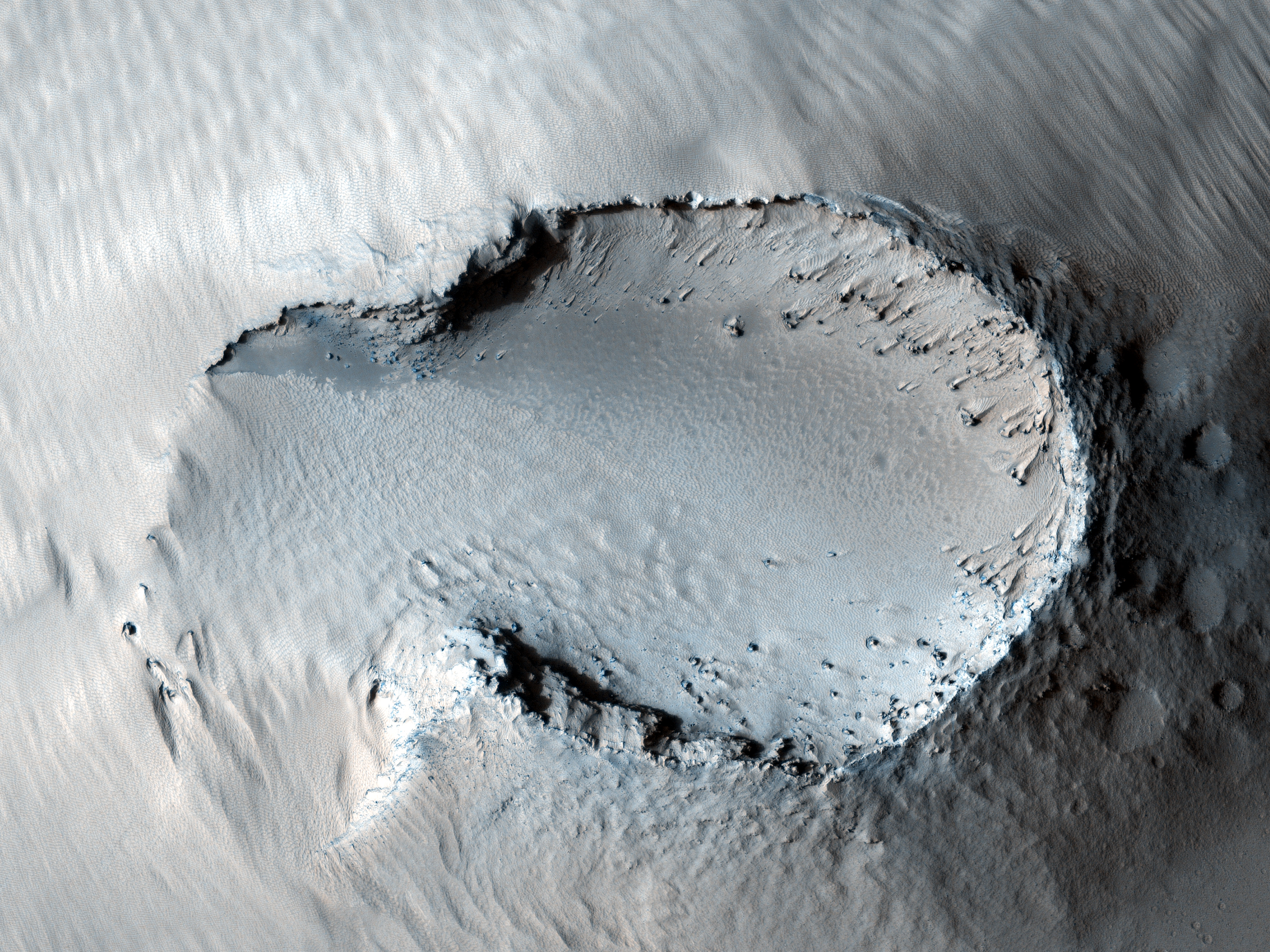
Today's Image of Mars comes from HiRISE and shows a 700 x 1100m cinder cone on the southern flank of Pavonis Mons, a large shield volcano. The cinder cone has some layers of hard rock, but most of it is made up of relatively soft material. Cinder cones are thought to be composed of pieces of lava hitting the ground during a small eruption. 

Generally, eruptions would spew large amounts of lava, which would cool and produce a loose pile of lava rocks. It seems that in this case some pulses of the eruption let the lava land without cooling first. This allowed the lava to meld together and create the hard layers that are visible today. 

I recommend checking this HiRISE photo out in high resolution, which you can access by clicking on the image below. [See the original HiRISE caption for this image]


Mars Photo of the Day - Dec 20 2011

Today's Image of Mars is a closeup of a pit on the Eastern flank of Pavonis Mons, a large volcano located in the Tharsis region of Mars. The pit is 180m at its widest diameter.

Even though the Western half of the pit is shrouded in shadow, HiRISE was able to peer into the shadows and determine what lies within. The boulders visible within the pit range from less than 1m to 5m in diameter. The HiRISE team reports that the boulders are covered in sediments.

Pits like the one below are called skylights and often form when the roof of an inactive lava tube collapses.

Clicking on this image will take you to the original captioned image from HiRISE.


Mars Photo of the Day - Nov 5 2011

Today's Image of Mars is of Arsia Mons, the southernmost of the Tharsis volcanoes. This volcano is larger than any on Earth, measuring nearly 12 miles high and over 270 miles wide. 

The fractures in the top right and bottom left of the image are aligned with Pavonis Mons and Ascreaus Mons to the Northeast. This may represent a large fracture or vent system that was responsible for the eruptions which created the volcanoes.  

This image was taken by the Thermal Emissions Imaging System (THEMIS) aboard Mars Odyssey Orbiter. The image was released to the public on June 13 2005. Click the image to see the original captioned image from THEMIS.


Mars Photo of the Day - Aug 18 2011

Today's Mars photo is of a 'skylight,' or an opening to an underground cavern, located in a crater on the Pavonis Mons volcano. The opening is 35 meters (115 feet) in diameter. These types of underground caverns often form in volcanic regions where lava flows solidify near the surface, but continue flowing underneath (the resulting structure is commonly referred to as a lava tube). When the lava ceases flowing the caverns are left empty. In this particular instance the cavern has been determined to be approximately 20 meters (65 feet) deep.

Image taken by the HiRISE camera on the Mars Reconnaissance Orbiter (Click Image for More Details)