Google+ Mars Travel: Mars discovery
Showing posts with label Mars discovery. Show all posts

MSL Curiosity - One Year on Mars

One year ago today Mars Science Laboratory touched down on Mars. Since August 5th 2012 Curiosity has transmitted over 190 gigabits of data, sending more than 70,000 images back to Earth. Not only that, but Curiosity has driven over one mile and fired its laser 75,000 times at 2,000 different targets.

Click for larger image from NASA/JPL
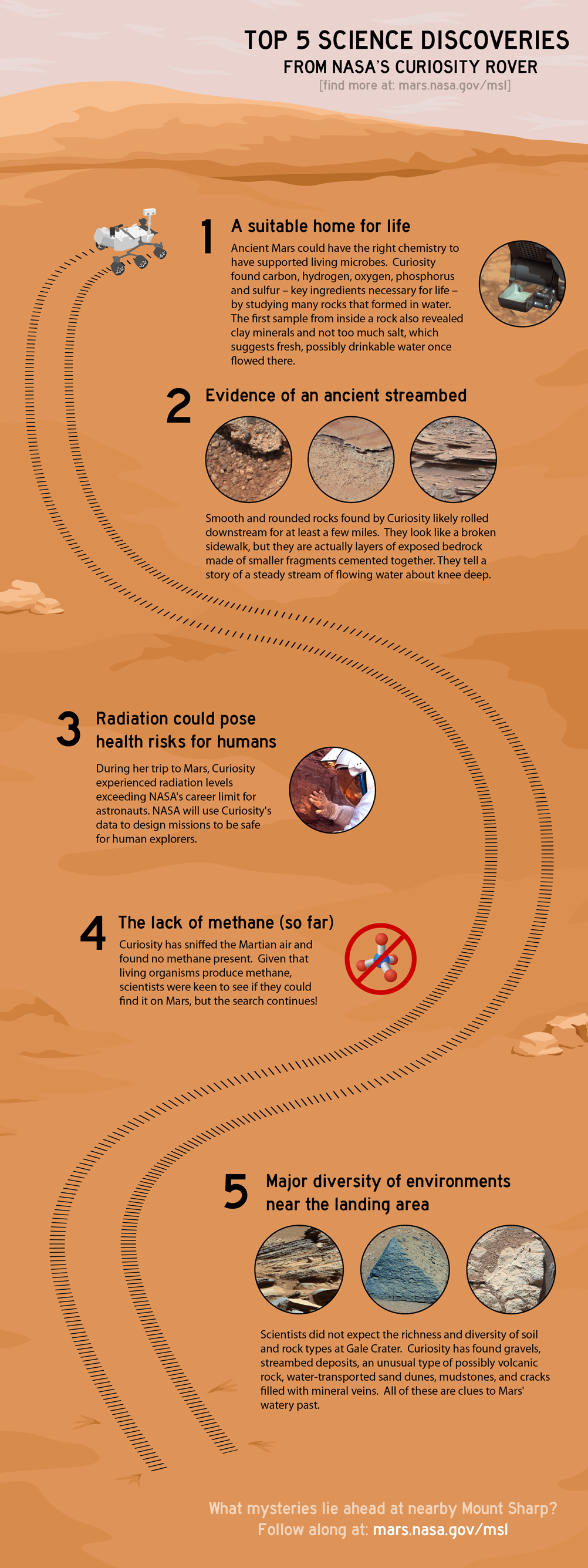
With all that activity, many discoveries have been made, the most important of which have been identified in NASA's infographic on the right. Click the image to see the larger version from NASA.

While MSL's overall mission is to scale Mount Sharp at the center of Gale Crater and study it's various layers, the science team decided to examine nearby outcrops Glenelg and Yellow Knife which is where many of the discoveries to date have been made.

One of the most significant discoveries was that Mars once had an environment that was conducive to microbial life, but that Mars somehow lost most of it's atmosphere "through processes that occurred at the top of the atmosphere" (NASA)

The next NASA mission to Mars, Mars Atmosphere and Volatile Evolution (MAVEN), launches in November of this year and will attempt to determine what caused the atmosphere to bleed into space billions of years ago.

MSL Curiosity has also discovered evidence of an ancient streambed in the form of smooth, rounded sedimentary rocks, that likely rolled with a current for many miles. Bedrock, made up of millions of smaller compacted sediments has been discovered. This type of compaction is only known to occur in the presence of flowing water.

Further evidence that Mars once contained water has been found in the form of "gravels, streambed deposits, an unusual type of possibly volcanic rock, water-transported sand dunes, mudstones, and cracks filled with mineral veins." (NASA)

For a better understanding of MSL Curiosity's  one mile journey, take a look at the below  annotated image from NASA.

Click to see a larger version of this annotated image from NASA
MSL Curiosity's journey began one year ago today, and in that time it has traveled one mile and made numerous discoveries. The next year will see the rover complete its primary goal of  scaling Mount Sharp and provide even more insight into the past and current environment on Mars. Who knows what amazing discoveries will be made in the next year!
Russian Citizen Scientists Have Likely Discovered Mars 3 Lander

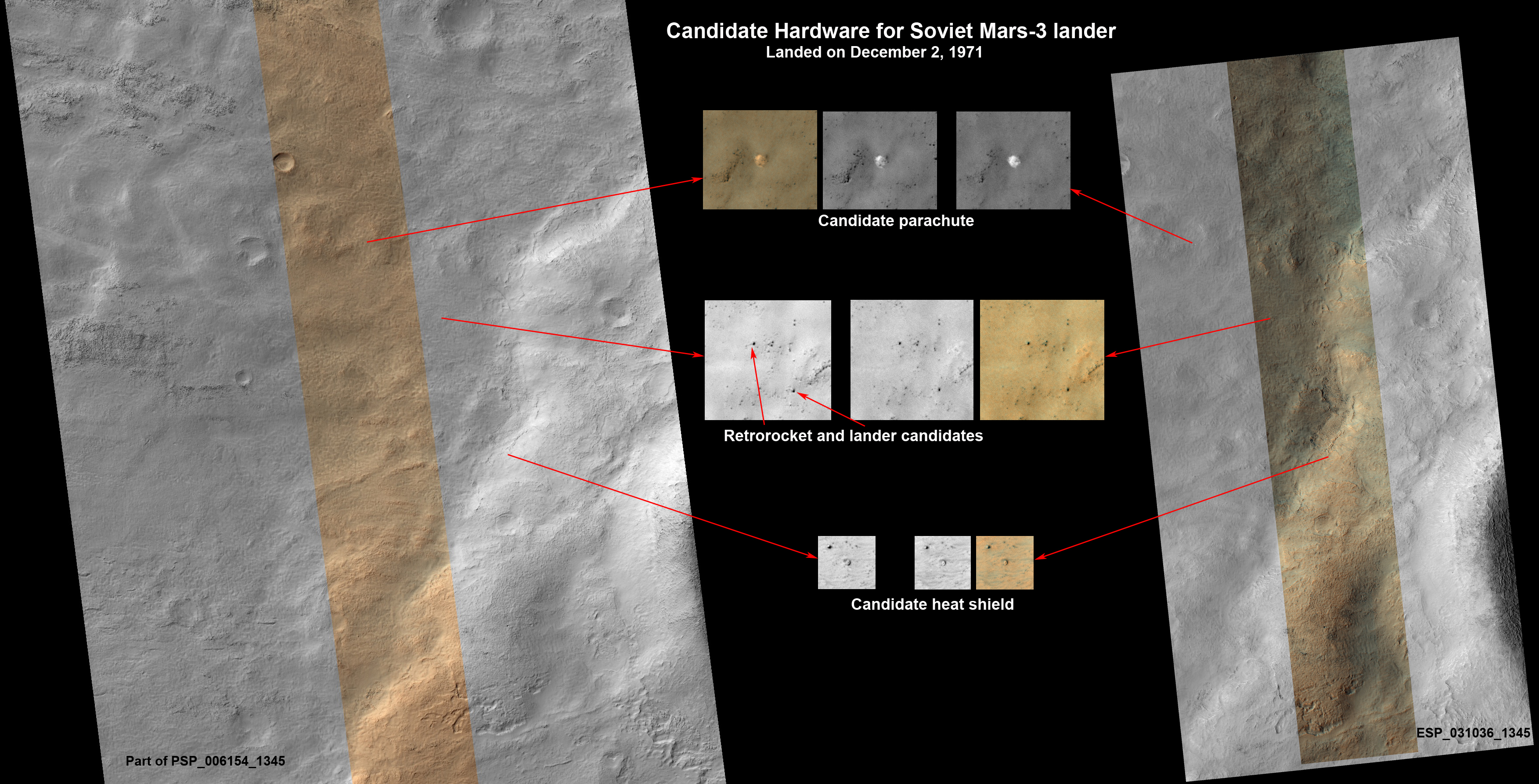
Recently, Russian citizen scientists claimed to have found the remnants of the failed Mars 3 Lander, which landed on Mars on December 2 1971, but had a communication failure after transmitting for only 14.5 seconds. This speculation led the Mars Reconnaissance Orbiter Team to further investigate the proposed sites on March 10 2013. Below you will see an image explaining what they investigated. To see the enlarged version from HiRISE simply click on the image below.


The candidiate descent module/retrorocket can be seen in the image above as well. It had a 4.5 meter chain attaching it to the lander, which is also visible. While the line is 4.8 meters, this difference could be explained if one assumes that it's momentum dragged it slightly across the surface. To best see this feature you will need to view the larger image from HiRISE by clicking on the image above.

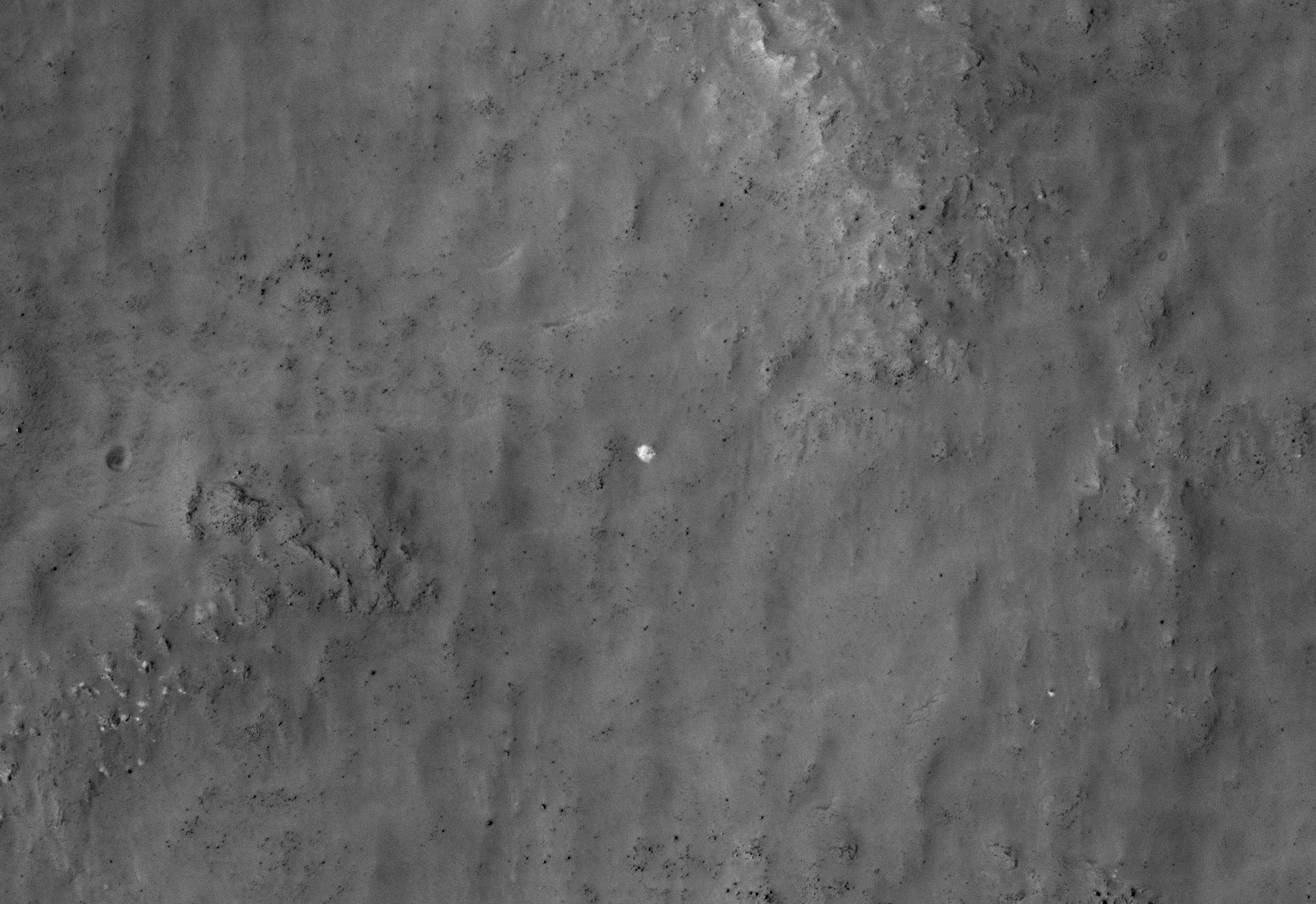
The candidate site for the parachute can be seen below. I'm betting you can guess where it is even in this small version, but if you can't just click on it to see the larger high defintion image from HiRISE.


The parachute is the unusually bright spot right in the center of the image, which measures approximately 7.5 meters in diameter. Mars 3 had a paerachute that measured 11 meters in diameter if fully spread out, so a 7.5 meter diameter is consistent in that the parachute would most likely not be completely unfurled. In previous images of the area the parachute was likely covered in dust because the bright spot seen in the most recent image was not there. It's likely that the wind blew dust off the parachute recently, making its white color stand out against the backdrop of the Martian surface.

In 2007 HiRISE took an image of the the predicted landing site for the Mars-3 lander in Ptolemaeus Crater, but according to their website that image "contains 1.8 billion pixels of data, so about 2,500 typical computer screens would be needed to view the entire image at full resolution. Promising candidates for the hardware from Mars 3 were found only very recently." (HiRISE 2013)

The Russian citizen scientists were members of Russia's largest online community about Mars Science Laboratory Curiosity, started by Vitali Erogov. They crowdsourced the preliminary research that led to finding the candidate site for Mars 3. Vitali Erogov then compiled the below graphic of the candidate Mars 3 hardware pieces.

While all of these images match to what would be expected of the corresponding hardware, there is still some investigation to be done. Further analysis of the data, as well as current and future images, will help scientists to verify these findings and potentially determine what caused the communication failure in the first place. While the latter is a long-shot, you never know! For right now though, it looks like we have finally discovered Mars 3!

If nothing else, this just goes to show you the importance of citizen scientists. There is so much data out there it is impossible for scientists to look at it all, but when ordinary people take their free time to examine the data they can make extraordinary disoveries. I encourage every space enthusiast to join one of these citizen science programs by participating in NASA citizen science programs.

One of the biggest programs, whose participants have made numerous historic discoveries is Planet Hunters, which enlists people like you to help discover new planets. Planet Hunters has had and will continue to have enormous impact not only on the scientific community, but on all of mankind, as one day we must find a planet that we can survive on and colonize it, else we keep the fat eof our entire species tied to that of a single planet or solar system.

So if you have some free time, join Planet Hunters and help humanity live on forever!

What Has MSL Curiosity Discovered?

Click for showcased image/post from Mars Travel
On 20 Nov 2012 MSL Curiosity's chief scientist John Grotzinger made a tantalizing announcement. He told NPR that MSL's Sample Analysis at Mars (SAM) Instrument discovered something extremely interesting, claiming that "the data is gonna be one for the history books. It's looking really good." He went on to say that the discovery was made from a soil sample taken by the SAM Instrument. This was most likely one of the five scoop samples taken from Rocknest (imaged right).

But what could it be? 

Could organics have been discovered? Or evidence of past or present life? Such a finding would shake the foundations of not only the scientific community, but of humanity's perception of themselves in the grand scheme of the universe. In a previous post (excerpted below) I delved into why finding life on Mars would be significant and what it would mean for us here on Earth.

Should we find life on Mars, there are two possible scenarios:

Mars Photo of the Day - Sept 2 2011

Today's Mars Photo shows the path taken by Mars Exploration Rover Opportunity in recent weeks. This photo was taken by Mars Reconnaissance Orbiter's HiRISE camera. I kept the labels added on by NASA because I know how hard it is to remember where everything is when you hear about Opportunity's discoveries. Hopefully you can use this image as a reference.
Clicking on this image will direct you to an article about Mars Exploration Rover Opportunity, its status and new mission. See the larger, original image.

Mars Photo of the Day - Aug 12 2011

Today's Mars photo of this day is Odyssey Crater as taken by Mars Exploration Rover Opportunity. Odyssey crater is a small crater at the edge of the much larger Endeavour Crater. This has been Opportunity's goal for almost 3 years. For more information about this photo and why the location is so significant, just click on the photo itself!


The Significance of Mars Travel and Exploration

We live in a world that continually shows us the worst of humanity; whether it be tyrants killing civilians, riots in London, or childish bickering among legislators in Washington. Every day we are told that something bad, or even horrible has happened, but rarely are we reminded of humanity's strength and magnificence. Rarely are we reminded that we have and continue to accomplish amazing feats every single day. There are so many great, fantastic, and unbelievably selfless things that humanity has done and achieved. Some of these remarkable achievements can be seen in our exploration of Mars.

Mars Exploration Rover Opportunity

Humanity designed a pair of rovers (Mars Exploration Rovers Spirit  and Opportunity) and sent them to Mars. We  have used them to traverse miles of the alien terrain for years. It is remarkable enough that we have set objects on another planet, but the fact that we are using them to send footage of that planet back to Earth is astounding. We can now examine rocks on another planet. That would have been unimaginable less than a century ago. Is this not a remarkable feat?


Mars Reconnaissance Orbiter
We have also sent the Mars Reconnaissance Orbiter to Mars where it has taken thousands of high definition photos of the planet. These photos, along with those from other orbiters, have been put together to allow the average person to explore Mars from the comfort of their living room through revolutionary software like Google Mars. Is this not an amazing accomplishment? Just 10 years ago NASA didn't have the images of Mars that every person has access to on their personal computer today. This in and of itself is an unbelievable accomplishment.

The fact that we now have evidence that salt water is currently flowing on Mars is testament to the remarkable discoveries and accomplishments that humanity is capable of making.

There have been many more accomplishments made by exploring Mars, all of which show the enduring and determined nature of the human spirit. These accomplishments show that humanity can accomplish anything we set our minds to, but more importantly they show that, as a species, we are better than some of our less exemplary individuals.

It is unfortunate that humanity's achievements are not heralded as much as our failings are broadcast, but this disproportionate representation does not mean that our accomplishments are less than our shortcomings. If ever you start despairing about the current state of humanity, take a look at Google Mars or the images from Spirit and Opportunity and remember that the human race is performing countless great feats every single day.

You must not lose faith in humanity. Humanity is an ocean; if a few drops of the ocean are dirty, the ocean does not become dirty. - Mohandas Gandhi

Live Blogging NASA's News Briefing on Mars Orbiter Findings


1451 EDT
The news briefing is over.
1450 EDT
We have to assume that if there are organisms on Mars they are highly adapted to radiation and other parts of the extreme environment.

1448 EDT
Newton Crater is 10km in diameter and probably a few hundred million years old. It has steep crater walls and exposed bedrock.
1444 EDT
Mars could have life that is dormant during colder seasons. They would live in the brine when it is liquid, but become dormant when it freezes
1443 EDT
Could be fluids of brine that create a column in the crust and can support life.
1442 EDT
Life with a sulfur based metabolism is possible.
We find life on Earth in many extreme environments. NASA believes such life is possible in the brine on Mars.

1440 EDT
Best evidence we have to-date of liquid water forming on Mars
1439 EDT
This is warmer water that is more hospitable to life than has ever been found on Mars
1439 EDT
How does this stack up with other discoveries on Mars.
1437 EDT
Many questions yet to be asked to confirm or deny.
1436 EDT
It will be a slow process to confirm or deny these findings.
1434 EDT
Gullies on Mars were discovered a bit over 10 years ago. Have been taken for liquid water. Current activity being seen is in winter when it is colder
1433 EDT
This is the first time we have found liquid water on Mars. Liquid water can sustain life better than ice. It is a haven for life
1432 EDT
Ice would be more usable than the brine for producing fuel, drinking, etc.
1430 EDT
Clarification - Brine water is extremely salty water. It can depress the freezing point many degrees. Not located on Earth because this is a watery planet.
1428 EDT
Laboratory experiments on Earth that will give best confirmation or refutation

1427 EDT
Curiosity would not be allowed to go near liquid water on the surface if it was found because it could "contaminate it 'Earth-life'"
1426 EDT
Mars Science Laboratory, Curiosity will have the sensitivity to detect methane being released by possible lifeforms that may live in the brine located in the Martian crust
1425 EDT
Possible there are pockets of brine in the crust.
1424 EDT
Gives us a chance to see an environment on Mars that could provide a hospitable envirnoment for life on Mars
Give opportunity to focus future orbiting equipment.
1423 EDT
Could provide a conduit to a larger, deeper brine pool. Could sustain life.
Briny water could be liquid even when permafrost is very cold because of salt content
1421 EDT
Take what they know about severe environments on Earth and the life they sustain to speculate about possible life on Mars and its ability to survive even on Mars
"Mars is simply too large a planet to keep an eye on every place all the time"
1420 EDT

Christensen - "One of the reasons we are interested in water is the potential for life." - Passes mic off


There is a nice correlation between where salt pockets and where water is. Mid-latitudes are turning out to be very important. Warm enough for liquid water to exist.
1419 EDT
Previously found ice at higher, colder latitudes, but now we are finding water near the equator at mid latitudes
1416 EDT
Christensen says -New observations occur at lower latitudes where it is much warmer and where liquid water could exist.
Phil Christensen is now speaking.
1415 EDT
Scale of gullies can be kilometer scaled
1414 EDT
There are many gullies that have been active. A dark deposit seems to form. Usually active in the winter when it is much cooler.
1413 EDT
Colin Dundras is talking about Martian gullies, which are often called evidence for water on Mars. Look like water carved features on Earth.
1412 EDT
Laboratory experiments will help to determine if this really is water. We have the ability to simulate Martian environment.
1411 EDT
HRISM does not see water, just the evidence of its recent flowing. Belief is that the water evaporates very quickly and so there is no standing water on Mars for long periods of time.
1410 EDT
Salt is lowering the freezing temperature of water so that it can remain in liquid form at temperatures below freezing.
1409
Slopes far too warm for carbon dioxide frost. -23 - +7 Centigrade.
1408 EDT
All of these "behaviors suggest some sort of volatile material to us"
They zoom in on the crater and show that there seems to be liquid water pooling slightly.
1406 EDT
About a thousand flows in Newton Crater. Seven sites and 20 candidates with other flows.
1405 EDT
The feature is in Newton Crater and it shows that there is flowing water on Mars presently. These observations have been taken over the course of 2.5 Martian Sol (Martian years)
1404 EDT
"Have found repeated and predictable evidence of water flowing on Mars"

Mars Reconnaissance Orbiter (MRO) has found many spectacular images in the past few years.
1403 EDT
Water plays a large role in many things, including life. We have found on Earth that if there is water there is life.
1402 EDT
Announcing the presenters as listed in the Press Release About News Briefing
1401 EDT
'Following the water on The Red Planet" - This is about water on Mars, or so it seems
1400 EDT
The news briefing should be beginning any second now!
1357 EDT
Be sure to check the streaming video on NASA TV if you can. I will be writing updates as fast as I can!
1300 EDT
With one hour to go before NASA's big announcement, many people and news agencies are making speculations about the contents of NASA's news briefing.
Many people feel that it will be a big let down, something that will be big in the scientific community, but not as important in the public eye. This kind of letdown happened in December of last year when NASA had a news briefing just like this and announced the discovery of life on Earth that relies on arsenic rather than phosphorous. While many in the public didn't take well to this because they were hoping for something much 'bigger,' it upset many of our understandings of life and the environments it could exist in. This discovery of arsenic reliant lifeforms on Earth has helped reinforce arguments for life on Mars.
The most optimistic speculation is that NASA has discovered evidence of microbial life on the surface of Mars, whereas most people think that NASA will tell us they have found further evidence that there is liquid water on Mars, or beneath its surface.
We can all hope or speculate, but we won't know until 1400 (2PM) EDT.

1053 EDT:
I will be live blogging NASA's  news briefing on findings by the Mars Reconnaissance Orbiter (MRO). It takes place at 1400. For more information about the briefing please see the Press Release About News Briefing. Keep checking back for the latest from the briefing!
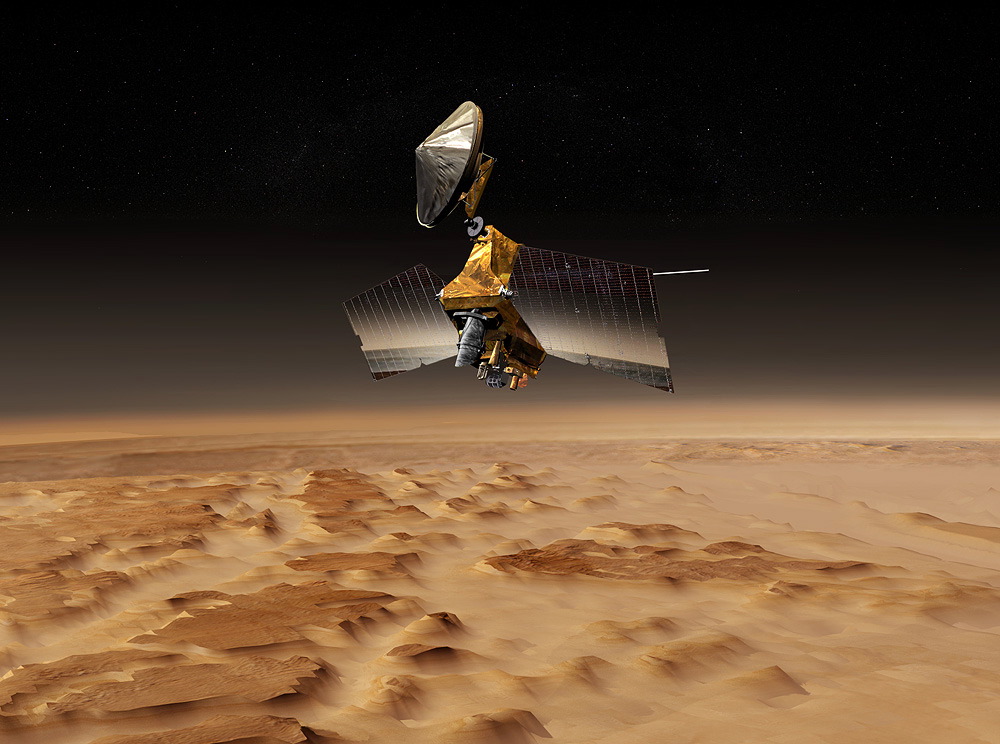
Just in case you don't know what the MRO looks like.
Mars Reconnaissance Orbiter
Source: NASA