1451 EDT
The news briefing is over.
1450 EDT
We have to assume that if there are organisms on Mars they are highly adapted to radiation and other parts of the extreme environment.
1448 EDT
Newton Crater is 10km in diameter and probably a few hundred million years old. It has steep crater walls and exposed bedrock.
1444 EDT
Mars could have life that is dormant during colder seasons. They would live in the brine when it is liquid, but become dormant when it freezes
1443 EDT
Could be fluids of brine that create a column in the crust and can support life.
1442 EDT
Life with a sulfur based metabolism is possible.
We find life on Earth in many extreme environments. NASA believes such life is possible in the brine on Mars.
1440 EDT
Best evidence we have to-date of
liquid water forming on Mars
1439 EDT
This is warmer water that is more hospitable to life than has ever been found on Mars
1439 EDT
How does this stack up with other discoveries on Mars.
1437 EDT
Many questions yet to be asked to confirm or deny.
1436 EDT
It will be a slow process to confirm or deny these findings.
1434 EDT
Gullies on Mars were discovered a bit over 10 years ago. Have been taken for liquid water. Current activity being seen is in winter when it is colder
1433 EDT
This is the first time we have found liquid water on Mars. Liquid water can sustain life better than ice. It is a haven for life
1432 EDT
Ice would be more usable than the brine for producing fuel, drinking, etc.
1430 EDT
Clarification - Brine water is extremely salty water. It can depress the freezing point many degrees. Not located on Earth because this is a watery planet.
1428 EDT
Laboratory experiments on Earth that will give best confirmation or refutation
1427 EDT
Curiosity would not be allowed to go near liquid water on the surface if it was found because it could "contaminate it 'Earth-life'"
1426 EDT
Mars Science Laboratory, Curiosity will have the sensitivity to detect methane being released by possible lifeforms that may live in the brine located in the Martian crust
1425 EDT
Possible there are pockets of brine in the crust.
1424 EDT
Gives us a chance to see an environment on Mars that could provide a hospitable envirnoment for life on Mars
Give opportunity to focus future orbiting equipment.
1423 EDT
Could provide a conduit to a larger, deeper brine pool. Could sustain life.
Briny water could be liquid even when permafrost is very cold because of salt content
1421 EDT
Take what they know about severe environments on Earth and the life they sustain to speculate about possible life on Mars and its ability to survive even on Mars
"Mars is simply too large a planet to keep an eye on every place all the time"
1420 EDT
Christensen - "One of the reasons we are interested in water is the potential for life." - Passes mic off
There is a nice correlation between where salt pockets and where water is. Mid-latitudes are turning out to be very important. Warm enough for liquid water to exist.
1419 EDT
Previously found ice at higher, colder latitudes, but now we are finding water near the equator at mid latitudes
1416 EDT
Christensen says -New observations occur at lower latitudes where it is much warmer and where liquid water could exist.
Phil Christensen is now speaking.
1415 EDT
Scale of gullies can be kilometer scaled
1414 EDT
There are many gullies that have been active. A dark deposit seems to form. Usually active in the winter when it is much cooler.
1413 EDT
Colin Dundras is talking about Martian gullies, which are often called evidence for water on Mars. Look like water carved features on Earth.
1412 EDT
Laboratory experiments will help to determine if this really is water. We have the ability to simulate Martian environment.
1411 EDT
HRISM does not see water, just the evidence of its recent flowing. Belief is that the water evaporates very quickly and so there is no standing water on Mars for long periods of time.
1410 EDT
Salt is lowering the freezing temperature of water so that it can remain in liquid form at temperatures below freezing.
1409
Slopes far too warm for carbon dioxide frost. -23 - +7 Centigrade.
1408 EDT
All of these "behaviors suggest some sort of volatile material to us"
They zoom in on the crater and show that there seems to be liquid water pooling slightly.
1406 EDT
About a thousand flows in Newton Crater. Seven sites and 20 candidates with other flows.
1405 EDT
The feature is in Newton Crater and it shows that there is flowing water on Mars presently. These observations have been taken over the course of 2.5 Martian Sol (Martian years)
1404 EDT
"Have found repeated and predictable evidence of water flowing on Mars"
Mars Reconnaissance Orbiter (MRO) has found many spectacular images in the past few years.
1403 EDT
Water plays a large role in many things, including life. We have found on Earth that if there is water there is life.
1402 EDT
Announcing the presenters as listed in the
Press Release About News Briefing
1401 EDT
'Following the water on The Red Planet" - This is about
water on Mars, or so it seems
1400 EDT
The news briefing should be beginning any second now!
1357 EDT
Be sure to check the streaming video on
NASA TV if you can. I will be writing updates as fast as I can!
1300 EDT
With one hour to go before NASA's big announcement, many people and news agencies are making speculations about the contents of NASA's news briefing.
Many people feel that it will be a big let down, something that will be big in the scientific community, but not as important in the public eye. This kind of letdown happened in December of last year when NASA had a news briefing just like this and announced the discovery of life on Earth that relies on arsenic rather than phosphorous. While many in the public didn't take well to this because they were hoping for something much 'bigger,' it upset many of our understandings of life and the environments it could exist in. This discovery of arsenic reliant lifeforms on Earth has helped reinforce
arguments for life on Mars.
The most optimistic speculation is that NASA has discovered evidence of microbial life on the surface of Mars, whereas most people think that NASA will tell us they have found further evidence that there is liquid
water on Mars, or beneath its surface.
We can all hope or speculate, but we won't know until 1400 (2PM) EDT.
1053 EDT:
I will be live blogging NASA's news briefing on findings by the Mars Reconnaissance Orbiter (MRO). It takes place at 1400. For more information about the briefing please see the
Press Release About News Briefing. Keep checking back for the latest from the briefing!
Just in case you don't know what the MRO looks like.
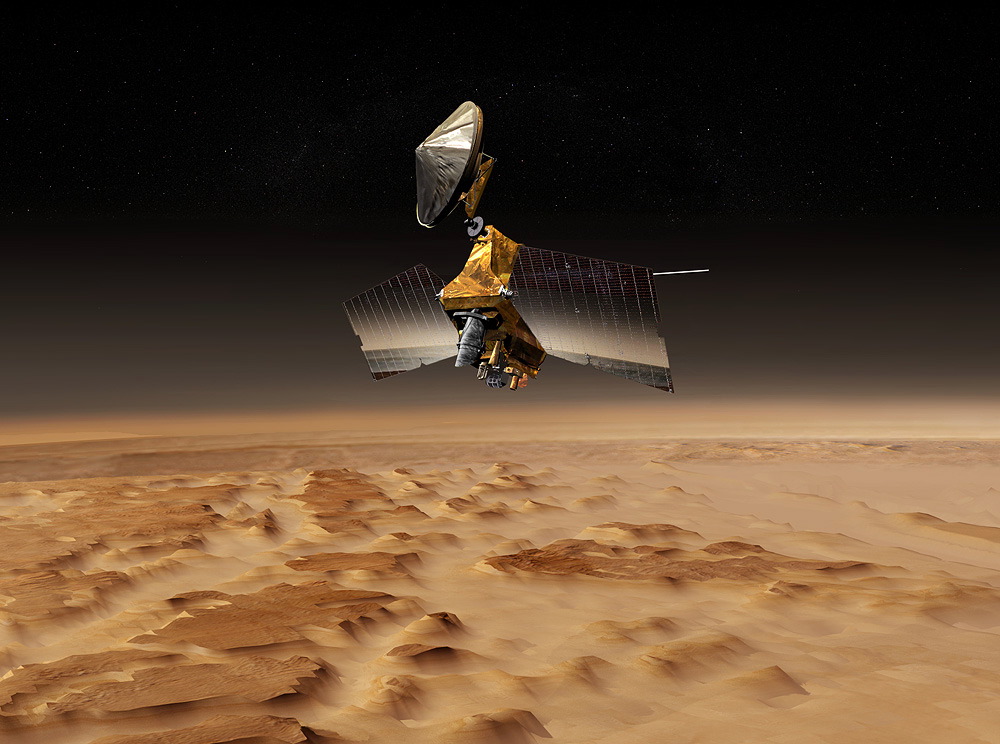 |
Mars Reconnaissance Orbiter
Source: NASA |


