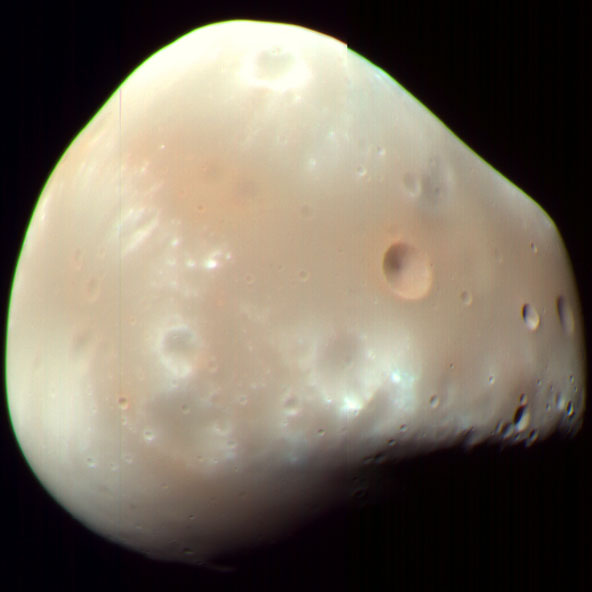
In a new article published in the journal Nature, researchers from Belgium, France and Japan offer a new theory on how Phobos and Deimos came to be. They suggest that there was a a giant impact with Mars that created a debris ring around the planet. This inner part of the debris ring would have hosted the preponderance of material and included at least one moon with a diameter of around 200km. Meanwhile the outer ring held less debris, which through the gravitational influence of the large moon could have eventually clumped together to form Phobos and Deimos.
So then what became of the large, 200km moon? This new theory suggests that it crashed back into Mars, splitting into hundreds of small parts that then disintegrated as they fell through the atmosphere, with some of the larger pieces leaving small impact craters on the surface.
Alas, in 20-40 million more years the same fate will befall Phobos.
Sources: Nature, The Guardian
 |
| New theory suggests that a proto-planet one-third the size of Mars crashed into Mars, creating a debris field around the planet that included a 200km moon in its inner ring. The gravitational pull of that moon helped the formation of Phobos and Deimos in the outer ring of debris. That larger moon eventually crashed back into Mars. Photograph: A. Trinh/Royal Observatory of Belgium |
So then what became of the large, 200km moon? This new theory suggests that it crashed back into Mars, splitting into hundreds of small parts that then disintegrated as they fell through the atmosphere, with some of the larger pieces leaving small impact craters on the surface.
Alas, in 20-40 million more years the same fate will befall Phobos.
Sources: Nature, The Guardian