Google+ Mars Travel: wind on Mars
Showing posts with label wind on Mars. Show all posts

Examining Images of Aureum Chaos for Change

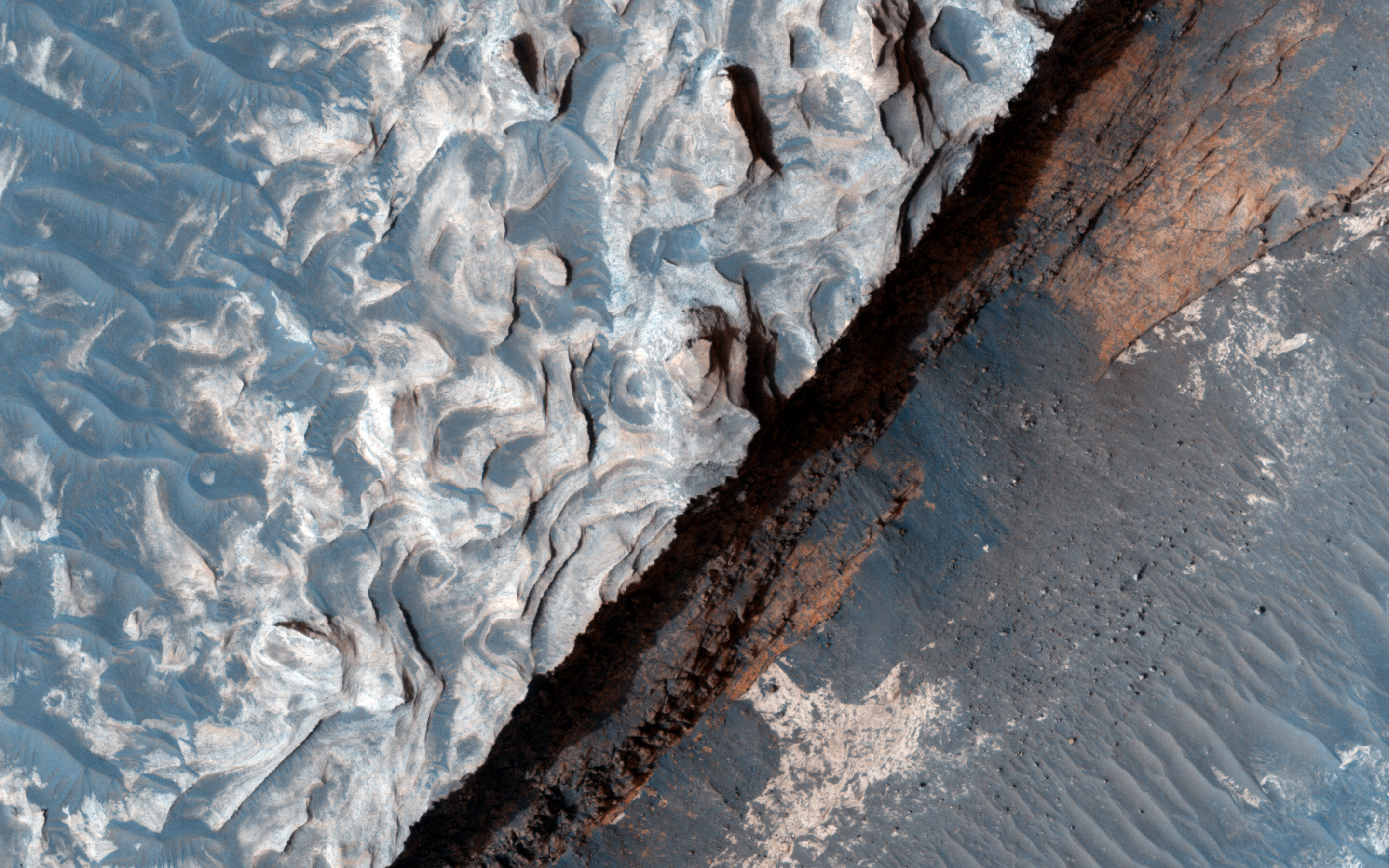
The primary source of erosion on Mars today is the wind. Scientists try to learn more about the wind and the changes it makes to the surface by studying images of Mars. To find these changes we often have to examine two pictures from a location taken at different times. This is true of the below photos taken of Aureum Chaos.

Acquired two Mars years ago. Source: HiRISE

Source: HiRISE

Although the above images are not exact overlays of one another, one can still pinpoint areas present in both images. Once done scientists can determine if there have been any changes or movements to material in the area. Although a preliminary look shows no changes in the past two years, a more fine-tuned examination will likely reveal minor changes.

Studying changes to the terrain allows scientists to assess the real affect of the wind on the environment. Knowing this will help us to know what we might see on the ground and what to watch out for on future prolonged missions to the surface. Imagine if you are living on Mars and you wake up one day to see rocks moved and sand displaced you might be disconcerted, but if you know about the wind you won't worry as much. Understanding how much effect the wind has on the surface also ensures that scientists take frequent images of landing areas because they know what might be a smooth area one week could be rocky terrain the next.

Studying images like the ones above ensures scientists learn the most they can about the wind on Mars and its effects on the environment.
Mars Photo of the Day - Mar 8 2012

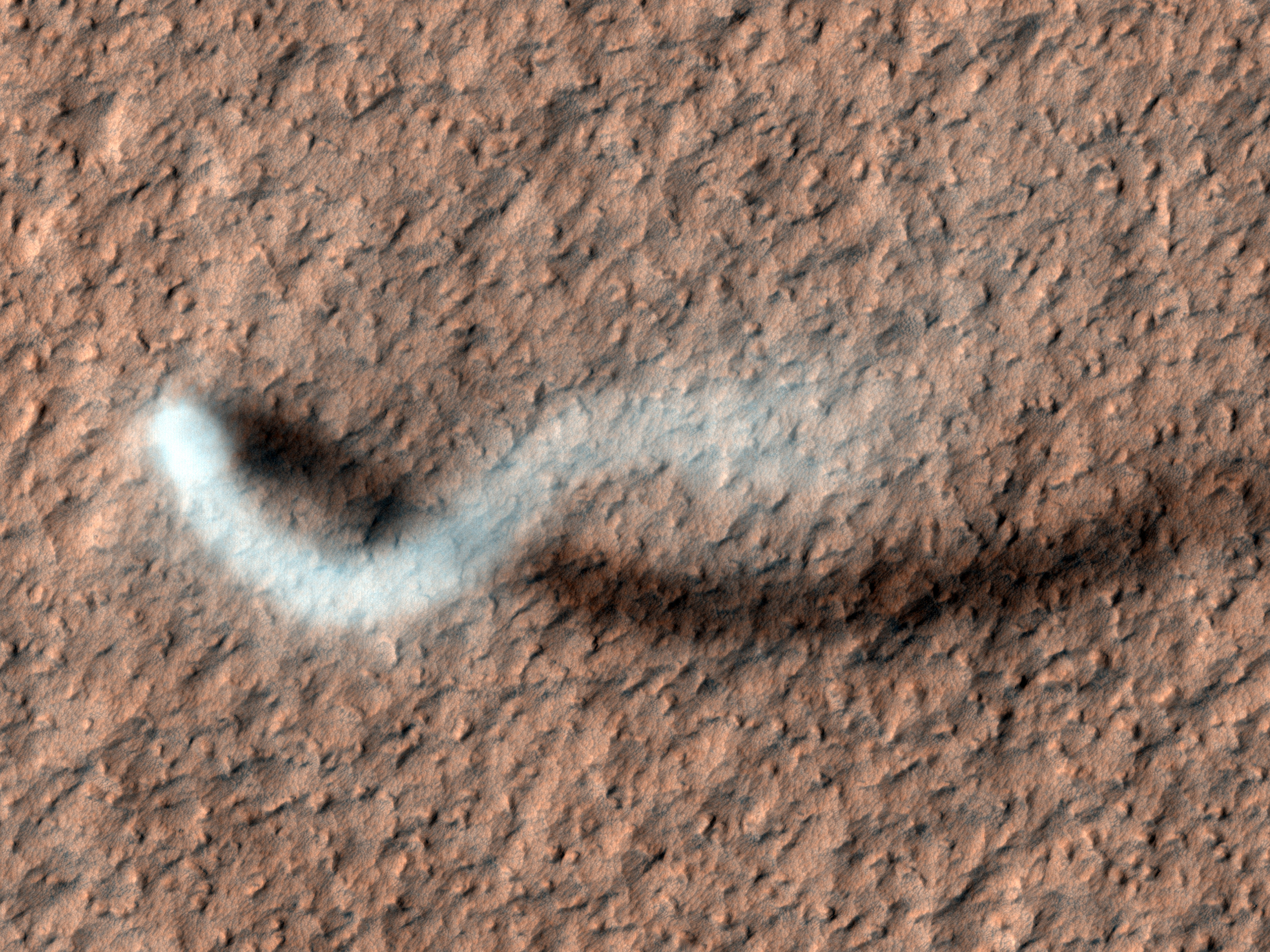
Today's Image of Mars comes from HiRISE and shows the snaking shadow of a huge dust devil in Amazonis Planitia. The length of this shadow indicates that this particular dust devil is approximately 800m (half a mile) in height.

The reason that it is so serpentine is that at about 250m above the surface a westerly breeze pushed the top of the dust devil to the east. This particular dust devil is about 30m in diameter.

What is extraordinary about this dust devil is that it formed during a time of year when Mars is furthest from the Sun. Just as on Earth, the Sun plays a large role in the winds on Mars, but it seems that even when Mars is further away from the Sun, it still has numerous dust devils!

Clicking on this image will take you to the original, captioned image from HiRISE, from where you can view the high resolution images!


Mars Photo of the Day - Nov 28 2011

Today's Image of Mars is a compilation of dust devil images from Mars Exploration Rover Spirit as taken in Gusev Crater. These images were taken on Sol 543 of Spirit's mission, which was on July 12 2005. 

Gusev Crater is approximately 166km in diameter and is thought to have formed between three and four billion years ago. The crater was likely home to a lake in the distant Martian past, as Ma'adim Valles drains into it and the ground is rich with sediments that are up to 3000 feet thick. 

Images of dust devil tracks in Gusev Crater were taken from orbit and investigated by Mars Rover Spirit. There is speculation that Spirit lasted so long on Mars because dust devils helped clean its solar panels. 

Clicking this image will take you to the original, slightly larger version of this from NASA.


Mars Photo of the Day - Nov 25 2011

Today's Image of Mars is of crescent shaped depressions on the surface created by strong winds.  The Earth equivalent are called blowoutsbut occurrences on Mars are much larger than those on Earth. This image is from North Azimuth on Mars, but there are many similar features in other parts of Mars. 

On Mars, wind is the currently the primary cause of erosion. [How strong are the winds on Mars?] There is evidence that water helped shape much of the Martian surface, but over billions of years Mars is now devoid of the massive seas, rivers, and lakes that once played a part in shaping the planet.

This image links to the original image page from Mars Odyssey's THEMIS.


Hurricane Force Winds on Mars

There are some powerful winds on Mars, but just how powerful was only discovered recently. David Choi of NASA's Goddard Space Flight Center used images of dust devils taken by Mars Reconnaissance Orbiter's HiRISE camera to determine the speed of the swirling dust devils. 


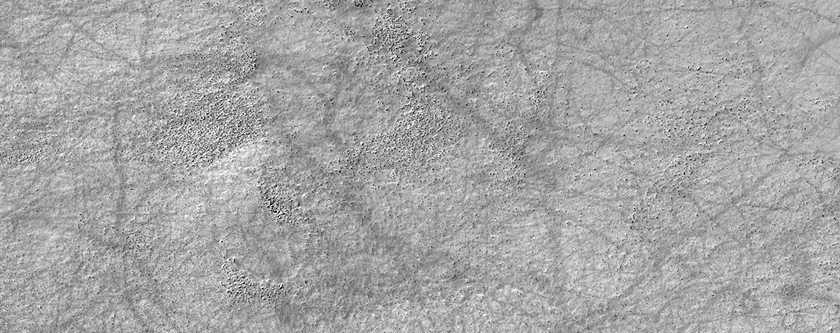
Tracks Left by Dust Devils on Mars
Source: HiRISE
But just how did he do this?

Choi looked at different HiRISE images of the same dust devil and determined how far four distinct cloud features had moved from one photo to the next. Because he knew the time elapsed between each image he was able to calculate how fast the swirling dust devil was moving. 

So just how fast was the wind blowing on Mars?

Really fast. In some cases the wind speeds were 45 m/s (162 km/hr), well above 33 m/s (118.8 km/hr) which constitutes hurricane force winds on Earth. The typical wind speed was from 20-30 m/s (72-108 km/hr). 

The dust devils observed were anywhere from 30-250 meters in diameters and rose from 150-700 meters into the sky.

These findings were presented in Nantes, France on October 3 2011 to the European Planetary Science Congress and the American Astronomical Society’s Division for Planetary Sciences.

Mars Photo of the Day - Sept 28 2011

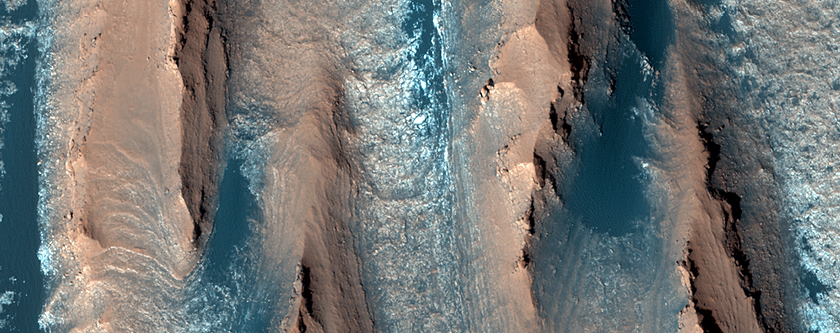
Today's Mars Photo was taken by Mars Reconnaissance Orbiter's HiRISE camera and shows the floor of a large degraded crater. But what are you seeing? The terrain seen is called yardangs which form when erosion is primarily caused by wind. 
Yardangs are identifiable by the multiple sharp ridges that are oriented in a similar way. The darker areas are low areas where dark sand is present in between the ridges. The sharp ridges are shaped by the heavy wind that has eroded them over millions of years.
Clicking the image will take you to the original image with a caption provided by the HiRISE team.