Google+ Mars Travel

Mars Photo of the Day - Feb 29 2012

Today's Image of Mars shows clouds in The Red Planet's North Polar Region obscuring the view of Mars Odyssey's THEMIS. Some of the lower portion of this image is entirely shrouded by clouds, so much so that THEMIS can't even make out the surface.

Clouds on Mars are generally 10-15km above the surface and primarily made up ofsublimated carbon dioxide ice. Occasionally the clouds will be made up of tiny water particles. That doesn't mean it rains on Mars though! 

Mars is so cold that it couldn't rain, but scientists speculate that it does snow! Scientists have only seen snow fall in the upper atmosphere a few times and have no evidence that it ever reaches the surface, but who knows! Maybe it only happens every so often, like a leap year every four years! (See how I worked that in there? Don't worry, you can hold your applause!)

Clicking on this image will take you to the high resolution image from THEMIS. [See Universe Today's caption for a subimage of this one]

Mars Photo of the Day - Feb 28 2012

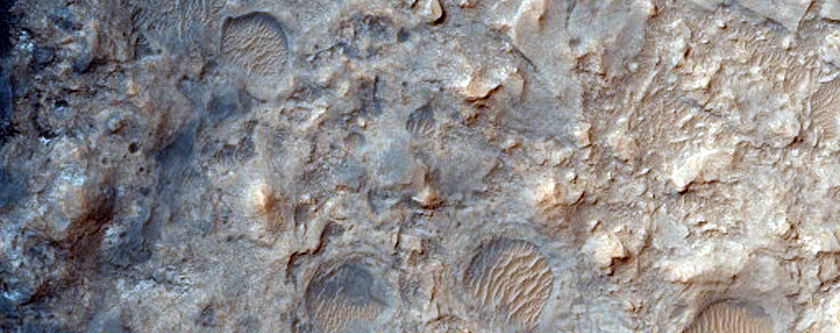
Today's Image of Mars shows a possible Mars Science Laboratory (MSL) landing site in Gale Crater, as imaged by HiRISE. Even though the rover launched in November 2011, the MSL team still isn't positive where within Gale Crater it will land. Even if they plan for a specific spot they can't guarantee the exact landing location.

You can see that this location has many interesting features, including Dunes, sub-craters, and evidence of past water on Mars.

MSL Curiosity is set to land in Gale Crater sometime between August 6 and August 20th 2012. To learn more about the mission of NASA's most advanced Mars rover and the reason Gale Crater was chosen as the destination, just click on the image below.


Mars Photo of the Day - Feb 27 2012

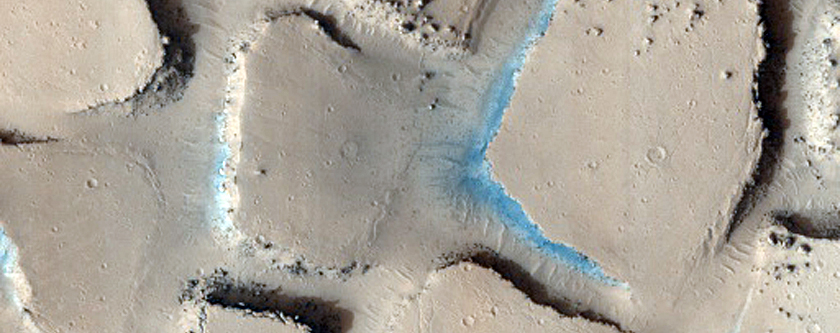
Today's Image of Mars comes from HiRISE and shows part of Cerberus Palus that is broken up and blocky. What you see was likely once a flat surface that broke apart; just under the surface was probably a freezing mudflow. The pieces of that flat surface began flowing apart on top of slushy material. When the slushy material eventually froze it would have expanded and forced its way up between broken, drifting pieces, pushing them even farther apart.

Cerberus Palus is 480km across and located in the Elysium quadrangle of Mars. Clicking on this image will take you to a similar image showcased by Mars Travel, since the original HiRISE image does not currently have a caption.