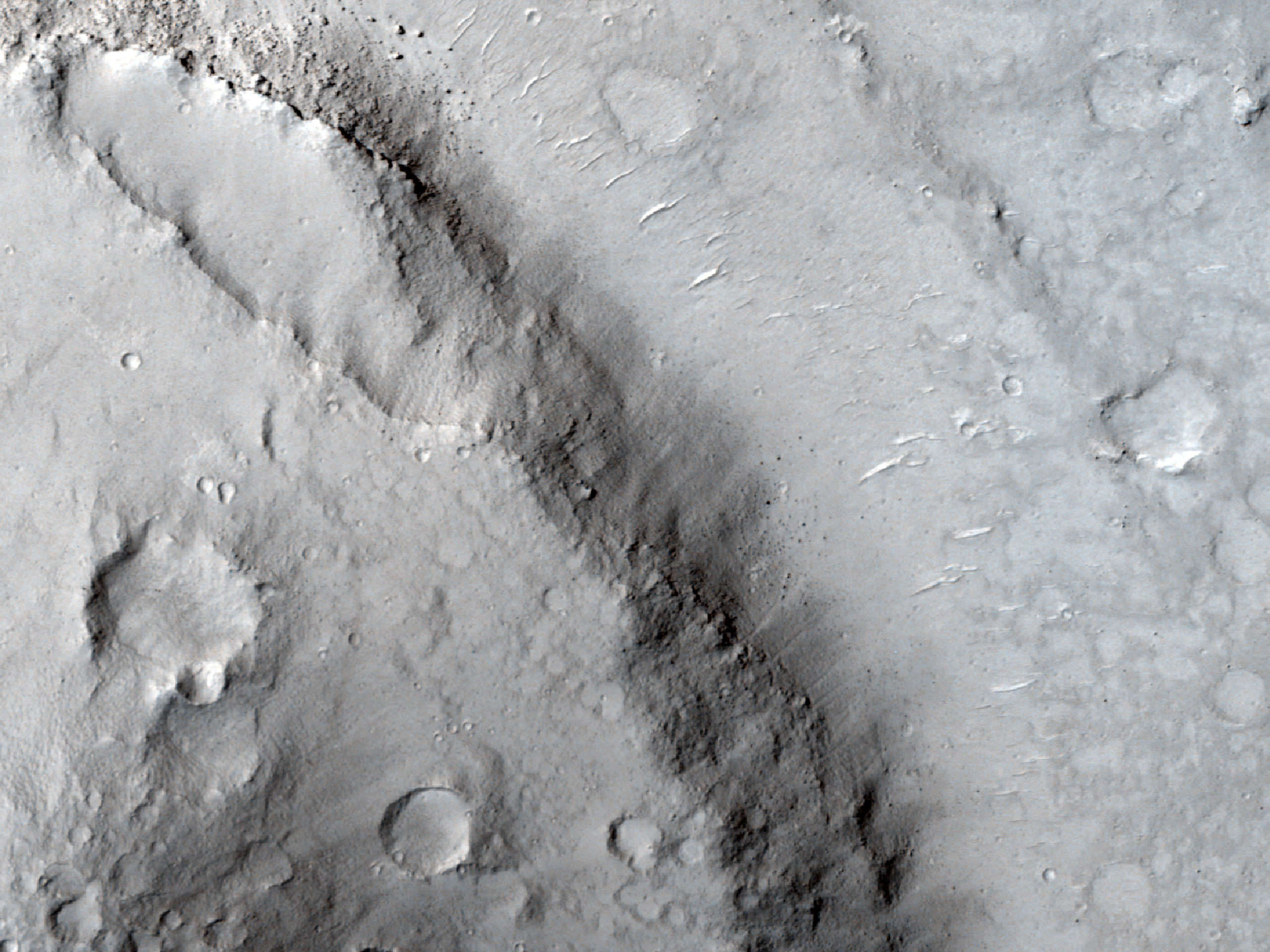
Today's Image of Mars shows streamlined features in Cerberus Fossae, as taken by HiRISE. These are indicative that water once flowed across the surface of Mars and eroded islands into what we see below, most particularly at the upper left of the image. Just imagine a huge wall of water washing over an island. Now imagine this happening constantly. It's going to flatten that island out, smashing it in the direction of the water flow. That's what happened in the image below.
These features also exist on Mercury and the Moon, where they were formed by lava, but scientists believe the case is different on Mars. They believe that on Mars these streamlined features were created by flowing water, which then evaporated or went underground. These streamlined features occur in areas where scientists believe large channels of water existed. In almost all instances the features have a layer of lava overlying them, which lends credence to the theory that the features were eroded by water, and covered by subsequent lava flows.
Observations like the one below will help scientists to prove their hypothesis that lava covered the features eroded by water. Click on the image to see the original high resolution image from HiRISE. [See their original caption]