Google+ Mars Travel: Carbon Dioxide Frost on Mars
Showing posts with label Carbon Dioxide Frost on Mars. Show all posts

Frost in Argyre Basin on Mars

Just like on Earth, a frost can develop on Mars. What you see below is a swath of land within the 1800km wide, 5km deep Argyre Basin, which was created from an enormous impact in the early part of Mars' history. The prominent crater partially captured in this image from Mars Express' High Resolution Stereo Camera is the 138km wide Hooke Crater.

Click to see original high resolution image from Mars Express. [See their article]
The frost you see in this image is actually carbon dioxide ice, which scientists believe only forms at ground level when it freezes out of the atmosphere. The reason why only the frost is only abundant in the southern (left) lowlands of this image is because of the angle of the sun at the time this image was taken. This image was taken at 1630 local time on Mars, when the Sun was at a 20 degrees above the horizon. It only had enough time to melt the frost off the north facing crater walls, but wasn't yet able to melt any in the low lying area to the south.

Understanding when and for how long frost can cover the surface of Mars will save future explorers from facing potential surprises! Imagine waking up in your space capsule only to look out the window and see the ground covered in ice!

Mars Photo of the Day - May 9 2012

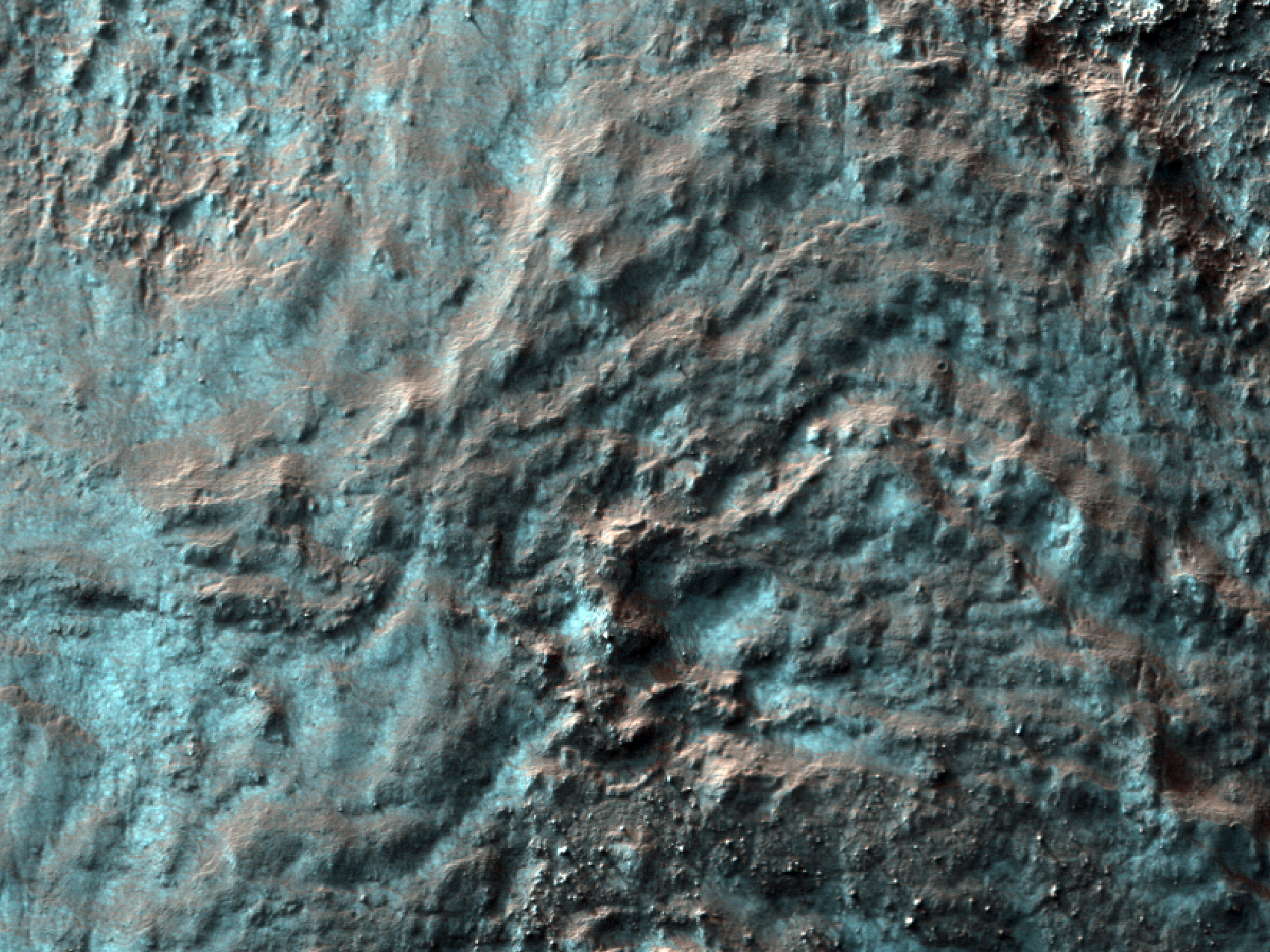
Today's Image of Mars shows frosted ground in the Southern Hemisphere of Mars during late fall, as imaged by HiRISE. The frost in this image is primarily carbon dioxide frost that began to accumulate as average temperatures dropped. Most of the frost is carbon dioxide frost because the Martian atmosphere is primarily carbon dioxide, which condenses onto the surface, not like the nitrogen that makes up most of the Earth's atmosphere and remains vapor at all Earthly temperatures. 

In this image the frost is blueish and primarily on south-facing slopes. The slopes facing north receive more sunlight so they contain less frost and appear red. During the winter months the frost will accumulate more heavily as the Sun becomes dimmer and less heat reaches Mars. Come spring the frost will sublimate until the next fall, and thus is the cycle on much of Mars. 

Clicking on this image will take you to the original high resolution image from HiRISE. [See the HiRISE caption for this image]


Mars Photo of the Day - Apr 22 2012

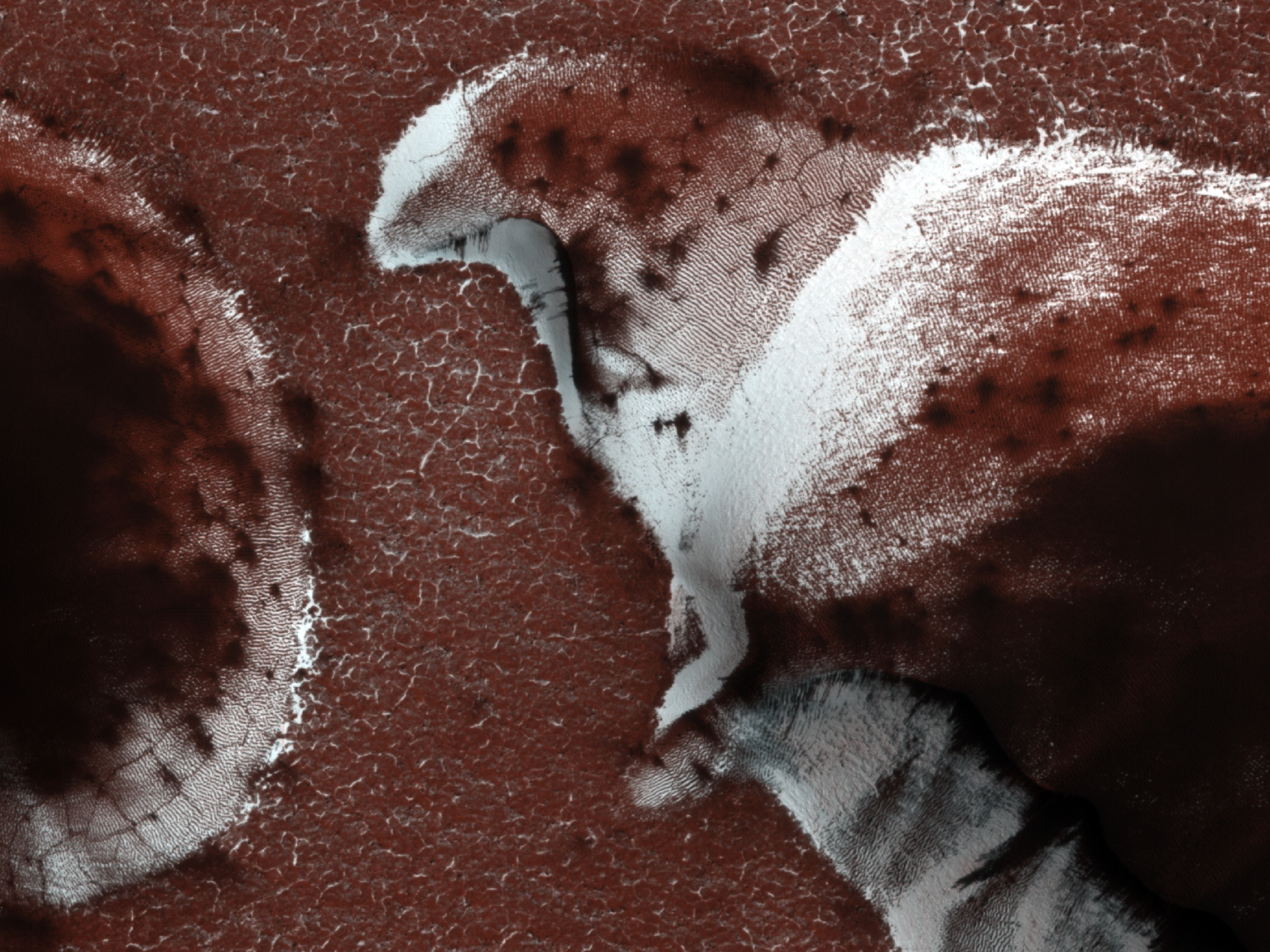
Today's Image of Mars comes from HiRISE shows defrosting dunes in the north polar region during late spring. The ice that you see is primarily carbon dioxide ice, which builds up over the winter months. During the spring the carbon dioxide ice begins to sublimate, turning directly from a solid into gas.

By the time this image was taken most of the ice had sublimated. As summer approaches more and more of the ice will sublimate, leaving only small patches, if that, but then when winter comes around the ice will begin to accumulate again! Thus is the never ending cycle in the north polar regions of Mars. 

Because there is such consistency on Mars scientists study the differences in the dunes each year to determine what processes, if any are still active on Mars. Click on this image to be taken to the original high resolution image. [See the HiRISE caption for this image]


Mars Photo of the Day - Sept 20 2011

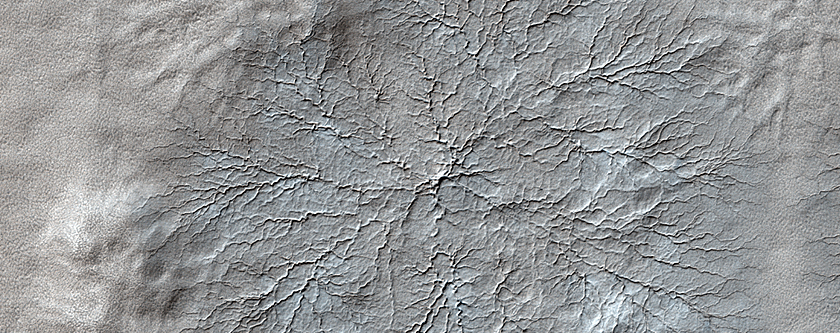
Today's Mars Photo is of a feature called starburst spiders, which develop when carbon dioxide frost accumulates at high latitudes (near the pole) during the winter. In the spring the carbon dioxide frost begins to sublimate, and the gas that rises from the bottom of the frost moves the dust and can even create channels like those seen below.

These channels are called starburst because they seem to emanate from a center point and explode outward. They form what look like many legged spiders, thus the name starburst spider. 

This image will link to the captioned photo from HiRISE.