Google+ Mars Travel: Cydonia region
Showing posts with label Cydonia region. Show all posts

Mars Photo of the Day - May 17 2012

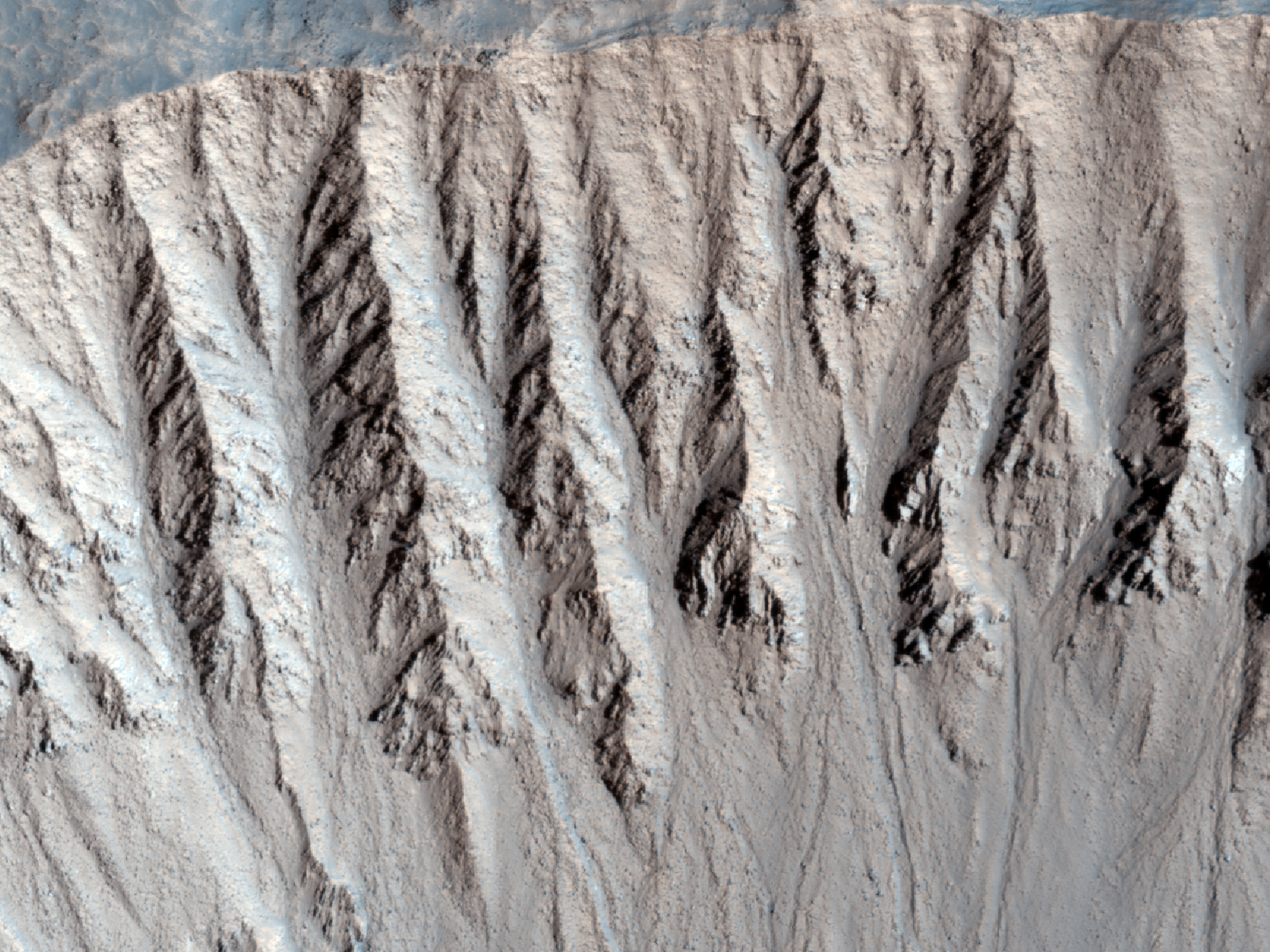
Today's Image of Mars shows the rim of an extremely recent impact crater in the Cydonia Colles Region, as taken by HiRISE. But how do we know that this is a recent impact crater?

An impact crater is deemed recent when it has a sharp rim, meaning that it is only lightly eroded. Generally crater rims undergo a process of erosion that wears away the sharpness of the rim. This occurs over hundreds of thousands, if not millions of years.

What does the term 'recent' mean?

The term recent is relative. In this case it is used in the geological sense, which means the crater could have formed tens of thousands of years ago or longer. The key is that it isn't as old and eroded as  Gale Crater or other ancient impact sites.

On Mars it can take a long time for features to change. Because there is no precipitation on present-day Mars, the wind is the only eroding element. This means that it takes a long time to wear down sharp crater rims, sometimes millions of years depending on the area.

Clicking on this image will take you to the original high resolution image from HiRISE. [See the original caption]


Mars Photo of the Day - Mar 13 2012

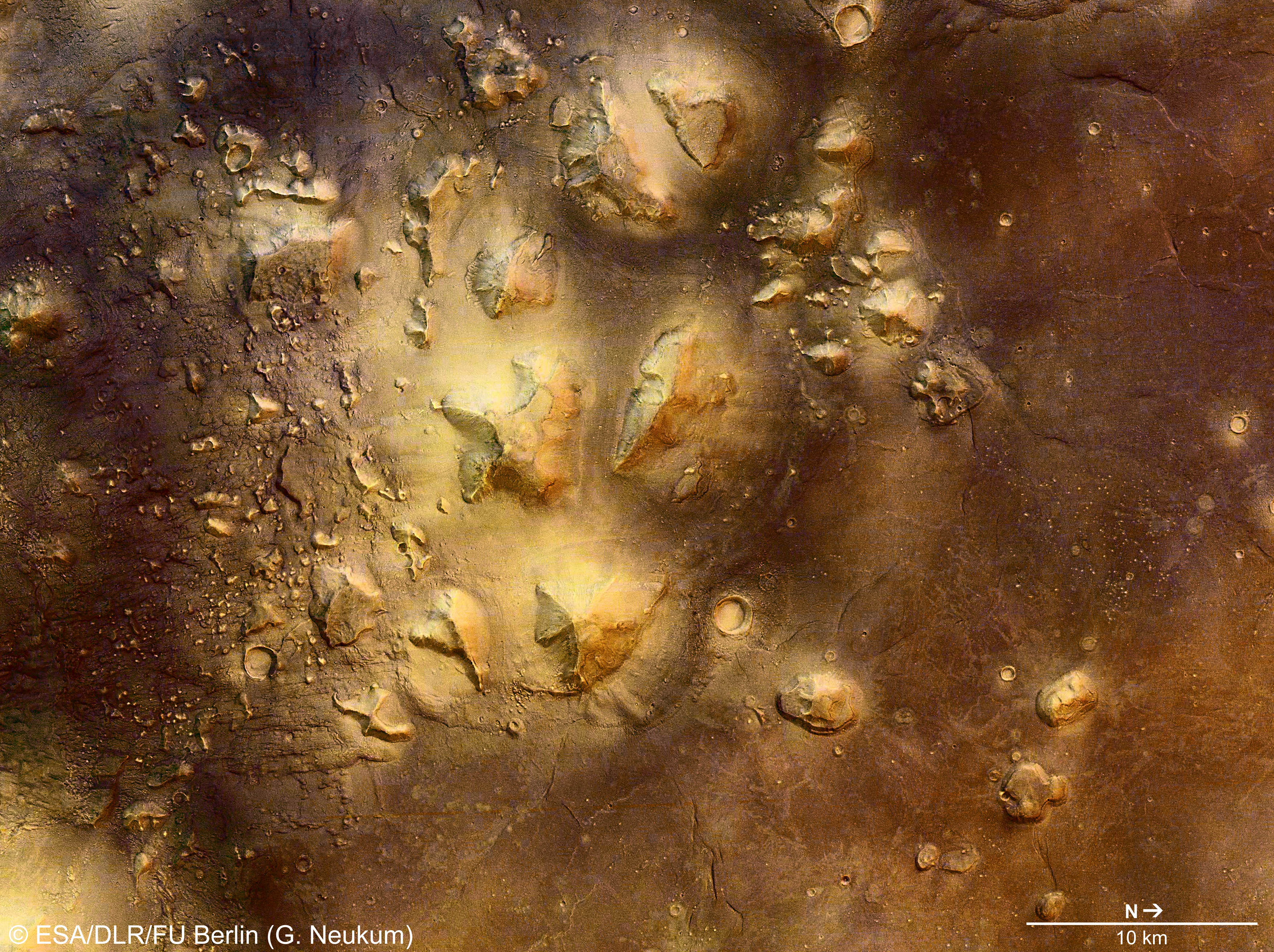
Today's Image of Mars shows mesas (flat topped hills or mountains) in the Cydonia region, as taken by Mars Express. One of the more prominent mesa's in this image can be seen in the far lower right. It became famous as the Face on Mars because Viking 1 Orbiter took an image of it that made it look like a human face. This created significant controversy, with conspiracy theorists claiming it was placed there by another species as a sign to humanity.

It turns out the reason why the rock looks like a face is much more mundane. It just happens that the time and angle Viking 1 took the image resulted in the mesa's features being lit in such a way that it resembled a human face. Subsequent images of the face on Mars (including this one) were taken with other orbiters and showed that it was nothing more than coincidence that the Viking 1 image made it look like a face.

As you can see in this image, the face on Mars is simply an interesting looking mesa, not a sign from another species, but despite all the evidence provided since the original Viking 1 image, conspiracy theorists continue to claim cover up. Sometimes people just can't be satisfied with reality I guess. 

I recommend clicking on this image so you can see the high resolution version and zoom in on the figure known as the face on Mars.


Mars Photo of the Day - Jan 9 2012

Today's Image of Mars is of the Face on Mars, one of the most famous pareidolias on Mars.

In 1976 the Viking I Orbiter was taking photos of possible landing sites for Viking II when it took the below shot of what looked like a human face. Scientists quickly realized this 'face' for what it was, a mesa with irregular shadows that at the right angle made it look like the face of an ancient Egyptian pharaoh.

The Face on Mars soon captured the public interest, but what many people don't realize is that NASA wanted that to happen. They initially published the photo with a caption "huge rock formation ... which resembles a human head ... formed by shadows giving the illusion of eyes, nose and mouth." They the created a public relations campaign around The Face on Mars. According to NASA "the authors [of the initial caption] reasoned it would be a good way to engage the public and attract attention to Mars." They were successful - perhaps too successful.

 The public became fascinated by The Face on Mars, with some theorizing it was an alien artifact being covered up by NASA. NASA felt it was important to dispatch these claims, so they imaged it with the Mars Global Surveyor in 1998 and 2001. [See those images in this NASA article]

Regardless of evidence, there will always be people that wish to believe in conspiracy, so NASA hasn't convinced them all, despite having a high resolution image of The Face. NASA has even pointed out they would have no reason to deny a civilization on Mars because their budget would surely increase if one was discovered. Alas, the Face on Mars is just one of many mesas in the Cydonia region of Mars.

Clicking on this image will take you to the 2001 article about the Face on Mars and the various images taken of it.