Google+ Mars Travel

Americans Anticipate Manned Mission to Mars Within 20 Years

According to a poll dubbed Mars Generation, Approximately 71% of Americans are excited for and anticipate a manned mission to Mars in the next 20 years, with more than half of American's feeling NASA should "play a strong role" in assisting a commercial company, or head up a mission themselves.

In the same poll, conducted by Phillips & Company and sponsored by The Boeing Corporation and Explore Mars, a majority of respondents incorrectly answered that they felt NASA's budget represented 2.5% of the federal budget (~$88.5 Billion). When presented with the reality that NASA's Fiscal Year 2013 budget sits at about .5% ($17.7 Billion) of the federal budget, 75% of those polled felt the Agency's funding should be doubled to 1% ($35.4 Billion) of the federal budget, with the express purpose of funding a manned mission to Mars.

Chris Carberry, Executive Director of Explore Mars, the non-profit that sponsored the Mars Generation poll proclaimed, “Despite difficult economic times, the American people are still inspired by space exploration and are committed to human exploration of Mars. This is a wake up call to our leaders that Americans are still explorers.” The poll showed this adventurous spirit is exemplified in the top three reasons Americans support a manned mission to Mars: to support a greater understanding of the planet, to search for signs of life on Mars, and to maintain American leadership in space. 73% feel a major hurdle to a manned mission to mars is affordability and 67% feel politics will be a large impediment to success.

An executive committee member of The Mars Initiative, a non-profit 501(c)(3) organization unaffiliated with this study,  interpreted these results as a sign of the American people's continued fascination with space: "Americans want space exploration to be more of a national priority. This poll should serve as a message for America's leaders that their citizens want to see more of a commitment to the space industry, not less." A full report on the poll's findings will be released on 4 March 2013.


Let's hope America's leaders take note of this poll, but in the meantime, I encourage you to keep following news about Mars and sharing it with people you know. The more people we have that support missions to Mars, the more likely it will become a national, or even global priority.

One easy way you are guaranteed to support the first manned mission to Mars is by joining The Mars Initiative, so I encourage you to take a look!

Nearly 90% of Mars Mapped by Mars Express

Earlier this month the the ESA made an astounding revelation: their Mars Express Orbiter's High Resolution Stereo Camera (HRSC) has successfully mapped nearly 90% of Mars' surface! Thus far 87.8% of the surface has been imaged, with 61.5% being imaged at a resolution of 20m per pixel or better. Mars Express was launched just ten years ago this June, making this feat even more remarkable.

The below map is a mosaic of 2702 individual images showing the entire Martian globe. The latest image was taken on the orbiter's 10,821st orbit of Mars, which took place on 20 June 2012 orbit. This map does not include areas that were particularly affected by dust and/or atmospheric distortions; these areas are shown in black.

Click to see the ESA's caption for this photo. From there you can download the high resolution version.

The slight change in color tones is primarily due to changes in Mars Express' solar elevation, but can also be attributed to variations in dust content in different parts of the atmosphere. I encourage you to go to the ESA's website (just click the above image) and download their high resolution version! Once you do that, try and find some of the more prominent features on Mars, like Olympus Mons (top left) and the Tharsis Trio (below Olympus Mons and to the right), or Valles Marineris (further right of the Tharsis Trio).

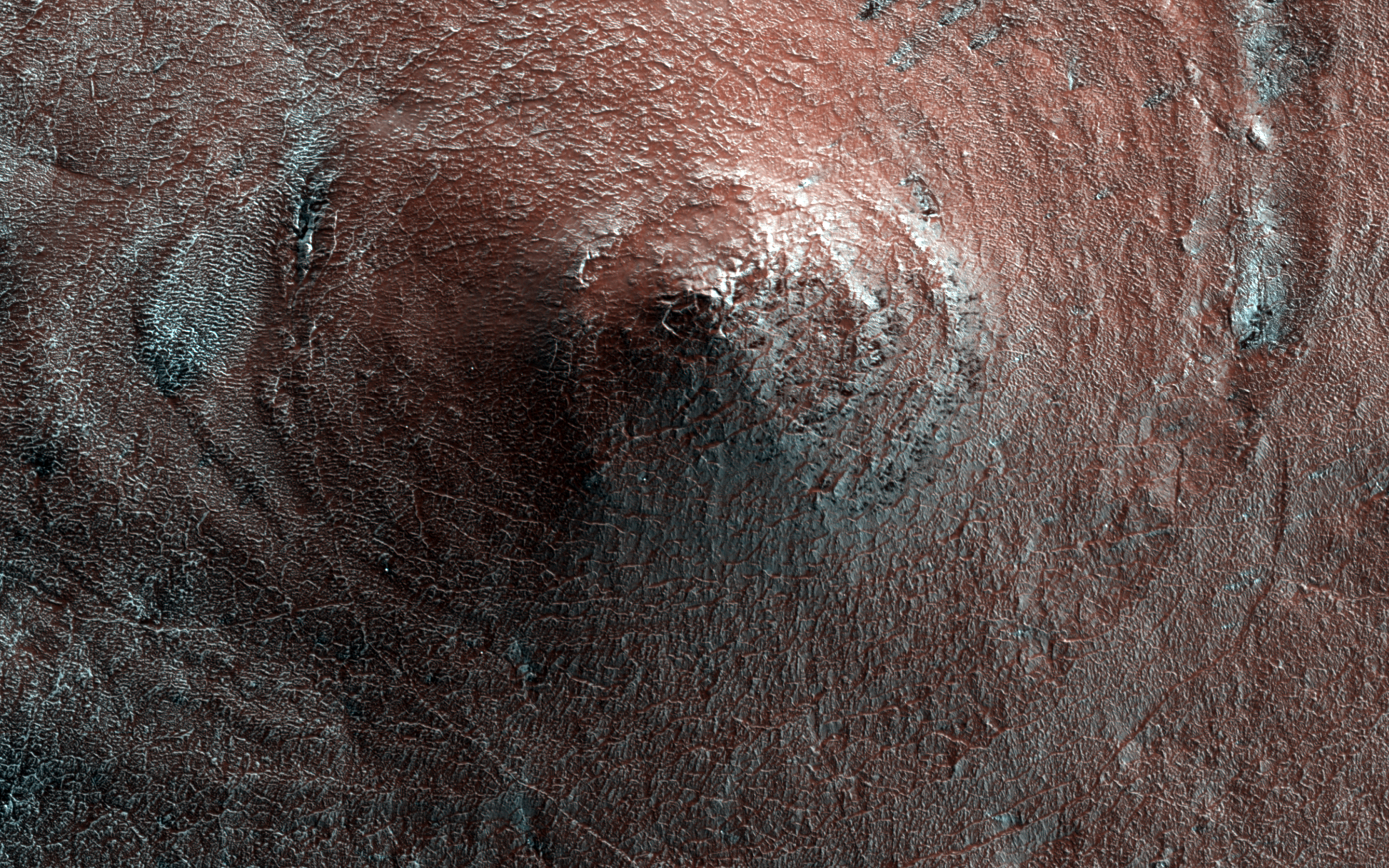
Cone-Shaped Hill on Mars

In the South Polar Region of Mars' Promethei Lingula there is an unusual cone shaped hill, measuring about 20-30 meters high. The white streaks are areas where carbon dioxide ice has not yet thawed. The unusual shape of this hill can likely be attributed to large scale erosion. Scientists still aren't sure why the area wasn't eroded evenly, but as they study more images of features like this they will gain a better understanding of the environment that created them.

Click to see HiRISE's original high resolution version. [See HiRISE caption]


One possible way this cone-shaped hill was created would have occurred long ago, when it once rained on Mars. A meteor could have hit the area, creating a crater, which would eventually developed a central uplift. After millions of years of rainfall the central uplift would have been smoothed out to what we see above, as the water flowed down its slopes. Over millions of years the distinguishing characteristics of the surrounding crater would have been washed away by the rain, blending it into the regional terrain. That's just a theory and an example of the fact that we may never know what caused this feature on Mars to develop.