Google+ Mars Travel: Basalt on Mars
Showing posts with label Basalt on Mars. Show all posts

Mars Photo of the Day - Jan 18 2012

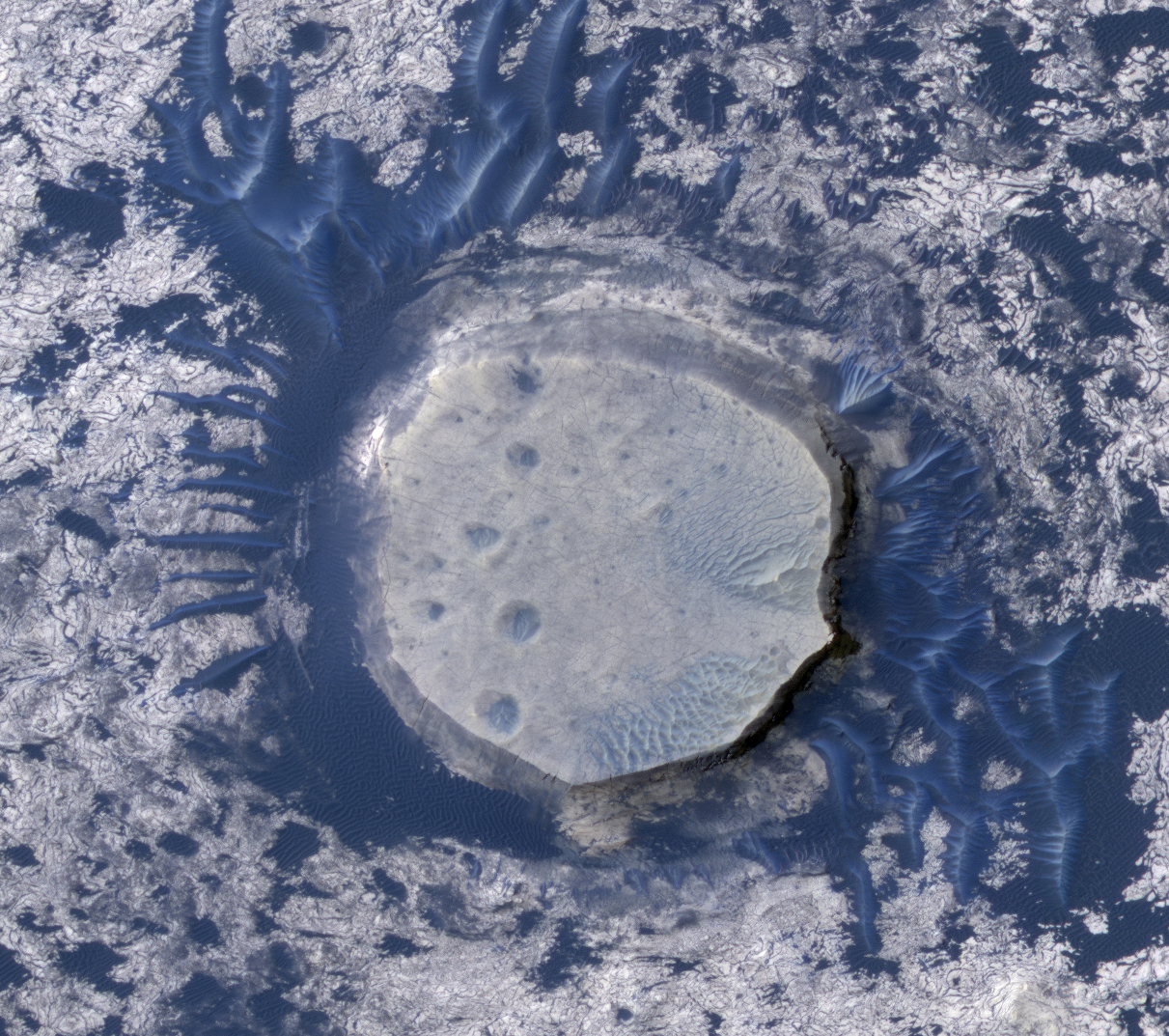
Today's Image of Mars is of an inverted crater surrounded by dark dunes in Arabia Terra. The dark dunes surrounding the inverted crater are comprised of basalt, a black igneous (volcanic) rock commonly found on Mars.

Inverted craters are formed in much the same way that inverted riverbeds are created. Sediment becomes deposited in the crater and packed down, usually in the presence of water. This make the material much denser and more wear-resistant than the surrounding terrain. Over the course of millions and billions of years wind erosion ended up wearing down the surrounding terrain, but since the sediment packed into this crater was more resistant, less of it was eroded. This created the inverted look that we see in the image below.

Clicking on this image will take you to a captioned HiRISE image that provides context for this inverted crater.


Mars Photo of the Day - Dec 21 2011

Today's Image of Mars shows part of a dune field found within Proctor Crater. Proctor Crater is approximately 150km in diameter and lies in the Southern Highlands of Mars.

The dark dunes seen in this image are made up of basaltic sand which has collected at the bottom of Proctor Crater. On top of these large dunes lie smaller secondary dunes consistent with terrestrial dunes of similar size.

In this image you can see that between the large, dark dunes lie smaller, brighter formations. It's been suggested that these are smaller dunes or granule ripples composed of material that is different from the larger dunes. The large, dark dunes overly the the smaller, brighter features, implying that they are a more recent addition to the crater.

Both the large and small features were formed through wind erosion. We can see in this image that the orientation of the smaller features was affected by the placement of the larger dunes.This is because wind must flow around the larger dunes.

HiRISE continues monitoring Proctor Crater to determine whether the dunes are still active today. Clicking on this image will take you to a similar, captioned HiRISE image of dunes in Proctor Crater.


Mars Photo of the Day - Dec 15 2011

Today's Image of Mars is of faults in Ius Chasma, one of many deep depressions in Valles Marineris, the solar system's largest known canyon. Ius Chasma is about 900km long and 8-10km deep. The chasma is divided by an east-west ridge called Geryon Montes.

The floor of Ius Chasma is comprised of layered deposits, but due to excessive faulting the deposits have become jumbled. The dark spots you see in this image are the result of ejecta from impacts. They have exposed a layer underlying the lighter surface area. Scientists speculate that the darker layer being exposed is basalt. 

If you look closely you can also see many linear dunes, which are prominent all throughout Ius Chasma. These dunes have a north-south orientation, which is indicative of prevailing westerly winds through the canyon.
Clicking on this image will take you to the original captioned image from HiRISE.


If you like the HiRISE images showcased in the Mars Photo of the Day posts I encourage you to enter for a free 2012 HiRISE Calendar

Mars Photo of the Day - Oct 22 2011

Today's Image of Mars is from the Mars Pathfinder mission and shows the Sojourner rover taking an Alpha X-ray spectrometer measurement of Yogi Rock. This image was taken on July 4, 1997.

Yogi Rock was the first basalt rock discovered on Mars. Basalt is an igneous rock, which implies previous volcanic activity in the region. But that is not all that makes Yogi Rock memorable; images of Sojourner driving up to Yogi Rock were aired in the opening credits of Star Trek: Enterprise. This was the first time that images from another planet were used in a science fiction television or film production.