Google+ Mars Travel: Climate Change on Mars
Showing posts with label Climate Change on Mars. Show all posts

Mars Photo of the Day - 15 Jul 2012

Today's Image of Mars shows a spectacular, yet potentially dangerous feature on Mars at the North Pole. What we see here is a massive ice sheet which, at its center measures a few miles thick. The edges of the ice sheet are sharp cliffs that can sometimes drop over 800m! Scientists are extremely interested in these cliff faces because understanding how they formed helps us understand the record of climate change they hold within them!

This image truly highlights why we should continuously, thoroughly examine an area from orbit before sending manned or unmanned missions. By studying this image, and others of the area, scientists have determined that ice pieces are constantly falling from the edge, only to shatter into a million pieces at the bottom! What if we had not studied many different images of the area taken at different times and we tried to send a rover, or worse, a manned mission to Mars to study the cliff faces? People could die, or billions of dollars could be lost because we didn't take and examine more HiRISE images like the one below!

So if someday in the future you're taking a stroll on Mars, make sure to check out the HiRISE and other orbital images of the area! You wouldn't want to be walking over a cliff!
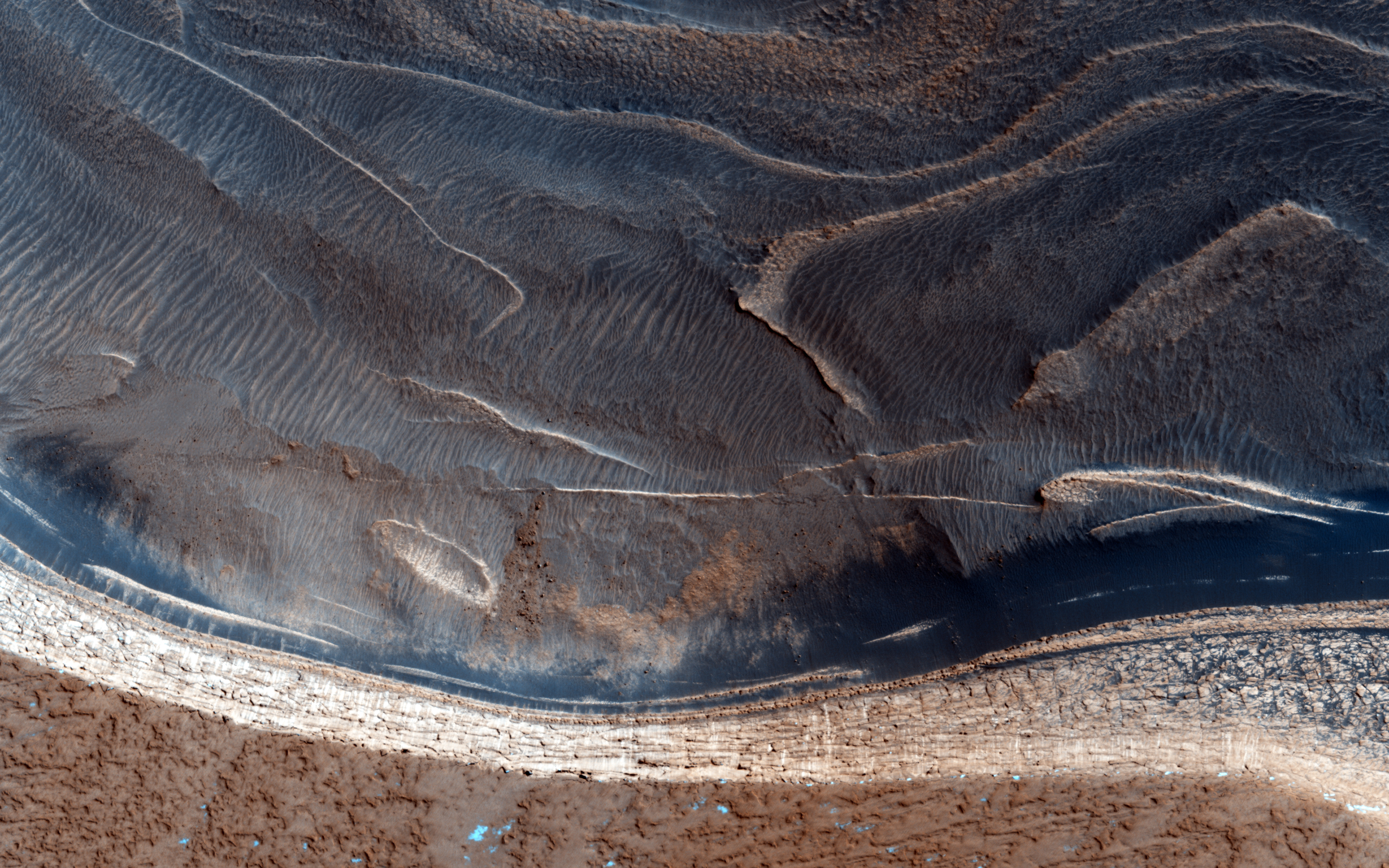
Click to see original high resolution image from HiRISE. [See their caption]

Mars Photo of the Day - 16 June 2012

Today's Image of Mars shows Danielson crater on the right and Kalocsa crater in the center, as imaged by Mars Express. Danielson crater is 60km in diameter, while Kalocsa crater is 33km in diameter and 1km shallower.

Click image to see high resolution original from Mars Express. [See their article]

Within Danielson you can see some yardangs, which form when erosion is primarily caused by wind. Yardangs have multiple sharp ridges are oriented in a similar way. That orientation can help scientists determine the direction of the winds that created them. In this case the yardangs indicate that there were once very strong north, north-easterly winds.

Danielson Crater shows evidence that the climate went through periodic climate shifts as a result of changes to the rotational axis. The several layered deposits visible within Danielson have similar thickness and separation, which scientists speculate means the climate has changed on Mars in regular intervals. This can easily be explained by periodic changes in the rotational axis of the planet.

Kalocsa crater shows completely different features, with no layered sedimentary deposits . Scientists have two theories for how this could have occurred. The first is that because the floor of Kalocsa is at a higher altitude, it did not break into the suspected underground ancient reservoir. Since layered deposits usually require the presence of an abundance of water, this would make sense. The second hypothesis is that Kalocsa crater is much younger than Danielson and was formed at a time when water was no longer present on the surface.


Mars Photo of the Day - Apr 11 2012

Today's Image of Mars shows strangely uniform layered deposits in Danielson Crater, as taken by HiRISE. The uniform size of these layers is indicative of climate change on Mars that occurs in regular intervals

So what does that mean? It means that our solar system goes through recurring, regular changes that effect the climate of places within it. Yes, I know these layers only tell us that Mars goes through regular changes in climate, but there has to be a reason for that doesn't there? If we know that climate change occurs on a regular basis in our solar system we can begin predicting when the next change will occur so that we're more prepared for it. We can do this by analyzing features like the below layers on Mars to determine the intervals between each shift in climate. 

By studying what has occurred in the past we can better understand the present, while preparing for what the past tells us will happen in the future. Failure to prepare is preparation for failure. If we don't prepare for climate change - what history tells is a recurring trend and something we may not be able to fully prevent -then we are gambling with the life of our species.

The first step to understanding climate change is by analyzing layers like the ones below to determine how often change occurs, how drastic the change is, and how abruptly it comes about. Understanding the process will bring us one step closer to controlling it and ensuring that we don't get caught unawares by something that we should have predicted.

Click to see the original high resolution image from HiRISE. [See their caption for the image]