Google+ Mars Travel: tracks on Mars
Showing posts with label tracks on Mars. Show all posts

Birds-Eye View of MSL Curiosity

Take a look at HiRISE's birds-eye view of MSL Curiosity, taken on the 157th sol of it's mission in Gale Crater. In this image you can see the rover itself, as well as tracks left from MSL's movement across the Martian terrain (this is especially true if you click on the image). The bright white/blue dots on the right shows the the area that was directly below MSL's Sky Crane rockets. Because of wind and other factors, the earliest tracks from MSL have begun to fade, but fortunately they can still be made out in the larger high resolution version (just click the image below to see it)! 
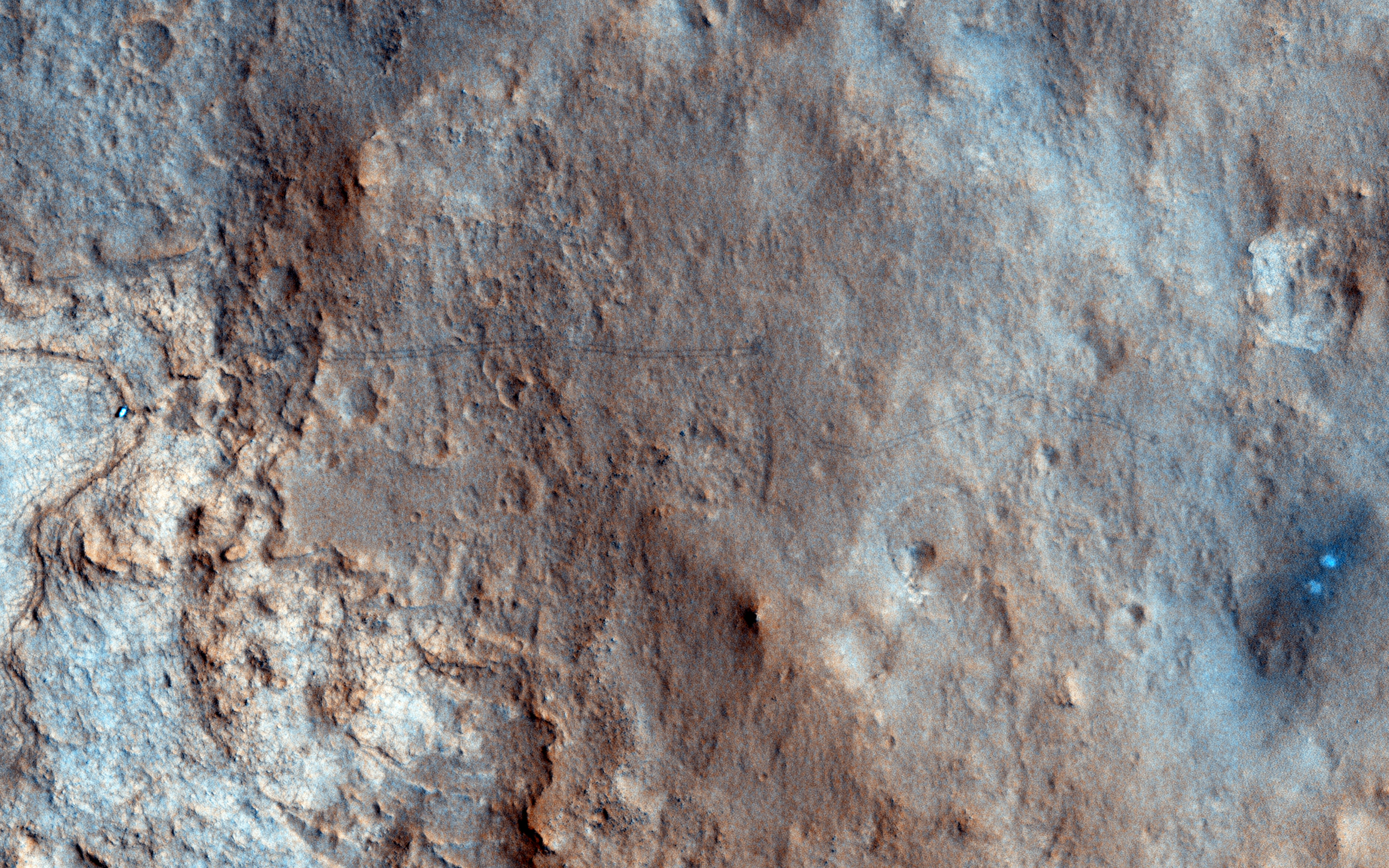
Source: HiRISE

This image is quite significant because it is the first color image showing MSL's tracks from orbit. It is oftentimes these images that provide us perspective because they show us the impact we are having on this pristine planet. Every rover we send to Mars is breaking new ground, every image shows a never before seen world, every soil analysis enhances our understanding of the solar system and provides context for our place in the universe. 

Studying MSL's Tracks Will Help Future Missions to Mars

Take a look at this remarkable image from HiRISE showing Mars Science Laboratory Curiosity and the tracks it made during the first few drives in Gale Crater. Scientists will be keeping a close eye on these tracks so as to track the rate of surface change on Mars. 

Click to see high resolution version from HiRISE.

Unlike Earth's Moon, Mars does have wind and other weather, so tracks will get covered up. Examining these tracks will let scientists determine the quantity and frequency of dust deposits in Gale Crater, as well the rate of erosion. Knowing how often features on the surface of Mars can change or be covered up will help current and future missions to Mars; let me explain how:

Imagine a Mars rover takes a long distance shot and sees something slightly protruding out of the surface. If we have a good idea of the rate of change on Mars then we can determine how long that feature will be there before getting covered up. If it will be covered up in a matter of days then it would become a higher priority then something that might be visible for a few weeks or months.

If you send a manned mission to Mars it is essential that they are knowledgeable about the rate of surface change. If you were going to take a walk on Mars you would make some reference points so as not to get lost. If you weren't aware of the rate of change you might use a field of hematite (blueberries) to the right of base camp as a reference point, not realizing that it might be covered up in a couple hours. You could get lost because you didn't know how fast something could get covered up!

As you can see, images like the one above are essential to our understanding of Mars and could help us save the lives of future explorers and billions in hardware!


Mars Photo of the Day - 25 Aug 2012

Today's Image of Mars shows the first tracks left by Mars Science Laboratory since it's arrival in Gale Crater. On 22 Aug 2012 MSL made it's first drive, moving to a spot 4.5m from it's landing site before rotating 120 degrees and reversing 2.5m. The rover is now 6m away from it's landing site, which is now called Bradbury Landing.

Unlike on the Moon, these tracks will likely be covered up in the weeks and months to come because of weather on Mars. The most likely ways these tracks will be erased is by a dust devil or dust storm, a weather phenomena that is a frequent occurrence on Mars.

To the left and right of the track marks you can see marks left from the descent stage landing. At the top of this image close to the center you can see the lower slopes of Mount Sharp, MSL's ultimate destination. Clicking on this image will take you to the original high resolution image from NASA.

Credit: NASA/JPL

Mars Photo of the Day - Apr 19 2012

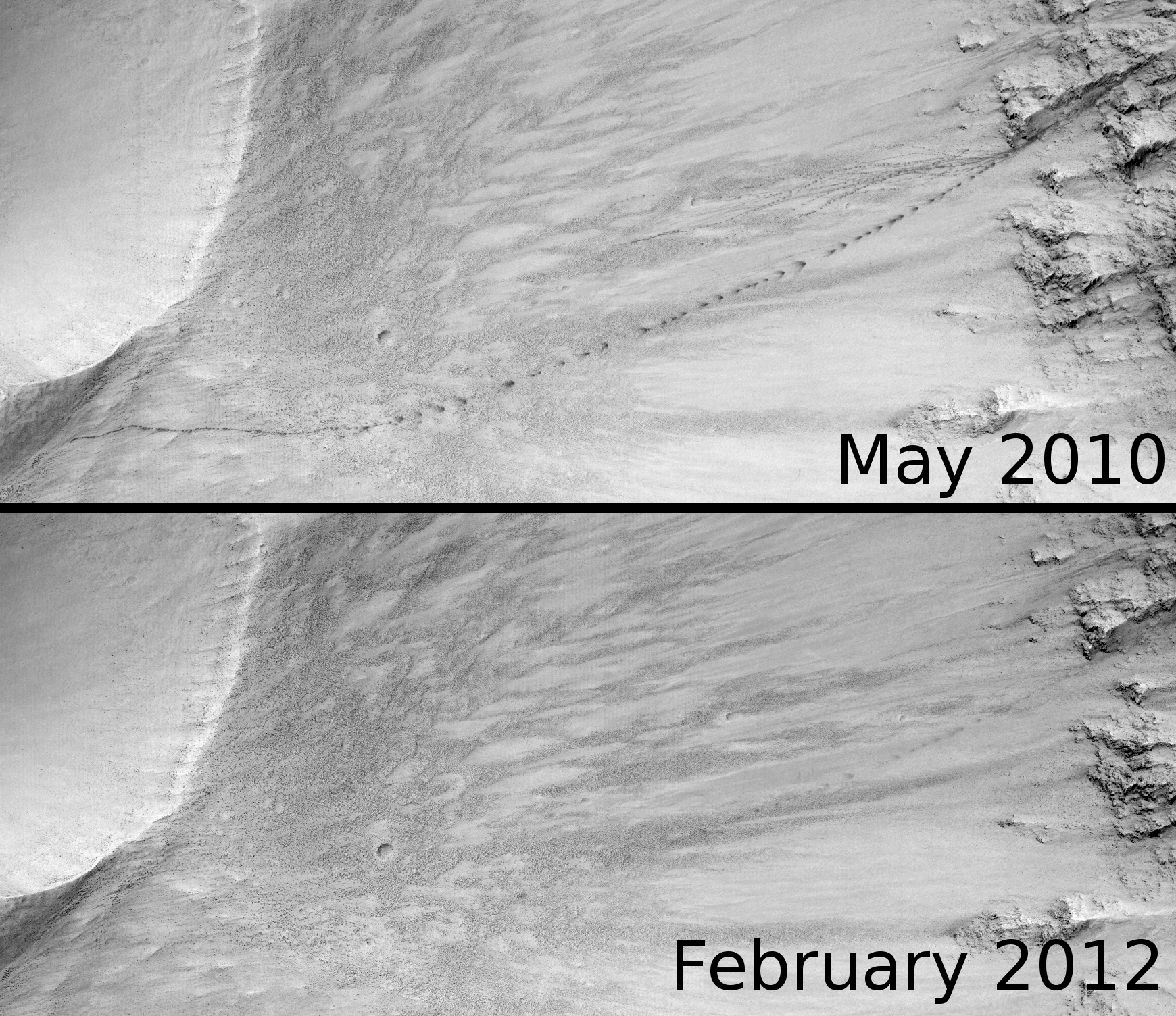
Today's Image of Mars is a reminder that features on Mars are constantly changing due to wind erosion. The image from May 2010 shows tracks left from large and small boulders as they rolled and bounced down the slope in Eastern Isidus Planitia. When you compare that with the image of the same area in February 2012 you'll notice that all but the largest trail has been completely erased from the surface, and even that has been significantly faded.

It's important that we realize that not all features on Mars are permanent. This is in direct contrast to the Moon, where even today the footprints of the Apollo astronauts can be seen. Understanding that Mars is still a changing planet is essential when sending future missions to Mars because we need to make sure that we use more permanent features for navigation while on the Red Planet. This may seem obvious, but when you look down from orbit it's easy to forget that some features can change in just a matter of months, given the right circumstances. 

Click on this image to see the original in high resolution from HiRISE. [See the original HiRISE caption for this image]