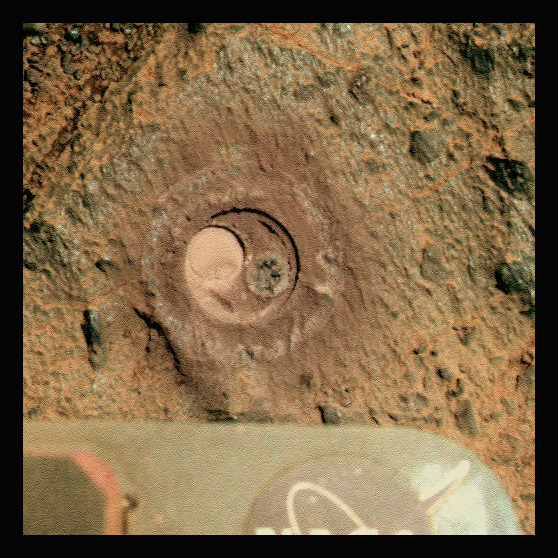
Thanks to Mars Science Laboratory (MSL) Curiosity, we know that Mars is a familar grey just below the surface. The image below shows the area where MSL first used its rock abrasion tool to remove a surface layer of dust, exposing the underlying grey rock, named Ekwir_1.
 |
| Source: NASA (Click image to see larger, captioned original) |
MSL then drilled into a separate rock, dubbed John Klein, on 8 Feb 2013, or Sol 182 of its operation on Mars. This was the first sample drilling conducted by MSL on Mars. The below hole measures 6.4 centimeters (2.5 inches) deep.
 |
| Source: NASA (Click image to see larger original) |
After drilling, MSL transfeered a powdered sample of the rock from the drill into its sample collection scoop. The below image, taken on 20 Feb 2013, shows the powdered rock sample obtained from the drilling. This is the first ever interior sample of a rock taken on another planet. Currently, MSL is examining small portions of the sample through the its Chemistry and Mineralogy (CheMin) instrument and Sample Analysis at Mars (SAM) instrument. The samples were processed into both analysis intruments on the 22nd and 23rd of February, but due to a computer issue the samples have yet to be analyzed.
 |
| Source: NASA (Click image to see larger, captioned original) |
John Klein is a veiny, fined grained sedimentary rock. It was chosen as the first location for drilling because it likely holds evidence of past wet conditions on Mars. MSL's analysis of the powdered sample will give us insight to the past environment on Mars.
On 28 February MSL's science team switched to a redundant onboard computer in response to a memory failure on the original, previously active computer. The transition resulted in the rover going into safe mode until 4 March, at which point it entered active status again. Despite this, the rover won't become fully operational for another few days.
Because of the computer issue MSL hasn't been able to analyze the powdered rock sample, but once systems come back on line we should see results within the subsequent few days. What will we find out about the past environment of Mars? Will we find out that Mars was or habitable? We can only guess for now, but within a week we should have the results back!