Google+ Mars Travel: Roscosmos
Showing posts with label Roscosmos. Show all posts

When and Where Could Phobos-Grunt Crash?

Updates on Phobos-Grunt landing site. 

UPDATE:  Reports from senior Russian military officials indicate that Phobos-Grunt crashed into the Pacific 1250 km west of Wellington Island. The image below shows the area. (Map source: @JPMajor)

.


EDIT: According to Roscosmos (The Russian Space Agency) Phobos-Grunt is expected to make landfall between approximately 1250-1334ET in the Atlantic Ocean (As of 1238ET). [This is a pretty good live Phobos-Grunt tracker]

Please note these calculations are based on numerous factors and they can change in an instant.
 For the latest information on Phobos-Grunt Reentry

----

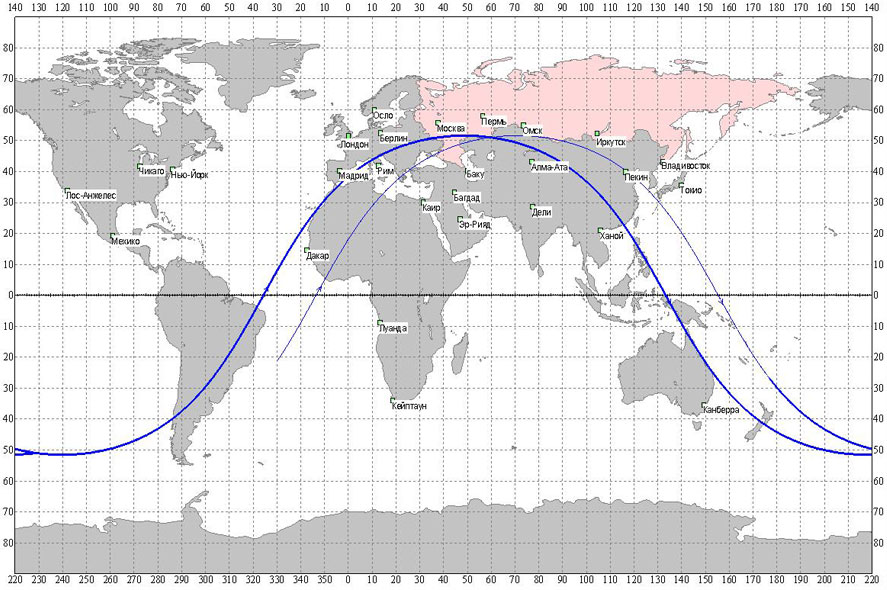
The below map from Roscosmos shows the anticipated orbit during which Phobos-Grunt is expected to make landfall. (Map Source: RussianSpaceWeb) You can see they have narrowed it down to one orbit.

It appears that Phobos-Grunt will miss North America, but landfall may occur on all other inhabited continents.

Click on the image to see the enlarged version.


Beware of False Phobos-Grunt Reentry Information

Reporting on the Russian Phobos-Grunt mission has been checkered with inaccuracies. Please ensure that when you hear or read something about its upcoming reentry you check the source.

Note that it is impossible to determine where Phobos-Grunt will land until just minutes before it does so. Anyone that claims to know where it will land either misinterpreted something or is lying.

In the coming weeks there are bound to many over-hyped reports about the toxic material aboard the failed probe. Do not listen to the fear-mongering headlines, but make sure to pay attention to he sources in the news stories.

I will do my best to tweet the latest news about Phobos-Grunt, so if you want updated information on its reentry  

ESA Ceases Attempts to Communicate with Phobos-Grunt

Quick update for all of those that don't follow @MarsTravel on Twitter:

The European Space Agency (ESA) has stopped attempting to communicate with Phobos-Grunt via their ground stations. This comes after consultation with the Phobos-Grunt mission controllers. The ESA emphasizes that it remains available to assist Roscosmos with Phobos-Grunt if the situation changes.

Since a brief link-up with Phobos-Grunt a week and a half ago there has been no communication with Phobos-Grunt despite numerous attempts by Roscosmos and the ESA. NASA has also been offering technical and communications assistance to no avail.

For the latest information I highly recommend that you follow @MarsTravel on Twitter because I will post information there first and more frequently. An easy follow button has been place below for your convenience. 


Response From NASA Regarding Assistance Provided to Roscosmos for Phobos-Grunt

As posted earlier, I called NASA to inquire about reports that they are prohibited from assisting Phobos-Grunt due to the Chinese orbiter being onboard. I just received a response from NASA.


-----


Mr. Geaney
Your query was passed to me.


NASA was working with Roscosmos to provide requested technical and communications assistance regarding the Phobos-Grunt spacecraft using NASA's Deep Space Network and other assets. These efforts were on-going prior to transitioning NASA Space Communications and Network and Jet Propulsion Laboratory personnel to support the launch and mission of the Mars Science Laboratory. For further information on the Phobos-Grunt mission, please contact Roscosmos.


Regards
Michael


Michael Braukus
Public Affairs Officer
NASA Headquarters
 Washington, DC 20546


-----


So reports from Russian Space Web that NASA is not assisting Roscosmos with Phobos-Grunt seem to be unsubstantiated.


UPDATE 17:45 EST


I sent a follow up email to see if assistance has resumed since the launch of Mars Science Laboratory. I got a response:
-----


I’m waiting on confirmation on that. But despite diverting some of the resources and personnel to support MSL’s launch and mission, we continued to work with Russia.


Michael Braukus
Public Affairs Officer
NASA Headquarters
 Washington, DC 20546


-----


So NASA continued to assist Phobos-Grunt as requested by Roscosmos, even during the buildup to Mars Science Laboratory's Launch.


I will post more details when I get a response about whether they are continuing to assist Roscosmos with Phobos-Grunt.


In the meantime my Twitter will probably get the update first so make sure to check that.


Mars Photo of the Day - Nov 23 2011

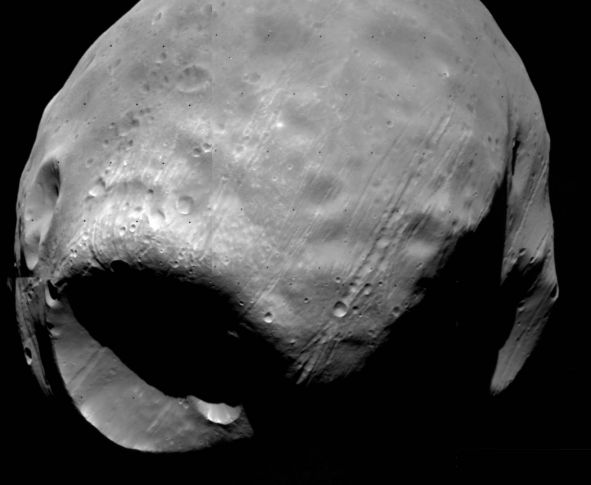
Today's Image of Mars is of Phobos, the larger of the two Martian moons and, if the mission can be saved, the destination for Roscosmos' Phobos-Grunt.

Phobos is 27 km at its longest point and orbits Mars at about 3000 miles above the surface in a little over 7 hours. Stickney Crater is on the bottom left of this image.

It's uncertain how Phobos became a moon of Mars, or even where it came from. It may be a main-belt asteroid that was captured by Mars' gravity, or have formed during the early stages of the solar system. Another theory suggests that the ejecta from a large impact on Mars resulted in many moons, but that over the course of millions of years, those moons fell back to the surface. One of the missions of Phobos-Grunt is to determine the origin of Phobos.

This image was taken by Viking 1 in 1977. Clicking on this image will take you to the Wikipedia page for Phobos where you can find a lot more information.

Contact Made with Phobos-Grunt - Mission May Proceed

ESA Tracking station in Perth, Australia
Image Credit: ESA
On Tuesday (Nov 22 2011) at 20:25 UT a tracking station based in Perth, Australia made contact with Phobos-Grunt. This was the first signal received on Earth from the spacecraft since it launched on November 8 2011. [Phobos-Grunt, Yinghuo-1, and LIFE Remain in Earth's Orbit]

Teams from the European Space Agency (ESA) that made the original contact are in discussions with Russian engineers to determine the best method for maintaining contact with Phobos-Grunt. According to Ria Novosti five attempts will be made to get telemetry from the spacecraft on Thursday. Each attempt will last for approximately 6-7 minutes.

If contact is made could the mission continue as planned?

While Ria Novosti and others report that the window to continue the mission passed on November 21 2011, some people like Dr. David Warmflash, lead investigator for the LIFE experiment on board the Phobos-Grunt spacecraft, says the mission could go on if Phobos-Grunt leaves Earth's orbit anytime well into December.

Why is this?

Current missions to Mars must fall within a specified launch window when travel between Earth and Mars is most optimal. Launch windows are calculated by determining a spacecrafts propulsion capabilities and the alignment of the concerned celestial bodies. Launch windows to get from Earth to Mars (or Mars to Earth) are around once every 26 months.

Phobos-Grunt could still make it to Mars within this launch window, but the issue is that by the time it collected samples from Phobos it would have missed the launch window for the trip back to Earth. That means that samples could not be returned until 2016, 26 months later than planned.

The two ride-along missions would still be fulfilled. 


Yinghuo-1 would be China's first foray to Mars. It would separate from the larger Russian probe in October 2012 (or maybe later now) and begin a year-long orbit of Mars. Its primary purpose is to collect data about the Martian atmosphere. On board it has a plasma package, a fluxgate magnetometer, a radio occultation sounder, and an optical imaging system. It also has two solar arrays to collect energy.

The Living Interplanetary Flight Experiment (LIFE), created by the Planetary Society is an astrobiological experiment containing ten types of organisms. It is an international venture, with cooperation from the Russian Space Research Institute, the Institute of Biomedical Problems of the Russian Academy of Sciences, the Moscow State University, the American Type Culture Collection, and the Institute of Aerospace Medicine, Germany. The mission is to see what types of organisms can survive the harsh conditions of space travel. Please see the LIFE page for more information on their missions.


The two ride along missions would essentially be unaffected by an extended stay on Mars. Yinghuo-1 is only set to remain in orbit for a year regardless and the purpose of the LIFE is to determine whether life can survive the harsh conditions of deep space for an extended period of time, so prolonging the time would likely only help to the experiment.

It remains to be seen whether commands can be sent to Phobos-Grunt, but for now there is renewed hope that the mission can go on.

For the latest information on the Phobos-Grunt mission I highly recommend following Dr. David Warmflash, (@CosmicEvolution) on Twitter.


Live Stream of Launch to the ISS

Watch the first manned launch to the International Space Station (ISS) since the failed Soyuz launch in August. This video is a live feed from SpaceFlightNow! The launch begins at 11:14PM EST.

The feed should begin automatically. (EDIT: I disabled automatic playing since the launch ended - It was a complete success!)
Watch live streaming video from spaceflightnow at livestream.com
Two cosmonauts, Anton Shkaplerov and Anatoly Ivanishin, as well as one astronaut, Daniel Burbank will be ascending to the ISS in what is the first manned launch since the last Shuttle (Atlantis) docked on July 10 2011.

Vladimir Popovkin, the director of Roscosmos, the Russian Federal Space Agency is confident that the launch and docking will be carried out successfully. He was quoted as saying, "We have no doubt in our minds both the rocket and the vehicle are ready, all the activities have been done at the appropriate level of quality and reliability." Regardless, you can be sure that the world will watch with admiration as these three brave men ascend to the ISS.

If you view this after the launch the feed will just go to live NASA TV, if anything. I will make sure it doesn't start automatically following the Soyuz docking with the ISS.

Phobos-Grunt, Yinghuo-1 and LIFE Remain in Earth's Orbit

The engines aboard Phobos-Grunt, which is also carrying Yinghuo-1 and the Living Interplanetary Flight Experiment (LIFE), failed to fire after separation with the larger booster. The Zenit-2 launch vehicle detached from the Phobos-Grunt on time and correctly, but the engine for the spacecraft itself failed to start.

The Zenit-2 rocket launching Phobos-Grunt
CREDIT: German Aerospace Center (DLR) 
Russia has been unable to make contact with Phobos-Grunt, despite several attempts and opportunities to do so. According to Vladimir Popovkin, head of Russia’s space agency Roscosmos, engineers have until November 23 to restart the probe's booster before it runs out of batteries.

Popovkin claims that this scenario is one that was prepared for and that can be remedied from the ground. He goes on to say, “We will attempt to reboot the program. The spacecraft is currently on a support orbit, the fuel tanks have not been jettisoned, and the fuel has not been spent.” There is still hope for Phobos-Grunt, and thus hope for the other two missions riding along with it.