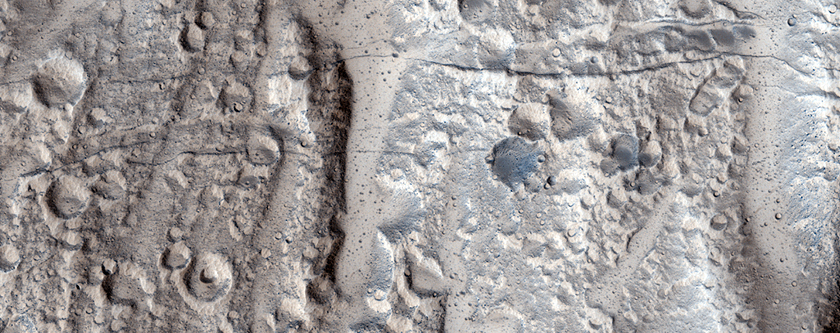
Today's Image of Mars is actually a map of the Tharsis Quadrangle, which covers the area from 90° to 135° west longitude and 0° to 30° north latitude on Mars. Tharsis Quadrangle is home to numerous large volcanoes, including the largest in our solar system, Olympus Mons.
It is thought that at one time the volcanoes in Tharsis Quadrangle had a large impact on the Martian climate. A large amount of carbon dioxide and water vapor was released into the air from the volcanoes in the Tharsis Quadrangle. Estimates show the amount of gas emitted by the volcanoes in the Tharsis Quadrangle would have been enough to produce an atmosphere thicker than Earth's. Additionally, the water vapor released from these volcanoes would have been enough to cover all of Mars in 120 meters of water. The volcanoes in Tharsis Quadrangle lead many experts to believe that Mars once had an atmosphere thicker than Earth's and that it was once a warm and wet planet.
This Tharsis Quadrangle map is one of 30 quadrangle maps used by United States Geological Survey (USGS) Astrogeology Research Program to catalogue Mars. Clicking on this image will take you to a list of maps produced by the USGS for Mars. From there you can open many of the maps of Mars produced by the USGS.
 |
| USGS Astrogeology Research Program |